The Word Was a Wall
The word paradise is Persian. It began as a description of something you could walk round: a park enclosed by a wall. In the language of the Persians themselves the term is reconstructed as paridaida — “a wall around” — and it survives in the administrative tablets of the empire in an Elamite spelling, partetaš, used for walled plantations and estates. Greek writers who visited those parks heard it as paradeisos. When the Jewish scholars of Alexandria translated the Hebrew Bible into Greek, it was the word they chose for the Garden of Eden. Latin kept it, the languages of Europe kept it, and a Persian word for a walled garden became the word for heaven.
That is not a curiosity. It is a clue to what kind of empire this was. It had no single capital: it had five — Pasargadae, Babylon, Susa, Ecbatana and Persepolis — and the court moved between them. What held it together was not one great city but a set of systems: a road, a bureaucracy of clay and seals, and a technology for drawing water out of desert ground. This dossier follows those systems, and is honest about the places where the evidence runs out.
A Capital That Was a Park
Start where the empire did. Pasargadae lies on a high plain in Fars, in south-western Iran. Around 546 BC Cyrus — Kourosh, as Iranians say it — had defeated the Medes and taken the immensely rich kingdom of Lydia in western Anatolia, and the capital he built here did not begin with a citadel. It began with a park.
Two palaces face each other across an open space, and between them run channels of cut white limestone, about twenty-five centimetres wide, with a deeper square basin every thirteen or fourteen metres, carrying water in perfectly straight lines. The excavated channels frame two long rectangles. The throne in the principal palace looked straight down the axis between them. Water, stone and line of sight were composed together: the king sat at the end of a view he had engineered.
What We Do Not Know About the Garden
Here a reconstruction site has to be careful, because the garden at Pasargadae is drawn everywhere — this site’s films included — as the classic Persian garden: four beds, quartered by two crossing channels, the plan later called chahar bagh.
That is not what was dug. The channels that the British archaeologist David Stronach excavated between 1961 and 1963 frame two rectangles, not four. The four-part plan is an inference — a strong one, made from the position of the throne and the axes of the buildings — but an inference. Later geomagnetic surveys led by Rémy Boucharlat, from 1999 onward, mapped far more beneath the plain: a grid of squares thirty to sixty metres a side, probably channels and ditches, perhaps lined with trees, laid out on the same axis as the palaces, and a large pool-like feature. The garden was real, it was engineered, and it was much larger than anyone had realised. Whether it was already the four-fold paradise of later Persia, we do not know.
Three Civilisations on One Body
The construction tells you who this empire was going to be.
The stonework at Pasargadae is cut and fitted in the manner of western Anatolia: blocks laid without mortar, their contact faces dressed so that only a narrow band touches, and locked together with metal clamps. It is the work of Lydian and Ionian masons — men from the lands Cyrus had just conquered, building the conqueror’s capital.
And on a doorway of the gatehouse stands a figure carved in relief that could only exist here: a man with four wings, like the protective spirits of Assyrian palaces, wearing the long robe of Elam, and on his head an elaborate crown of a type worn by Egyptian gods. Three civilisations on one body, carved in the first years of an empire that would soon rule all three.
A King Was Supposed to Be a Gardener
The gardening was not ornament. It was ideology.
Some 140 years after Pasargadae was laid out, the Spartan commander Lysander visited a Persian prince — another Cyrus, known as Cyrus the Younger — in his park at Sardis. Xenophon, who tells the story, has Lysander admiring the trees standing in perfect rows, and the prince replying that he had measured and arranged it all himself, and planted some of the trees with his own hands.
The empire’s own paperwork bears out the ideal. Among the thousands of administrative tablets from Persepolis there is one unique text that inventories tree seedlings — apple, pear and other fruit trees — at several of these walled plantations. Its total is read as 6,166, with a question mark from its editors. Even allowing for the uncertainty, it is a royal administration counting saplings by the thousand. In Persia, the king was meant to be a gardener, and the gardens were meant to be counted.
The Tomb That Survived Under Another Name
About a kilometre from the palaces stands the most loved building in Iran: six great steps of white limestone, and on top a small gabled chamber, the whole a little over eleven metres high. It is the tomb of Cyrus.
When Alexander’s companions saw it, it stood inside the royal park, in a grove of trees, watered by streams, the grass deep around it — the founder buried in his garden. Aristobulus, one of those companions, whose account survives through Arrian and Strabo, reports that Alexander found it broken into and plundered, ordered it repaired and sealed, and read an inscription asking those who passed not to begrudge Cyrus the little earth that covered him.
It is often said that every later conqueror honoured that wish. The building says otherwise: the metal clamps that once locked its blocks were prised out long ago, and the empty sockets are still visible. The tomb survived for a stranger reason. People forgot whose it was. By the medieval period it was known as the tomb of the mother of Solomon, and in the thirteenth century a prayer niche was carved inside the chamber and the monument was incorporated into a mosque. Only in the early nineteenth century did European travellers, reading the Greek descriptions on site, give it back its name. It did not survive because Cyrus was remembered. It survived because it was loved under another name.
Babylon Without a Battle
Seven years after the garden, Cyrus reached the greatest city on Earth.
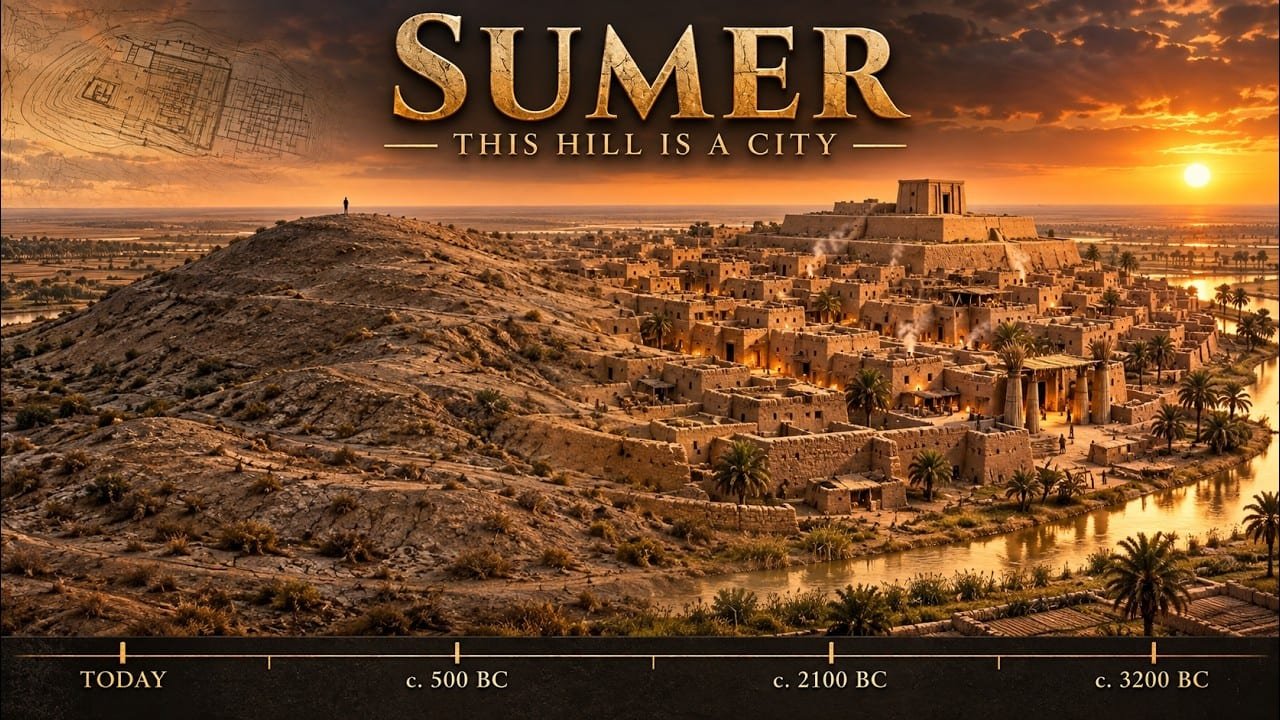
On the throne of Babylon sat Nabonidus — the king who, as this site’s dossier on the Sumerian cities describes, dug into ancient temple foundations looking for the inscriptions of older kings. In October 539 BC, after a battle upriver at Opis, the Babylonian chronicle records that the Persian army entered Babylon without a battle. Some two weeks later — on 29 October by our calendar — Cyrus rode in himself.
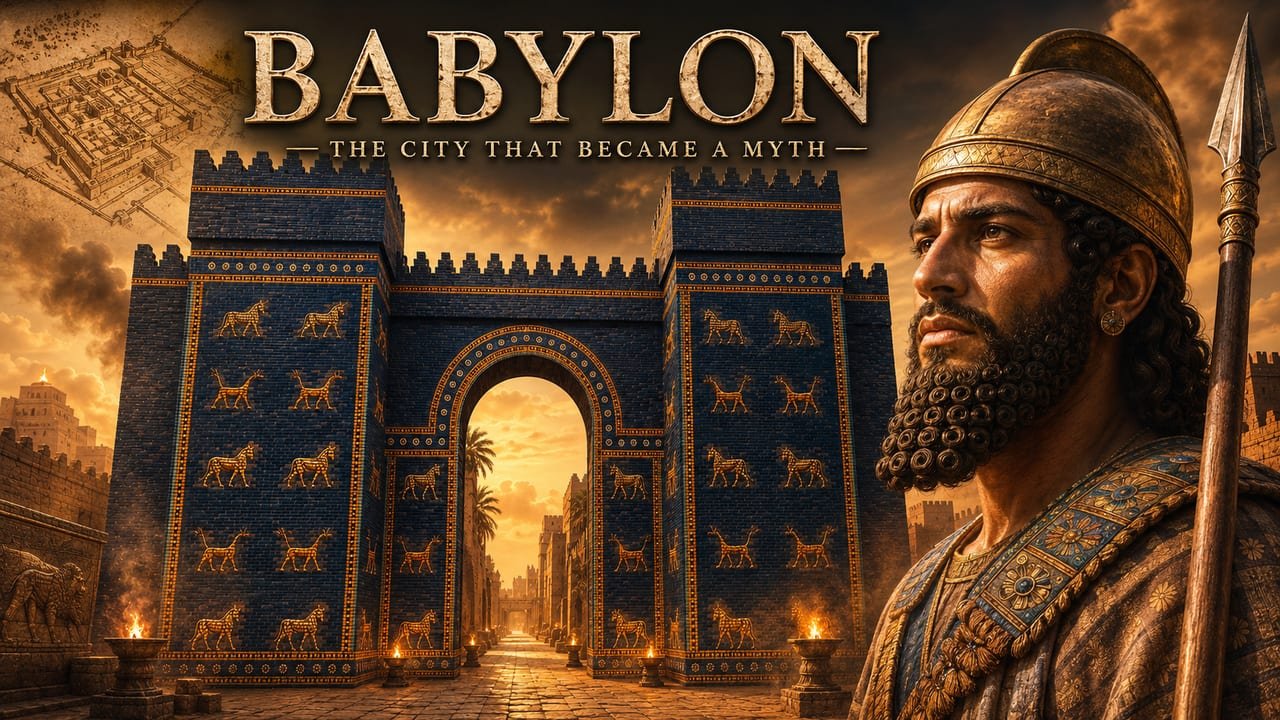
And then he did what conquerors of Babylon usually did not. He left it standing. Babylon became one of the empire’s royal cities — Greek writers say the winter residence — and beside the great palace of Nebuchadnezzar a Persian king later added a columned hall in Persian style. Two centuries afterwards, a Macedonian king would die in that palace. The Persians had kept it for him.
What the Cylinder Is, and Is Not
In 1879, in the ruins of Babylon, an excavation found a barrel-shaped clay cylinder covered in Babylonian cuneiform, written in Cyrus’s name. It blames Nabonidus for neglecting the gods, says that Babylon’s own god Marduk chose Cyrus, and lists what he did: the gods of conquered cities returned to their sanctuaries, and deported people gathered and returned to their homes. Then it turns into a building record. Cyrus says he repaired Babylon’s wall, and that inside it he found an inscription of the Assyrian king Ashurbanipal, who had built there before him. The Persian who took Nabonidus’s throne was doing what Nabonidus had done: reading dead kings in the walls.
You will often see the Cyrus Cylinder described as the first charter of human rights. It is not. It is a royal building inscription, composed in a form Babylonian kings had used for centuries, and it praises its king exactly as such texts always do. But it is still worth noticing what it chose to boast about. Not the number of enemies killed. Gods sent home. People sent home. A wall repaired.
The Hebrew Bible remembers the same policy from the other side. The exiles of Judah were allowed to return and rebuild their temple, and the book of Isaiah calls Cyrus — a foreign king — the Lord’s anointed.
An Office at Susa
Cyrus built a garden. Darius — Dariush — built an office.
Darius took the throne in 522 BC, after a year of civil war and revolt. As his working capital he chose Susa, on the plain of Elam in what is now south-western Iran, a city already inhabited for some three and a half thousand years. There he raised a new palace on a platform, and he wrote down how it was built. The ground, his foundation inscription says, was dug down until rock was reached, and the excavation was filled with rubble to a depth of forty cubits — around twenty metres.
Then Darius did something that turns a building into a portrait. He listed where everything came from, and who made it. Cedar from the mountains of Lebanon, brought by Assyrians to Babylon and then by Carians and Ionians to Susa. Timber from Gandhara and Carmania. Gold from Sardis and from Bactria. Lapis lazuli and carnelian from Sogdiana. Turquoise from Chorasmia. Silver and ebony from Egypt. Ivory from Kush, from India and from Arachosia. Stone columns from a village in Elam. The stonecutters were Ionians and Sardians; the goldsmiths Medes and Egyptians; the men who baked the bricks, Babylonians.
Empires usually describe themselves by listing the enemies they defeated. This one, in this document at least, described itself as a supply chain.
A City That Collected the World
You can still see the brick-makers’ work. Glazed bricks from Susa — rows of guards in long robes, spears upright — were excavated in the 1880s by Marcel and Jane Dieulafoy and reassembled in the Louvre.
Susa already had a habit of collecting the world. In the winter of 1901–1902 a French mission found here the law code of Hammurabi — a Babylonian monument that an Elamite king had carried off as a trophy some six centuries before Darius was born. And in December 1972, excavators at Susa’s great gate found a statue of Darius himself: carved in Egypt from Egyptian stone, inscribed in hieroglyphs as well as in the languages of Persia, and still standing almost two and a half metres tall without its head. Around its base, twenty-four peoples of the empire are named, each in a fortified oval above a kneeling figure — the Iranian peoples on one side, the others facing them. A Persian king, made by Egyptians, standing on the names of two dozen nations.
People also lived here who never appear in stone. According to the Bible, a Judean named Nehemiah served the king as cupbearer at Susa, asked leave to go and rebuild the walls of Jerusalem, and was given it — with letters to the governors along the way to let him pass.
An Empire With a Route, Not a Capital
Susa was only one address. Greek writers say the court moved with the seasons: winter in Babylon, spring in Susa, summer in the mountains at Ecbatana. An empire this size did not have a capital so much as a route.
Ecbatana — Hagmatana, “the place of gathering” — sits almost two thousand metres up beneath Mount Alvand, where the summers are cool. It had been the capital of the Medes before the Persians. Herodotus says it was ringed by seven concentric walls, their battlements painted white, black, crimson, blue and orange, the two innermost plated in silver and in gold. It is almost certainly too good to be true, and it cannot be checked: the ancient city lies beneath the modern city of Hamadan. What survives in better sources is this. Polybius describes its palace, with beams of cedar and cypress sheathed in silver, later stripped by successive kings. And the book of Ezra says that when the Judeans’ right to rebuild their temple was challenged, Cyrus’s decree was searched for and found in the royal archive at Ecbatana.
On the granite above the city, Darius and his son Xerxes carved two inscriptions in three languages. For centuries no one nearby could read them, and local tradition decided they must be the key to a hidden treasure. The place is still called Ganjnameh: the treasure book.
The Road
What let one court live in three cities was a road.
Herodotus gives the figures for the Royal Road from Sardis, near the Aegean, to Susa: one hundred and eleven staging posts, some two and a half thousand kilometres, about ninety days for a traveller on foot. Royal messages did not travel at walking pace. At each station a fresh horse and rider waited, each responsible for a single day’s stage, passing the message on like a torch in a relay. Across the whole road that may have meant something like a week, though nobody timed a run, and modern estimates differ. Nothing stopped these riders, Herodotus wrote — not snow, not rain, not heat, not the dark of night.
In New York, the great General Post Office on Eighth Avenue, opened in 1914, carries an inscription chosen by its architects that paraphrases that sentence: neither snow nor rain nor heat nor gloom of night stays these couriers from the swift completion of their appointed rounds. It is still there, and it is widely taken to be the motto of the American postal service. It was written about Persia.
We know the road worked because its paperwork survived. Clay tablets from the administrative archive at Persepolis record travellers heading to and from India, Egypt, Sardis and the east, drawing flour, wine and beer at the stations along the way — and line after line notes that the traveller carried a sealed document of the king. A travel authorisation, in effect a passport, two and a half thousand years ago.
Signed on a Cliff
On the road from Babylon up to Ecbatana, the empire signed its name.
At Behistun, Darius had his own account of how he took the throne carved high on a cliff — a panel some fifteen metres high, around a hundred metres above the road, in three languages: Old Persian, Elamite and Babylonian. It was placed where no one could reach it to deface it, and it boasts plainly of the battles Darius fought to hold his throne in a single year of revolts.
For almost two thousand years no one could read it. Between the 1830s and 1847 a British officer, Henry Rawlinson, climbed to it on ladders and ropes — with a local boy working the most dangerous stretch — and copied the texts. Because it said the same thing in three scripts, it became a key to cuneiform. That we can read Babylonian today — and, through Babylonian, Sumerian — is owed in part to a Persian king who wanted everyone on his road to know who had built it.
Teaching a Desert to Drink
The road carried orders. What kept anyone alive at the end of it was water.
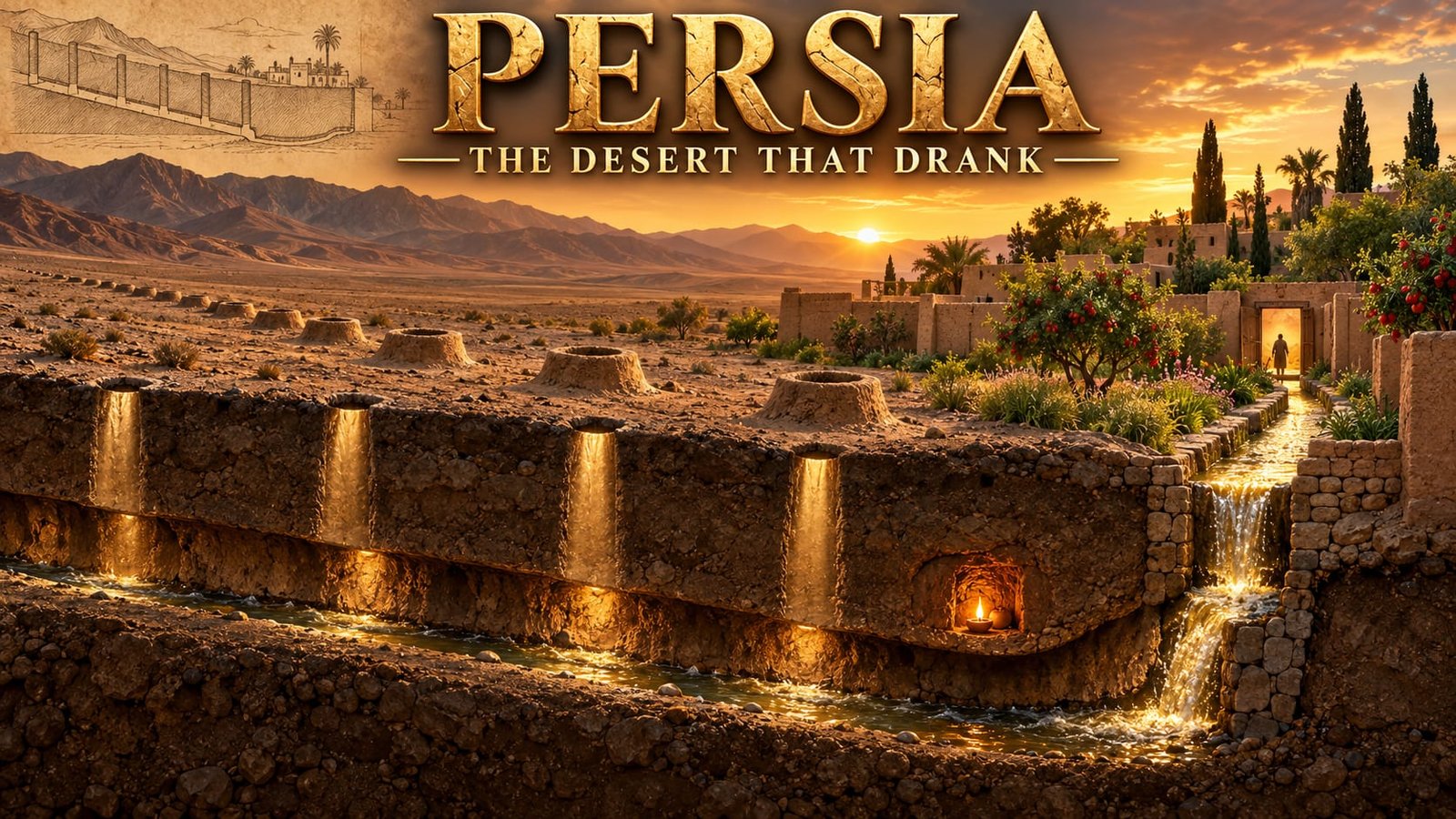
Much of the Iranian plateau receives around a quarter of a metre of rain a year or less, and the deserts at its heart far less. Rivers run down from the mountains in spring and vanish into the gravel. Water left in the open evaporates. So the answer was to go underground.
At the foot of the mountains, where water lies deep in the alluvial fans, diggers sank a first shaft — the mother well — down to the water table. Then, starting from the fields, sometimes kilometres away, they dug a tunnel back towards it, rising so gently that the water barely registers the slope, with a vertical shaft every few dozen metres for air and for hauling out spoil. When the tunnel reached the water, the water ran downhill on its own, in the dark, protected from the sun, and came out into daylight in the middle of the settlement. No pumps. No power. From the air, a qanat is a line of craters marching across the desert. The men who dug them worked by lamplight in tunnels barely wider than their shoulders, and in parts of Iran the craft still passes down within families.
Who dug the first is still argued: some scholars place the origin on the Iranian plateau early in the first millennium BC, while others argue for south-eastern Arabia. In the middle of the twentieth century Iran still had something in the order of fifty thousand qanats, and many remain in use. At Gonabad in the east, the Qasabeh qanat — believed to be among the oldest still running, though its exact age is estimated rather than established — runs for some thirty-three kilometres through 427 shafts, its mother well hundreds of metres deep. It is part of the World Heritage property inscribed in 2016 as the Persian Qanat.
Water Became Policy
What nobody argues about is what the Persians did with the technique.
The Greek historian Polybius records that under Persian rule, whoever brought water by underground channels to land that had never been irrigated was granted the use of that land for five generations — a reward lasting a century and a half, for water.
And it travelled. In Egypt’s Western Desert, at ʿAyn Manâwir in the Kharga Oasis, French archaeologists mapped a network of qanats of the Persian period, and found some 450 potsherds written in Egyptian demotic, dated between 483 and 370 BC. Many are contracts, some leasing shares of water collected by the qanats in return for a portion of the harvest; they name at least six different channels. Darius also took water to the scale of a continent: he completed a canal linking the Nile to the Red Sea, and on the stelae he set up along it he wrote that ships went from Egypt through this canal to Persia, as he had intended.
This is where the garden comes back. In a land like this, a garden is water made visible. The channel down the middle of a Persian garden is the qanat, brought up into the light and displayed.
The Stage
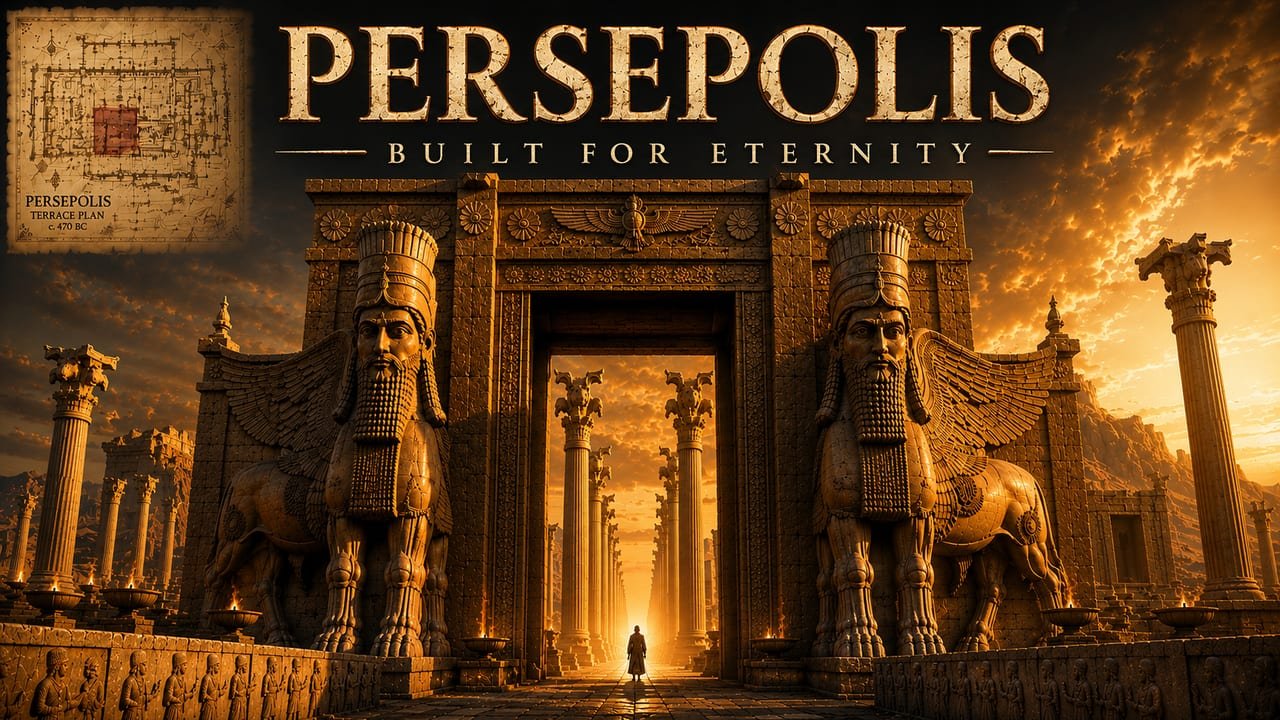
Which leaves the capital everyone knows. This site’s dossier on Persepolis covers its terrace, its staircase and its fire; here it is enough to say where it fitted. If Susa was the office, Persepolis was the stage — the one city of the empire built above all to be looked at, with the treasury and the administrative archive of the Persian homeland behind its columns. That archive is where the tablets of the Royal Road and the inventory of the fruit trees come from.
The Conqueror Moved In
In 331 and 330 BC, Alexander of Macedon took all of it — Babylon, Susa, Persepolis, Ecbatana — one after another, along the same roads.
And then the conqueror did what the empire had taught everyone to do. He moved in. He kept the provinces and the roads running. He adopted elements of Persian royal dress and ceremony. He had the tomb of Cyrus repaired. At Susa in 324 BC he married a daughter of the last Darius in a Persian ceremony, on the same day that some eighty of his officers married Persian and Median noblewomen. The following year he died in Babylon, in the palace the Persians had kept standing. The empire had outlived its own kings, and then it outlived its conqueror.
What Held It, and What It Left
So what held it together? Not kindness. At Behistun Darius boasts of the battles he fought in a single year, and rebels were dealt with without mercy. It held because it was cheaper, and wiser, to rule peoples who kept their own gods, their own languages and their own builders — and to connect them, with roads, with water and with sealed documents. Look again at the figure on the gate at Pasargadae: the wings of Assyria, the robe of Elam, the crown of Egypt, carved by Ionian hands. The empire did not erase what it conquered. It wore it.
And what it left behind is not a wall. The qanats kept running under every dynasty that followed. The garden kept growing — under the Sasanian kings, and into the Islamic world, where the four-part garden with its crossing channels became an image of the gardens of paradise. That tradition travelled east to the gardens of Mughal India, the Taj Mahal among them, and west to al-Andalus and the Alhambra. Since 2011, nine Persian gardens — Pasargadae among them — have been protected together as a World Heritage property.
The empire fell within a few years. The garden is still being planted. Twenty-five centuries after Cyrus, whenever anyone says the word paradise, they are describing a Persian garden with a wall around it.