A City With One Job
The most powerful empire on Earth built a city with no market, no army camp, and no real streets — a city with one job: to be seen. And then the most famous man in history burned it to the ground in a single night. Persepolis — the showpiece capital of an empire that stretched from India to Ethiopia. This story comes down to three things: a palace built to hold the whole world. A payroll, baked into clay, that rewrites what we know about ancient empires. And a fire that destroyed the city — and is the only reason we can read its story.
The Staircase and the Gate of All Nations
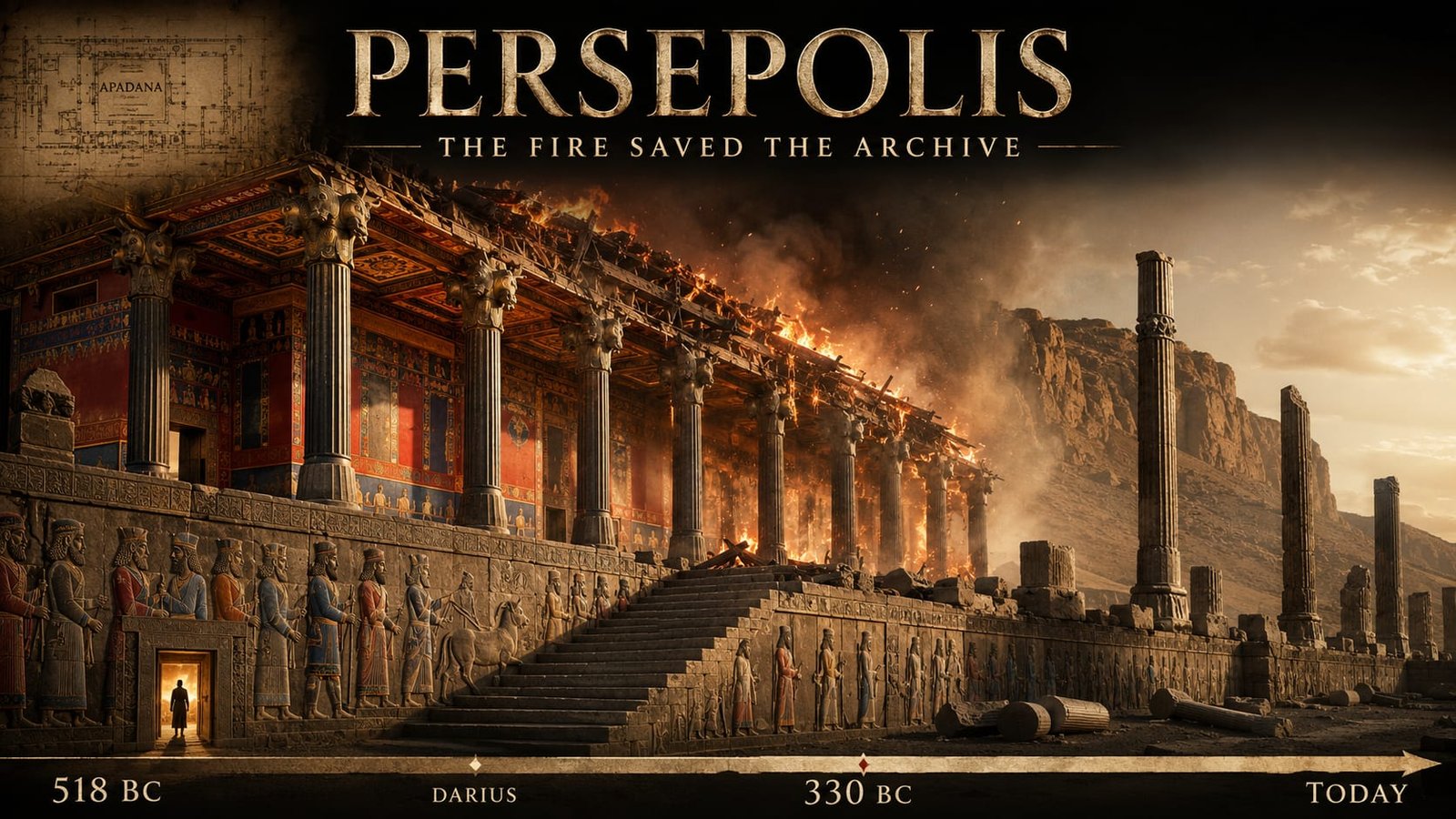
Climb the staircase, because the staircase is the point. One hundred eleven steps of polished stone, cut wide and shallow — shallow enough, it’s said, for dignitaries in long robes, even horses, to ascend with dignity. No fortress makes its entrance easy. Persepolis does, because Persepolis was not built to keep the world out. It was built to bring the world in. At the top, you pass through the Gate of All Nations — a hall guarded by colossal winged bulls with the faces of bearded kings — and the name is not a boast, it is a job description. Carved along the walls of the great audience hall beyond, a procession of twenty-three nations climbs with you, frozen in stone: Medes in round caps, Babylonians with fringed shawls, Ethiopians with ivory, Bactrians leading two-humped camels, Indians carrying gold. Each delegation is led by the hand — gently, by an usher — toward the king. Look closely at what is missing. No chains. No kneeling captives being trampled. In an age when other empires carved themselves flaying rebels alive, the Persians carved… a reception line. This is the first thing to understand about Persepolis: it is propaganda, yes — but propaganda of a kind the ancient world had never seen. Not “fear us.” Something stranger and more confident: “everyone belongs to us.”
To understand who could afford confidence like that, go back a single lifetime before the first stone was cut. In the mid-500s BC, Cyrus the Great — a king from the highlands of Persis — conquered, in about twenty years, nearly every power that had ever mattered: the Medes, the kingdom of Lydia and its legendary rich king Croesus, and then Babylon itself, the greatest city on Earth, which opened its gates to him. Cyrus’s empire became the largest the world had yet seen — and he ran it on a policy that startled his own age: conquered peoples kept their gods, their languages, their customs. When he took Babylon, he presented himself not as a destroyer but as a liberator chosen by Babylon’s own god — and the exiled peoples he sent home, including the Jews of the Babylonian captivity, remembered him for it ever after.
Cyrus — The Empire That Let You Keep Your Gods
But Cyrus built no great capital of stone. That fell to Darius the First — an official’s son who seized a shaking throne around 522 BC, crushed the revolts that followed, and then spent the rest of his reign building the machine to hold it all together. Roads with relay stations that could move a royal message over two and a half thousand kilometers in about a week. Provinces — satrapies — each with a governor, an auditor, and a tax bill. Standard coinage. And around 518 BC, in the homeland of Persis, he ordered something no Persian king had needed before: a stage. A place where, once a year, that whole sprawling machine could gather and see itself. He chose a shelf of rock against a mountain the locals came to call the Mountain of Mercy, and he did not level the site — he extended it, raising an artificial terrace of colossal stone blocks, some weighing tens of tons, fitted without mortar and clamped together with iron and lead. Half palace, half plateau: a hundred and twenty-five thousand square meters — about eighteen football pitches — lifted a dozen meters above the plain.
Before the columns rose, Darius buried a message. At the corners of his great audience hall, workmen sealed stone boxes into the foundations, and inside them lay plates of solid gold and silver, inscribed in three languages with a single idea: this is the kingdom I hold — from the Scythians beyond Sogdiana, to Ethiopia; from India, to Sardis. Not a prayer. A property deed, addressed to eternity. Archaeologists lifted two of the boxes out of the ground in the 1930s, the plates still gleaming. The building’s first act, before it held a single ceremony, was to state the size of the world it stood for.
Darius Builds the Stage
And on that platform, three generations of kings — Darius, his son Xerxes, his grandson Artaxerxes — raised the buildings that made the ancient world stare. The Apadana, the great audience hall: a forest of seventy-two stone columns, each nearly twenty meters tall — as high as a six-story building — so slender and so widely spaced that the cedar roof they carried seemed to float. Column capitals carved as twin bulls and lions, back to back, cradling the beams. Walls of sun-dried brick faced in glazed color, floors that archaeologists believe held ten thousand people at once. Beneath the floors, the engineering you were never meant to notice: kilometers of stone-cut water channels and drains threading the terrace — because a king who summons the world to a desert plateau must first defeat the desert. Water came by channel and cistern; the mountain itself was plumbed. And every material was a map of the empire: cedar from Lebanon, gold from Sardis, ivory from Nubia and India, turquoise from Chorasmia, craftsmen from Egypt, Babylon, and the Greek cities of the coast. A royal inscription from a sister palace makes it explicit, listing land after land that contributed — the building itself was the empire’s group portrait.
Picture the terrace at its height, on the spring gathering the reliefs seem to describe. Out on the plain below, a temporary city of tents rises — grooms, guards, cooks, translators for a dozen languages. Camel trains and mule caravans stand in lines that vanish toward the horizon. Delegations in their national dress wait their turn at the foot of the great stair: wool, silk, leopard skin, gold. Torches on the terrace at dusk; the smell of cedar and roasting meat; the murmur of an empire introducing itself to itself. We cannot prove the ceremony matched the carvings — scholars still argue about exactly what happened here and when. But the architecture only makes sense as a stage. Every ramp, gate, courtyard, and stair is choreography: it slows you down, lines you up, turns you at the right moment, and delivers you — awed, orderly, and small — into the presence of the king.
The Apadana — A Forest of Stone
And the stage was never finished. That is one of its strangest features. For a hundred and fifty years, from Darius to the last Achaemenids, Persepolis was a permanent construction site — each king adding his own palace, his own gate, his own inscription, the way each generation adds a chapter to a family book. Xerxes doubled down on his father’s plan: his own residence, the harem complex, and the towering Gate of All Nations through which every visitor now passed. His successor raised the Hall of a Hundred Columns, a throne hall even wider than the Apadana. When Alexander arrived, an entire new gate still stood half-carved — the masons’ work interrupted mid-stroke, and never resumed. The city that was built to display an eternal empire never reached its own final form. Empires never do.
The Payroll Baked in Clay
Now for the second thing — the one that rewrites the textbook. In the 1930s, excavators clearing a fortification wall found two archives of clay tablets, tens of thousands of them, written mostly in Elamite. Not poetry. Not scripture. Receipts. The administrative paperwork of the complex and its region — and it records, in dry bureaucratic detail, something remarkable: the people who built and ran Persepolis were paid. Workers drawing rations of grain, wine, and silver, graded by skill. Foreign laborers alongside Persians. And — read this twice — women on the payroll: female work crews, female supervisors of male workers, and extra rations issued to mothers of newborns. Was the Persian Empire a paradise? No — it was an iron-fisted autocracy that crushed rebellion without mercy, and unfree labor existed in it, as it did everywhere in the ancient world. But at the empire’s showpiece, the state’s own ledgers show wages, not whips. Compare the myth of the pyramid slave-gangs — false — and the reality of the Greek quarries — grim — and Persepolis’s clay receipts start to look like one of antiquity’s most surprising documents.
Alexander at the Gates
So why is this city not as famous as Rome or Athens? Partly because of what happened at Athens — and what Athens’ most famous student did about it. The Persian kings had tried, twice, to conquer Greece. In 480 BC, Xerxes’ army took Athens itself and burned the temples on its acropolis — an act the Greeks never forgot, and never forgave. The war ended, the empire endured; but the grudge compounded interest for a hundred and fifty years. And in 334 BC, a twenty-two-year-old king of Macedon crossed into Asia announcing exactly what he had come to collect. Alexander shattered the Persian armies, took Babylon, took Susa — and in the winter of 331 to 330 BC, he reached the empire’s ceremonial heart. Persepolis was handed over, its treasury intact: the accumulated bullion of two centuries, a sum the ancient sources describe as the greatest fortune ever captured — they claim it took thousands of pack animals to carry it away. For months, Alexander wintered in the palaces. And then, on the eve of leaving, in circumstances that embarrassed even his own historians — a night of drinking, the sources say, with a courtesan from Athens named Thaïs said to have called for torches — the palace of Xerxes was set alight. Deliberate revenge for the acropolis of Athens, staged as theater? A drunken impulse regretted by morning? The ancient sources themselves disagree, and historians still do. What no one disputes is the result. The cedar roofs caught, the great halls became chimneys, and the city built to hold the whole world burned through the night. The archaeology confirms it: a layer of ash across the terrace, column heads cracked by heat, arrowheads and debris where the roofs came down. The empire of Cyrus was dead within months, and its stage was a ruin.
The Night It Burned
And here is the twist that makes Persepolis unlike any other lost city: the fire is the reason we know it. Those clay tablets — the payroll, the rations, the working mothers — were unbaked when the archive rooms burned. The blaze that destroyed the palaces fired the clay hard, like a kiln, and the collapsing walls sealed the tablets under rubble for twenty-three centuries. The flames that erased the empire’s stage accidentally preserved its paperwork. Alexander burned the building and, without meaning to, published the archive. History rarely writes irony that clean.
And then Alexander did something that tells you the fire, whatever its cause, was not simple hatred of Persia. A few days’ ride away, at Pasargadae, stood the modest gabled tomb of Cyrus the Great — the empire’s founder, dead two centuries. Alexander visited it with something close to reverence; and when, years later, he returned from India to find the tomb broken open and plundered, the sources say he was furious — he had the tomb restored and the entrance sealed, and sought the robbers for punishment. Sit with that image: the man who burned the stage of the Persian kings, repairing the grave of the first of them. Conquerors are rarely consistent. Alexander wanted to punish Xerxes — and to be Cyrus. Persepolis paid for the first ambition; Pasargadae profited from the second.
The Fire That Saved the Story
Afterward came the long quiet. The plain stayed important — it had been sacred before the fire, and it stayed sacred after. In the cliff face of a nearby rock wall, the Achaemenid kings had already cut their tombs: monumental crosses of carved stone high above the ground, Darius himself watching his stage from his grave. Centuries later, new Persian dynasties — who ruled long after Alexander’s successors were gone — carved their own triumphs into the same cliffs, right beneath the old kings, claiming the lineage of a city they could no longer read. Even ruined, the place still meant kingship. Locals gave the columns a new name from legend: Takht-e Jamshid, the Throne of Jamshid, a mythical king — the true builders half-forgotten on their own stage. Travelers wondered at it; the ruins filled with sand. Only in the 1930s did systematic excavation clear the terrace, raise fallen capitals, and read the tablets — and a city that existed mostly as a rumor in Greek war histories got its own voice back, in its own accounting.
What Persepolis Really Was
So stand on the terrace at the end and put the three pieces together. A stage, built by an empire so vast and so confident that its self-portrait was a reception line of nations, not a pile of enemy dead. A workforce on wages — women among them — recorded in clay by the most organized state the world had yet produced. And a single night of fire that ended the performance, froze the stage in ash, and baked the evidence solid. Persepolis is not a story about architecture surviving time. It is the opposite — and something better: proof that a civilization’s records can outlive its walls, that how an empire treats its workers can echo louder, twenty-five centuries on, than how it treated its enemies. The columns still stand on the plain in the mountains of Iran, holding up nothing but sky. What they carry now is heavier than any roof: the memory of the one ancient empire whose monument said everyone, and the warning of how fast everyone can burn.