The Gate in the Wrong City
The greatest gate of the ancient world is not in Iraq. It is in Berlin. Twenty-five centuries ago, this wall of blue glazed brick — blue as lapis lazuli, prowled by golden dragons — opened into the largest city on Earth, a city whose walls alone were counted among the wonders of the world. And that city fell without a battle. In a single night. This story comes down to three things: the gate that changed the color of power. The gardens that may never have existed. And the night the river betrayed the city.
The Blue Gate of Babylon
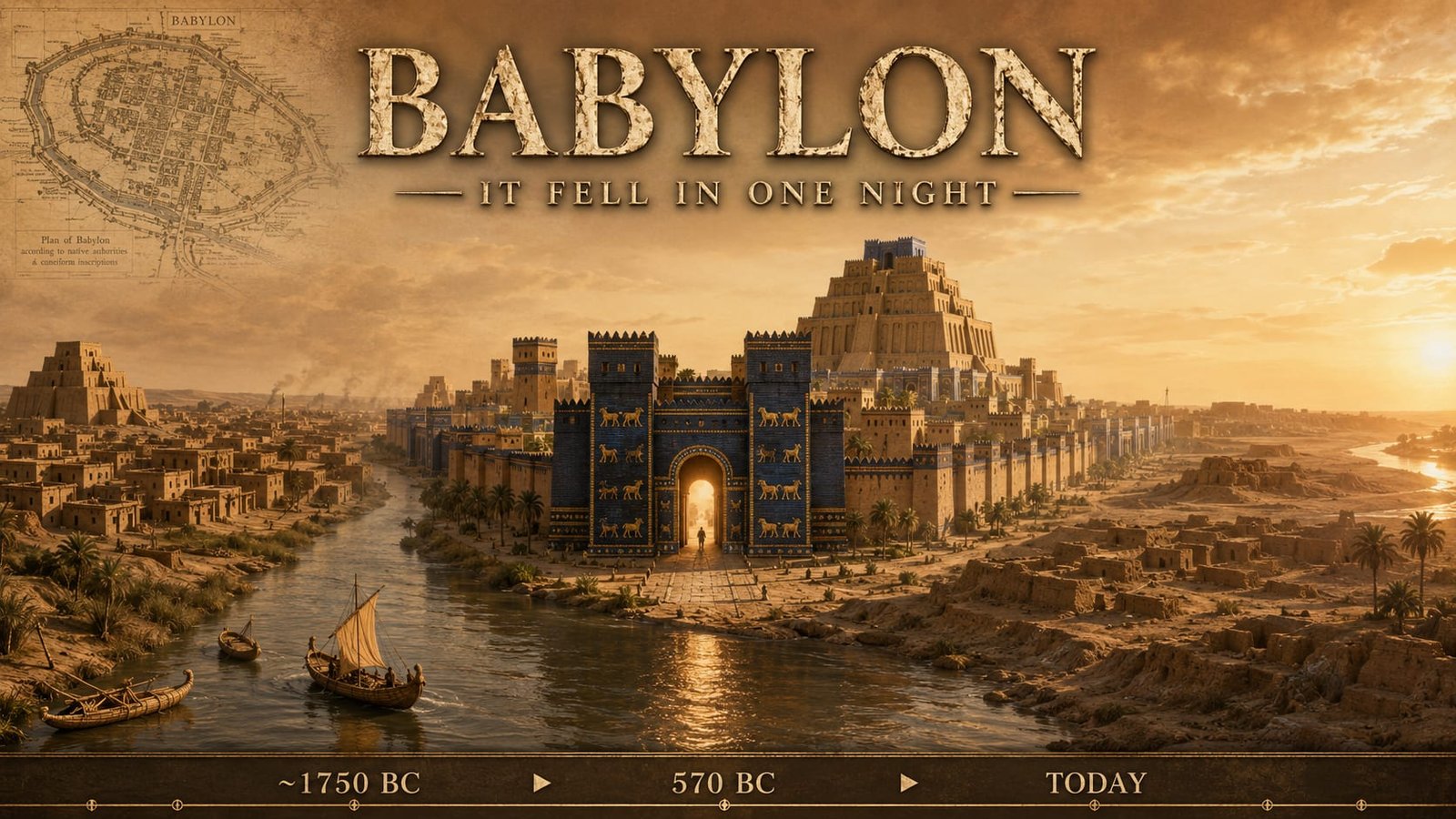
Start at the gate, because the gate was the argument. Every empire announces itself in a material. Egypt chose stone. Rome would choose concrete. Babylon, built on a floodplain with no quarries and no forests, had only mud — and turned it into the most dazzling surface ever seen. Bricks of ordinary river clay were glazed with minerals and fired until they shone like enamel, deep blue as the semiprecious stone kings hoarded, and set with rows of striding animals in molded relief: bulls of the storm god, and the mušhuššu — the slender dragon of Marduk, scaled, long-necked, impossible. Through this gate, dedicated to the goddess Ishtar, ran the Processional Way — a paved avenue wider than a modern boulevard, walled on both sides with sixty snarling lions on the same lapis-blue ground. Imagine arriving from a world of mud villages and dusty tracks, and seeing this: a canyon of color, glowing in the desert sun. That was the point. You were meant to understand, before you ever reached the palace, that this city was not like other cities.
The Largest City on Earth
Now step back, and see what the gate belonged to. Babylon in the sixth century BC was, by most estimates, the largest city on the planet — perhaps the first in history to hold two hundred thousand people. The Euphrates ran straight through its heart, crossed by a bridge on stone piers — itself a marvel in a world that barely bridged streams. Around everything ran the walls: not one ring but two, an outer and an inner system, so thick that ancient writers swore a four-horse chariot could turn around on top of them. Herodotus, the Greek traveler, gave the walls dimensions so vast that scholars still argue about how much he exaggerated — but the archaeology confirms the essentials: a double circuit, kilometers long, of baked brick set in bitumen, studded with towers. Before there was a lighthouse at Alexandria, the earliest lists of the world’s wonders included the walls of Babylon — the only city ever admitted to the list simply for its defenses. And rising above the rooftops, at the center, stood a stepped tower of brick: Etemenanki — “the House of the Foundation of Heaven and Earth” — the great ziggurat of Marduk. A surviving Babylonian tablet gives its measurements, and if we read it right, the tower stood roughly ninety meters tall, on a base ninety meters square — a man-made mountain on a plain with no mountains, visible for a day’s walk in every direction. To the Judeans who were marched into this city as captives, that tower needed a story. Most scholars agree it is the building remembered in the Book of Genesis as the Tower of Babel. The tower was real. You could touch it. Its bricks are still there.
The King Who Drowned Babylon
But Babylon was not born great. By the time Nebuchadnezzar’s masons glazed the first dragon, the city was already ancient — and it had already died once. Wind back thirteen centuries, and Babylon is a modest town on the river, one of a dozen squabbling city-states — until a king named Hammurabi turns it, in one lifetime, into the capital of Mesopotamia. Around 1750 BC he sets up a black stone pillar carved with two hundred and eighty-two laws — if a builder’s house collapses and kills its owner, the builder dies; the strong shall not oppress the weak — one of the oldest complete law codes on Earth. That stele survives; it stands today in the Louvre. From Hammurabi on, Babylon was Mesopotamia’s holy city, the seat of Marduk, the place where — for two thousand years, through every conquest — a ruler did not truly reign until he had come to Babylon at the New Year festival and grasped the hand of the god. Empires learned to possess the city. The city, patiently, possessed them back. And then, in 689 BC, it met an empire that refused to play. Sennacherib of Assyria, enraged by Babylon’s endless rebellions, did the unthinkable: his army tore the temples down, threw the rubble into the Euphrates, and turned the water over the ruins — so that, in his own words, the place of the city might not be found. The holy city of the world, erased by its own river. It should have been the end. It lasted a decade. Sennacherib was murdered — by his own sons, in a temple — and Babylonians whispered that Marduk had kept the receipt. His successor rebuilt the city stone by stone, begging the gods’ pardon in his inscriptions. Remember that sequence — a king who drowns Babylon, and a river that avenges it — because the river was not finished with this story.
Nebuchadnezzar — Wonder and Cage
What rose from that resurrection was the Babylon of legend. In 612 BC, Babylon and its allies burned Nineveh and broke Assyria forever; the spoils of the world’s empire flowed south. And for forty-three years, one man spent them: Nebuchadnezzar the Second. Almost everything you have seen in this video is his — the Ishtar Gate, the Processional Way, the doubled walls, the rebuilt tower of Etemenanki, a palace he called “the marvel of mankind.” He was Babylon’s greatest builder. He was also — and the two facts must stand together — the king who, in 586 BC, burned Jerusalem, destroyed its temple, and deported the survivors to Babylon. The Hebrew Bible remembers this from the inside: by the rivers of Babylon, we sat down and wept. The exiles sat by these canals, under that tower, inside those walls — a captive people in the most magnificent city on Earth. Hold both truths. The city was a wonder. And for some of the people inside it, the wonder was a cage.
The City That Invented the Hour
And before the fall, look once more at what daily life inside those walls actually was — because Babylon’s deepest export was not brick, and it was not gold. Down the lanes off the Processional Way lived scribes, merchants, brewers, priests — and the best astronomers on the planet. On the terraces of the temples, night after night, for centuries, Babylonian observers logged the positions of the moon and the planets in cuneiform — the longest continuous scientific record ever kept by any civilization, so precise that from it they learned to predict lunar eclipses years in advance. They did their mathematics in base sixty. Keep that number. Sixty seconds in a minute. Sixty minutes in an hour. Three hundred sixty degrees in a circle. Every clock on Earth, every compass, every protractor in every schoolbag, still runs on Babylonian arithmetic — a five-thousand-year-old operating system nobody ever uninstalled. And once a year, at the spring New Year festival, the whole machine of the city turned over: eleven days of processions, when the statues of the gods sailed and rode in state through the Ishtar Gate, and the king himself was marched into the temple, stripped of his crown, slapped across the face by the high priest, and made to swear he had not oppressed Babylon — before the god handed the kingship back for another year. The most powerful men alive, humbled on schedule, in public, by the city itself. Babylon did not just build bigger than everyone else. It counted, watched, and remembered longer than everyone else. Keep that in mind when the empires start falling — because in this story, the buildings die, and the numbers survive.
The Hanging Gardens Problem
Which brings us to the strangest wonder of all — the one that may be a ghost. The Hanging Gardens of Babylon: terraces of trees and flowers rising like a green mountain in the desert, watered by hidden machines, built — the story goes — by Nebuchadnezzar for a queen homesick for the hills of her native Media. Every list of the Seven Wonders includes them. And here is the problem, stated plainly: no Babylonian text mentions them. Not one. We have Nebuchadnezzar’s own building inscriptions, brick by boastful brick — palaces, walls, temples, the gate. Never gardens. Herodotus, who described Babylon’s walls in loving detail, says nothing of them. Archaeologists led by Robert Koldewey dug the city for eighteen years and found no structure they could prove was the gardens. The lush descriptions all come from Greek and Roman writers, generations later, quoting earlier accounts now lost. So there are three honest possibilities. The gardens existed, and lie under the part of Babylon the river swallowed — the Euphrates has shifted its bed since antiquity, and part of the ancient city drowned beneath it. Or they never existed at all — a traveler’s tale that hardened into a wonder. Or — the theory with real evidence behind it — we have been looking in the wrong city. One Assyrian relief shows a palace garden on arched terraces, watered by aqueduct: not in Babylon, but in Nineveh, three hundred miles north, where Sennacherib — Babylon’s destroyer — boasted of raising water to his “palace without rival” with bronze screws. Perhaps history’s most famous garden was planted by Babylon’s worst enemy, and the world’s memory replanted it in the more famous city. We reconstruct the gardens in this video as the ancient writers described them — and we tell you honestly: of everything in Babylon, this is the one thing we cannot promise you was there.
539 BC — The Night the River Betrayed the City
What we can promise is the ending — because for the fall of Babylon, the sources converge from three directions at once. The scene is October, 539 BC. Babylon’s last native king, Nabonidus, is an aging scholar more interested in restoring ancient temples than in ruling; he has already lost the only pitched battle, days earlier, upriver at Opis, against a rising power from the east: Cyrus of Persia. But the city itself — the double walls, the towers, the bridged river, provisions for years — the city is considered untakeable. The Greek historians tell us how the untakeable city was taken, and the trick is worthy of a heist: you do not go over the walls of Babylon, and you do not go through them. You go under — through the one gap no one can close: the river. Upstream, Cyrus’s engineers cut a channel into an old flood basin and bent the Euphrates out of its bed. Through the night, the water level inside the city began to drop — until, in the small hours, Persian soldiers waded down the riverbed itself, under the great bridge, beneath the water-gates, and walked into the streets of Babylon with their thighs barely wet. The Babylonian chronicle — a clay tablet written close to the events — records the astonishing result: the army of Cyrus entered Babylon without a battle. No siege. No burning. The largest city on Earth, the fortress of the age, changed hands overnight — the river that had made Babylon rich, and had once been used to drown it, finally simply let the conqueror in. And the Hebrew Bible remembers that same night from inside the palace: the feast of Belshazzar — the crown prince who ruled while his father Nabonidus was away — wine in the gold vessels looted from Jerusalem’s temple, and a hand writing on the plaster wall: mene, mene, tekel, upharsin. Weighed. Weighed. Found wanting. Divided. Whatever one believes about the writing, the tablet and the scripture agree on the outcome: that night, Babylon’s kingdom passed to the Medes and Persians. On the Cyrus Cylinder — the conqueror’s own proclamation, pressed into clay, now in the British Museum — Cyrus claims he entered Babylon as a liberator, welcomed by the city, restoring peoples and their gods to their homes. Propaganda, of course; victors write on clay too. But the biblical books of Ezra and Isaiah remember Cyrus the same way — as the king who let the Judean exiles go home after fifty years, and rebuild Jerusalem. Two traditions, written for different gods, agreeing for once: the night Babylon fell, its captives were set free.
Why Falling in One Night Saved Babylon
And here is the twist hidden in the mercy: because Babylon fell in one night, Babylon survived. No siege engines broke the walls; no fire took the archives. Cyrus took the hand of Marduk and ruled as a Babylonian king; the city stayed rich, sacred, and standing. Alexander the Great entered it two centuries later — down the same Processional Way, through the same blue gate — and chose it as the capital of his world empire. He ordered the rubble of the aging Etemenanki cleared for a full rebuilding of the tower; and then, in the palace of Nebuchadnezzar, in June of 323 BC, Alexander died — thirty-two years old. The rebuilding died with him. His successors founded a new capital nearby and moved the population away, and Babylon did what abandoned cities on floodplains do: it dissolved. Mud brick returned to mud. The river shifted. The greatest city of the ancient world sank back into the clay it was made of — not destroyed, in the end. Just unattended.
The Bricks Still Carry His Name
So put the three stories together — the gate, the gardens, the night — and look at what remains. In 1899, German archaeologists began pulling the Ishtar Gate’s shattered glaze out of the mud, fragment by fragment — hundreds of crates of blue — and reassembled it in Berlin, where it stands today, indoors, in a museum, the color still electric after twenty-five centuries. The gardens remain what they have always been: a rumor too beautiful to delete. And at Babylon itself, ninety kilometers south of Baghdad, you can walk the original Processional Way — on bricks whose undersides are stamped, each one, with the same sentence: Nebuchadnezzar, king of Babylon, am I. The city that fell in one night has outlived every empire that took it — Persia, Alexander, all of them — because Babylon was never really made of brick. It was made of stories: the tower that reached for heaven, the writing on the wall, the garden in the sky. Brick returns to mud. The stories are still standing.