That Is Not a Hill
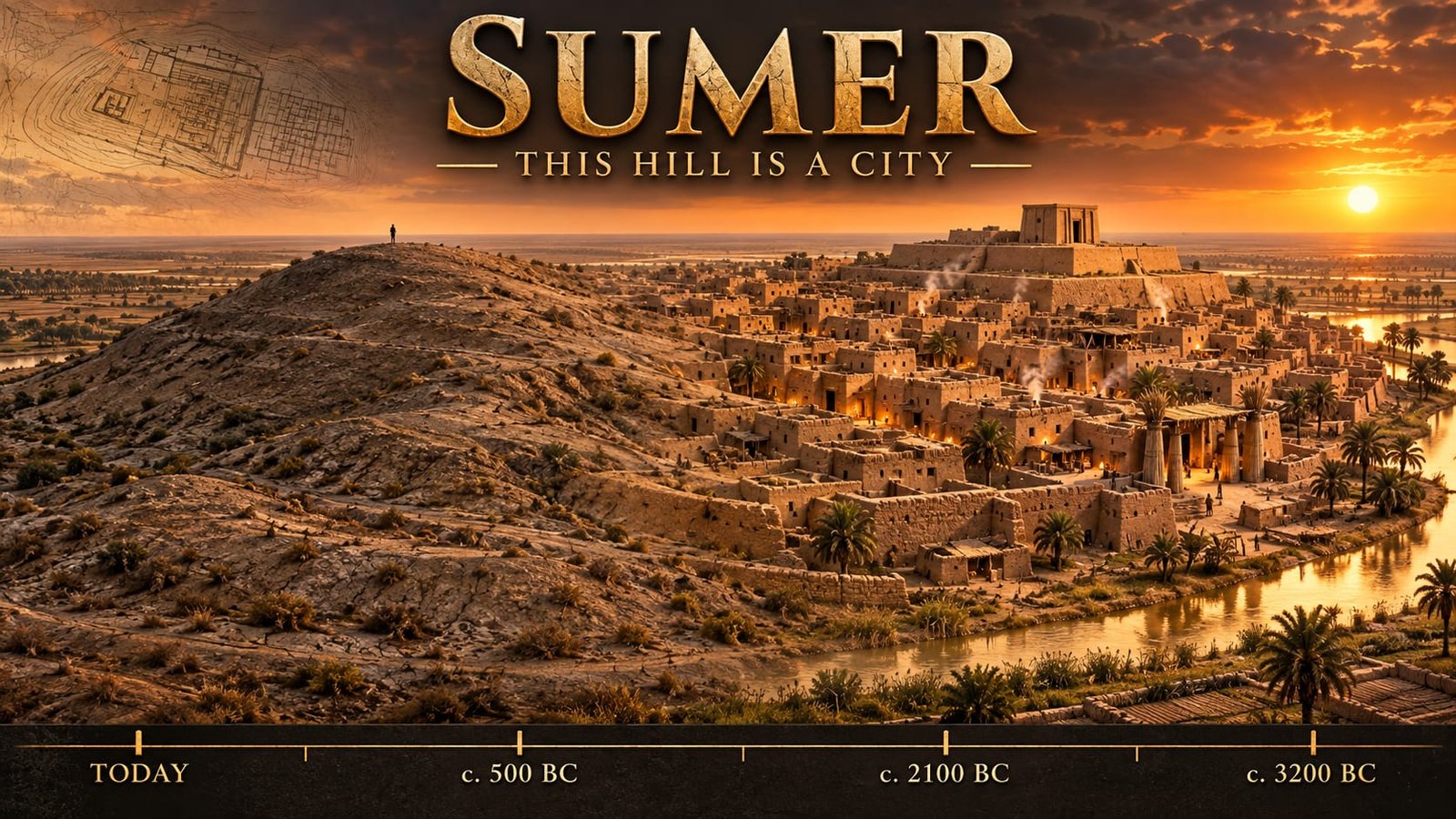
Drive across the plain of southern Iraq and you pass low, pale hills, standing alone in land so flat that anything higher than a palm tree is visible for miles. They look natural. They are not. Each one is a city — or rather, what a city becomes when it is built out of mud, lived in for thousands of years, and never quite abandoned until the very end.
The word archaeologists use is tell, from the Arabic for a mound. A tell is not a hill with ruins on top. It is made of the ruins. Every generation, the old walls slumped and dissolved; people levelled what was left and built on top of it; and over centuries the settlement rose, metres at a time, on its own debris. Dig into one and you are reading downward through time.
These are the oldest cities on Earth. When Egypt cut the first block of the Great Pyramid, around 2560 BC, people on this plain had been living in cities for well over a thousand years, and writing for some seven hundred. This dossier is about how they did it — with no example anywhere to copy — and about the three things everyone gets wrong about them: what they were built of, what writing was first for, and what finally ended them. It was not an army.
The Invention Was the Job
Start with the biggest of them. Uruk — modern Warka, in southern Iraq — was already large by the late fourth millennium BC: around 3200 BC its built-up area is estimated at something like 250 hectares, about two and a half square kilometres. A few centuries later, by around 3000 BC, a wall roughly nine kilometres long enclosed some 550 hectares, and the city inside it is usually estimated at about forty thousand people. Estimates run higher and lower depending on how you count, and anyone offering one confident figure is choosing a method. But no human beings anywhere had lived together in such numbers before.
Literature remembered the wall. The Epic of Gilgamesh opens by telling its reader to go and look at the ramparts of Uruk — to climb them, walk them, and inspect the brickwork — and credits them to Gilgamesh, its king. It is, among other things, the oldest building credit in literature.
What those numbers did matters more than the numbers themselves. Put tens of thousands of people inside one wall and they can no longer all be farmers. Someone throws the pots for everyone — and at Uruk they did so in astonishing quantity: a crude, mould-made “bevelled-rim bowl” turns up in such numbers across Uruk-period sites that it is widely read as a standard ration container, handed out by the thousand. Someone else weaves, or smelts copper, or keeps the accounts of the temple household, and is fed for it.
That is the real invention of the Sumerian city. Not a building — a job. Uruk is the first place we can show that a person could spend an entire working life doing one specialised thing, because the organisation around them fed and supplied them while everyone else did the rest.
A Venice in the Desert
The Uruk you would see today is desert. The Uruk its people knew was not.
When German geophysicists ran magnetometers across the site in the early 2000s — reading the faint magnetic traces of buried walls and waterlogged fills without digging a single trench — the plan that emerged was threaded with water: a network of canals, harbours and waterways reaching into the city’s quarters, some seventy hectares of it by their estimate. They called it, fairly, a Venice in the desert. The canals moved goods and people through the city, and helped protect it from the river’s annual flood.
The wider landscape was wetter too. In the fifth and fourth millennia BC, southern Mesopotamia held extensive marshes, and after the rise in sea level at the end of the last Ice Age the head of the Persian Gulf reached much further inland than it does today. The earliest cities of the south were built in a world of reed beds, channels and brackish water — which is why fish, reeds and boats run all through their earliest imagery, and why the map as it looks now will mislead you about where these cities stood.
Built of the River
Southern Mesopotamia has almost no building stone, very little timber worth the name, and no metal ores. What it has is silt. Every year the Tigris and the Euphrates spread it across the plain, and for practical purposes it is infinite.
So the Sumerians built out of mud. Clay and water, straw for binding, a wooden mould, and the sun. Sun-dried mud brick is the cheapest building material that has ever existed, and it has one flaw: water dissolves it. Walls weathered, slumped, and had to be rebuilt — and each rebuilding raised the ground a little higher. That is the whole mechanism of a tell.
And because the material was free, they used it with astonishing ambition. In the Eanna precinct at Uruk, the district of the goddess Inanna, builders decorated columns and walls with tens of thousands of small clay cones, pressed point-first into wet plaster, their heads coloured black, red and white to form zigzags and lozenges — so that from a distance a mud wall read like a woven textile. On the other side of the city, on a high terrace associated with the sky-god Anu, stood a whitewashed shrine that its excavators named the White Temple, raised so that it could be seen from far across the plain.
None of it was imported. It is all the same riverbed, shaped.
Writing Began as a Receipt
The second thing the mud made possible is the strangest turn in the whole story.
The earliest tablets — found above all at Uruk, and dated to around 3300 to 3000 BC — are not poems, prayers or royal inscriptions. They are accounts. Of the several thousand archaic tablets recovered from Uruk, the overwhelming majority are administrative: rations of grain, deliveries of malt and dates, jars of beer, herds of sheep and goats, and the labour owed and paid. Most of the remainder are word lists — standardised catalogues of signs that scribes copied as training. Writing, in its first form, was an instrument of management.
How did it start? One influential answer, argued at length by the archaeologist Denise Schmandt-Besserat, runs like this. For thousands of years before writing, people across the Near East used small clay tokens — cones, spheres, discs — each shape standing for a quantity of a particular commodity. To send a sealed count, tokens were enclosed inside a hollow clay ball. But you cannot check a sealed ball without breaking it, so the tokens were first pressed into its surface as a label. At some point someone noticed that the marks on the outside made the tokens inside unnecessary. Keep the marks, drop the tokens, flatten the clay — and you have a tablet.
It is an elegant story, and parts of it are well supported: tokens, sealed clay envelopes and impressed tablets all exist. But it is a hypothesis, not a settled fact. Critics have questioned how neatly the token shapes map onto early signs, and whether the development was really one continuous line. What is not in doubt is the conclusion the tablets themselves force: writing was invented by accountants, not by poets.
On a number of these accounts the same pair of signs recurs, read KU and ŠIM — Kushim. On the most-quoted reading of one tablet, now in the Schøyen Collection, it records 29,086 measures of barley received over thirty-seven months, with the name at the end. The name appears on some eighteen tablets in all, on some of them alongside a title for a temple administrator. It may be one man. It may be an office several people held. Specialists genuinely disagree. But if it is a person, then one of the first human beings whose name we can read was not a king or a hero. He was the official who signed for the barley, and we know of him because he wrote it down so that nobody could argue with him later.
From Counting to Language
For several centuries the signs could do little more than record things and quantities. The step that turned bookkeeping into writing was the use of signs for their sound rather than their meaning — the rebus principle, the way a picture of a bee can stand for the start of “belief”. Over the first centuries of the third millennium BC, Sumerian scribes increasingly used signs phonetically, and once you can spell sounds you can write names, contracts, laws, letters, hymns — and eventually an epic that tells you to go and inspect the walls of Uruk.
The same scribes left something you used this morning. They counted in sixties. Sixty is the smallest number that divides without remainder by two, three, four, five and six, which makes it superb for splitting rations, fields and labour into fair shares. Their accounting system passed to the Babylonian astronomers, from them to the Greeks, and so to us: sixty seconds in a minute, sixty minutes in an hour, 360 degrees in a circle. It is a Sumerian administrative convenience that nobody has ever managed to replace.
A Mountain Made of Brick
Go south-east from Uruk to Ur and forward about a thousand years, and the mud becomes monumental.
Around 2100 BC Ur-Nammu, founder of the dynasty historians call Ur III, began a great stepped platform for the moon-god Nanna, completed under his son Shulgi. The ziggurat’s base measures about sixty-four by forty-six metres. It rose in stages to something over thirty metres; the upper parts are gone, so its original height is an estimate, and exact figures should be treated as reconstructions.
The engineering is the interesting part. The core is sun-dried mud brick — cheap, fast, and vulnerable to rain. So it was wrapped in a skin of kiln-fired brick set in bitumen, around two and a half metres thick, a waterproof jacket over a vulnerable heart. And that jacket is pierced with vertical drainage slots, because a mud core that gets wet swells and can burst its casing from the inside. Woolley, who excavated it, also noted that the walls lean inward and that the lines of the building are very slightly curved rather than straight, which makes a squat mass look taller and more solid from the ground. This is deliberate architectural refinement, in brick, more than sixteen centuries before the Parthenon.
And here a reconstruction site has to be honest, because the Ziggurat of Ur is the most photographed ancient building in Iraq. What those photographs show is not all ancient. The lowest façade and the great triple staircase were reconstructed in the 1980s. Long before that, in the sixth century BC, the Babylonian king Nabonidus restored the ziggurat himself — and Woolley’s reading of the evidence gave his rebuild more stages than the original. Beneath both campaigns, Ur-Nammu’s core is still there. What you see is a twentieth-century face over a sixth-century-BC repair over a twenty-first-century-BC building. All three are real. Only one of them is Sumerian.
The Royal Tombs
Ur is also where Sumer stops being abstract and becomes people.
Between 1922 and 1934, Leonard Woolley’s joint expedition for the British Museum and the University of Pennsylvania excavated a cemetery of some two thousand graves at Ur. Sixteen of them were unlike the rest — built of stone and brick, and packed with offerings — and Woolley called them the royal tombs. In one lay a woman whose cylinder seal names her Puabi, buried under an elaborate headdress of gold leaves, rings and ribbons, with lapis lazuli and carnelian beads.
In another, the pit Woolley named the Great Death Pit, seventy-four people had been laid out in rows on the floor: six men near the entrance, some with weapons, and sixty-eight women, many wearing headdresses of their own, with lyres beside them. Woolley believed they had walked in, drunk poison and lain down in peace.
In 2009 researchers at the Penn Museum used CT scanning on two skulls from the cemetery and found fractures consistent with blows from a heavy, pointed instrument. Their published study went further, arguing that at least some bodies had been heated and treated to slow decay before being dressed and laid out. Two skulls are two skulls, and the ritual is still reconstructed from very little. But the gentle version of the story is no longer the safe one.
Look again at what Puabi wore. The deep-blue lapis lazuli in her jewellery almost certainly came from Badakhshan, in what is now north-eastern Afghanistan — roughly two and a half thousand kilometres away. A city that could not quarry a single block of building stone was importing blue rock across half a continent, because it had grain, cloth and a written record of who owed what.
Where the Sumerians Said It Began
The Sumerians themselves had an opinion about which city came first. The Sumerian King List opens by saying that when kingship first descended from heaven, it came down at Eridu.
Eridu lies at the southern edge of the Sumerian world, on what is now a desert plain. Its mound — Abu Shahrain — was excavated between 1946 and 1949 by Fuad Safar, working with Seton Lloyd and Mohammad Ali Mustafa for the Iraqi antiquities service. Beneath the later temple platform they found something remarkably patient: a sequence of eighteen building levels on the same sacred spot, each temple built on the levelled remains of the one before, beginning around 5400 BC. The earliest is a small single room. The latest are monumental buildings on high platforms.
For once, the legend and the excavation point to the same patch of ground. And the work is not over: from 2019 an Iraqi–Italian mission led from Sapienza University of Rome, with teams from the University of Strasbourg, has returned to Eridu and its surrounding mounds, re-examining the great temple complex with modern methods.
The City That Crowned Kings
Nippur is the strangest of the Sumerian cities, because it never ruled anything.
It was never a great imperial capital and never built an empire over its neighbours. What it held was the Ekur — the house of Enlil, the god who, in Sumerian belief, granted kingship. For centuries, kings from rival cities sought recognition and legitimacy at Nippur and competed to endow its temples, in a town whose power was religious rather than military.
Nippur also gave up tens of thousands of tablets, first to the University of Pennsylvania’s expeditions of 1889 to 1900 and then to later excavators, and much of the Sumerian literature we can read today survives in copies from its scribal schools. One tablet from the site is a plan of the city itself, drawn in the later second millennium BC — walls, gates, canals and the temple precinct — one of the oldest surviving maps drawn to be used.
The First Named Author
At Ur, around 2300 BC, a woman named Enheduanna held the high priesthood of the moon-god Nanna. She was a daughter of Sargon of Akkad, placed there as part of her father’s hold on the south. Hymns survive that speak in her voice and name her as their composer, which is why she is so often described as the first named author in history.
The honest caveat matters here. The copies we have were made in the Old Babylonian period, some five centuries after her lifetime, and some Assyriologists argue that the attribution is later tradition, or that her name functioned more as a title than a signature. She is either the first author whose name we know, or the first author anyone thought worth naming. Both are remarkable.
Salt
So what ended them? Not an army. The cities of Sumer were conquered and reconquered constantly, and it barely dented them. What finished them was slower and far less dramatic.
Southern Mesopotamia is a hot floodplain with almost no rain, so its fields depend on irrigation. River water carries dissolved salts. Pour it on a field, let it evaporate, and the salt stays behind. Without winter rains to flush it out, and without drainage to carry it away, it accumulates year after year.
In 1958 Thorkild Jacobsen and Robert Adams set out a famous argument from the tablets themselves: farmers in the south shifting away from wheat, which tolerates salt poorly, towards barley, which tolerates it better, while recorded yields declined. It was a powerful thesis, and later scholars have shown the picture is messier. Marvin Powell and others argued that the textual evidence does not show a simple progressive collapse, and that politics, war, labour and canal maintenance can move the same numbers. The debate is real. But the salt in the soil is real too, and it is still there.
The River Walked Away
Then the rivers moved.
On a very flat plain a river such as the Euphrates does not stay fixed. It deposits silt in its own bed, building up its channel until the water runs above the surrounding land, and then, in some flood season, breaks out and takes a new course. When that happens, a city that has been a river port for centuries can suddenly find itself inland. Uruk’s long life ended, in the end, because the Euphrates shifted away to the west. Eridu, long since marooned on a drying plain, was finally deserted around 600 BC.
And as the south dried and salted, wealth and power moved north and upstream — to Babylon, and later to Nineveh. The Sumerian cities were not sacked into oblivion. They were outlived. People left over generations, the mud went back to being mud, and each city subsided quietly into the shape of a hill.
The First Museum, and What Is Still Down There
It ends with someone doing what this site is trying to do.
In the sixth century BC — some fifteen hundred years after Ur-Nammu — Nabonidus, the last native king of Babylon, became preoccupied with the distant past. He had ancient temple foundations searched for the inscriptions of earlier kings, and restored what he found. His daughter Ennigaldi-Nanna was high priestess at Ur, and when Woolley excavated there he found, in a building beside her residence, a collection of objects centuries apart in age, arranged together — with a clay cylinder inscribed in more than one language explaining what one of them was and where it had come from. Woolley called it a museum. People have argued about the word ever since. But the labels are there.
Nabonidus was still at it when Cyrus of Persia took Babylon from him in 539 BC. Everything that followed in the region — Babylon, Nineveh, and the stone cities the Persian empire would build to be looked at — stood on a way of organising people and recording obligations that had been worked out, in mud, at Uruk.
In the marshes of southern Iraq, people still build long arched halls from bundled reeds, the mudhif, in a shape recognisable on Sumerian seals. Since 2016 those marshes and the remains of Uruk, Ur and Eridu have been protected together as a single World Heritage property — a relict landscape of the first cities. And most of Iraq’s recorded archaeological sites have never been excavated at all. The oldest cities on Earth are mostly still down there, waiting, disguised as scenery.