This Hill Is Troy
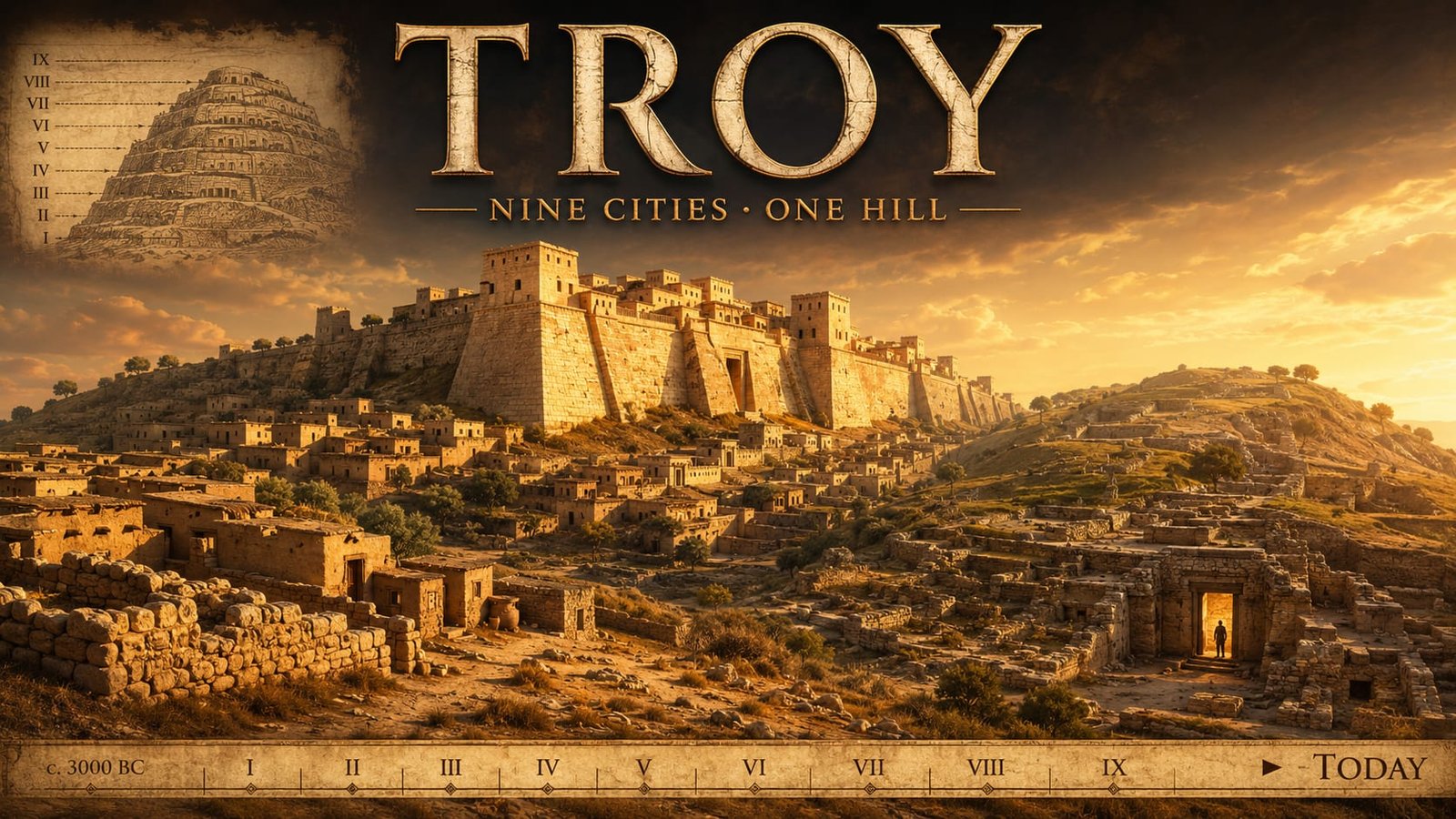
This hill in Turkey is Troy. Not a metaphor — the actual place. The war may be legend. The city is real.
And here is the first impossible fact: it isn’t one city. Cut into the mound and you fall through nine Troys — nine cities stacked one upon another across three and a half thousand years.
So this is what no film could show you — three things. One: the real walls of Troy, the ones Homer actually describes, still standing. Two: the armor Odysseus really wore — because archaeologists found it. Three: the island that might not be Ithaca at all.
The Real Walls of Troy
Begin with the walls — because you can still touch them. The mound is called Hisarlik, a short ride from Turkey’s Aegean coast, and archaeologists have been cutting into it for a hundred and fifty years: Schliemann with a treasure-hunter’s impatience in the 1870s, Carl Blegen with surgical care in the 1930s, Manfred Korfmann with a modern army of specialists from 1988. The layer that matches Homer’s city is the sixth — Troy VI. Its walls rise in fitted limestone blocks, four to five meters thick, leaning inward at a smooth, deliberate angle. And that detail matters, because Homer remembers it: three times, the Iliad says, Patroclus climbed the sloping angle of that wall. The poem even insists one stretch was weaker than the rest — near the fig tree, where the city could be scaled. When excavators traced the circuit, they found it: one western section, older and cruder than all the others. A poet, four centuries after the fall, describing masonry no one alive had seen.
The Lost Lower City & the Horse
For a century, the skeptics kept one good argument: Troy was too small — a hilltop fort, not a kingdom worth a thousand ships. Then Korfmann’s team ran magnetometers over the fields below the citadel, and a lower city surfaced in the readouts — streets, houses, and a defensive ditch cut into bedrock, making Troy roughly fifteen times larger than anyone had believed: a true Bronze Age capital, home to thousands. Hittite clay tablets even seem to name the place: Wilusa. In Greek — Ilios. As for the horse, the honest answer is that archaeology has found no horse. What it found, in the burn layer of the city called Troy VIIa, is arrowheads in the streets, sling stones stockpiled for a siege, and bodies left unburied. Something violent ended this city around 1180 BC. Was the horse a battering ram? An earthquake — sent by Poseidon, the earth-shaker, who was also the god of horses? The prow of a ship? The debate is open — and it is a better story than a wooden statue.
Mycenae — The Mask That Lied
Now cross the Aegean to the fortress the attackers sailed from: Mycenae, city of Agamemnon. Its gate is still standing — two lionesses carved over a lintel of some twenty tons, the only monumental sculpture the Mycenaean world left us, set in ramparts of boulders so huge that later Greeks decided only the Cyclopes could have lifted them. When Schliemann dug inside in 1876, he found grave circles heavy with gold, and lifted a golden death-mask he was certain belonged to Agamemnon himself. He was wrong — beautifully wrong. The mask is real, and royal, and roughly three hundred years too old: the face of a king who died before any Trojan War could have begun.
The Armor Odysseus Actually Wore
But the treasure that matters most here is smaller and stranger. In Book Ten of the Iliad, Homer stops the battle to describe, in loving detail, the helmet Odysseus puts on: leather, felt-lined, and armored on the outside with rows of gleaming white boar’s tusks. For centuries, readers assumed he invented it. Then the helmets started coming out of the ground — at Mycenae, at Knossos, at Dendra — plated with sliced boar tusk, row upon row, exactly as described. And here is the detail that gives historians chills: boar’s-tusk helmets had fallen out of use centuries before Homer was born. He was describing, correctly, an antique he could never have seen — a memory carried down four hundred years by nothing but spoken verse. At Dendra, one warrior was buried in a complete suit of bronze plate armor — almost three thousand years before the knights of medieval Europe — with the remains of a boar’s-tusk helmet beside it. When Homer clads his heroes in bronze, he isn’t exaggerating. He’s underselling.
The Island That Might Not Be Ithaca
Which brings us to the hero’s destination — and the strangest puzzle in the whole geography. Homer describes Ithaca precisely: low-lying, and the farthest of its islands out toward the sunset. The island called Ithaca today is neither — it is mountainous, and its neighbors lie west of it. Either Homer never saw it, or the map has changed. One serious proposal says exactly that: that Paliki, the low western peninsula of Kefalonia — the westernmost land in the group — was once a separate island, and that earthquakes and landslides have since filled the channel that divided it. Geologists have been testing the idea ever since. It is not proven. But “the map changed” is no wild claim here: this is one of the most seismically violent corners of Europe.
Pylos — Homer’s Names, Written in Clay
And if Ithaca is uncertain, its neighbor kingdom is anything but. At Pylos, on the mainland’s southwest coast, Blegen sank a trench into a quiet olive-grove hilltop in 1939 and struck, on the very first day, the archive room of a Mycenaean palace — the palace of Nestor, the Odyssey’s wise old king. The fire that destroyed it around 1180 BC baked its clay tablets hard — and so preserved them. When their script, Linear B, was finally cracked in 1952, the tablets turned out to be Greek: the oldest written Greek in existence. And in them are names. A man called Hektor. A man called Achilleus. Ordinary men, tallied in land records and rations — but the names of the epics, pressed into clay while Troy’s ruins still smoked. The palace even kept its painted bathtub; and in the Odyssey it is exactly here, in Nestor’s house, that young Telemachus is given a bath. The throne room around it blazed with frescoes — crimson, ochre, brilliant blue — because unlike the film’s grey seas, the real Bronze Age Aegean was a world of color.
Homer Was a Poet, Not a Liar
So stack the evidence the way Troy stacks its cities. Walls that slope exactly where the poem says they slope, with a weak stretch exactly where the poem puts it. A helmet of boar’s tusks, described perfectly, four centuries after the last one was worn. A palace where the poem says a palace should be — with a bathtub where the poem runs a bath — and the heroes’ names written in clay by real Bronze Age hands. None of this proves a ten-year war, or a wooden horse, or a man who blinded a cyclops. It proves something better: beneath the poetry lies a real world, remembered with astonishing accuracy across four dark centuries. The myth has stone foundations. Homer was a poet — not a liar.
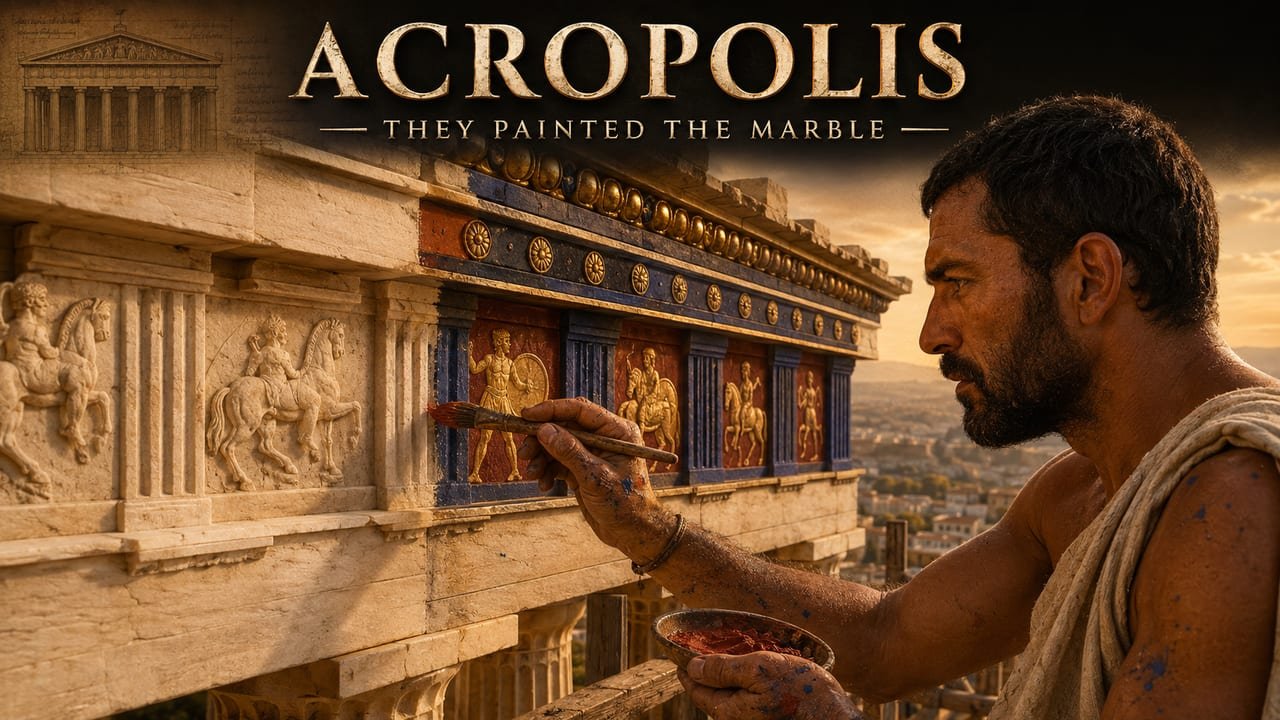
And that opens the next question: what did Homer’s own descendants build, once they climbed out of those dark centuries into the light? Next, Archmyst rebuilds the summit of that answer — the Acropolis of Athens, the world Homer’s heirs created. And it did not look the way you think. You’ll find it waiting on screen in a moment.