You’re Only Seeing the Skeleton
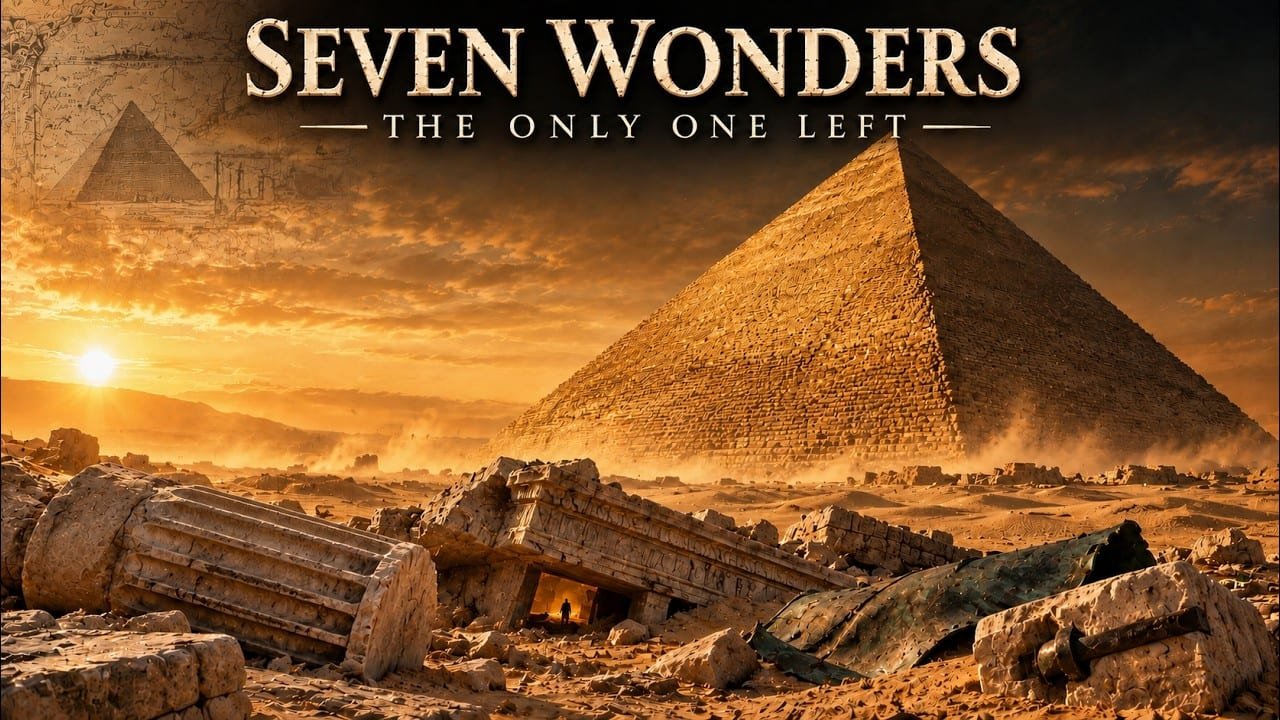
This is not the Great Pyramid. Not really. What you are looking at is its skeleton. The finished pyramid was smooth, and it was white — twenty-two acres of polished limestone throwing the desert sun back like a mirror. For nearly four thousand years, nothing human stood taller. This story comes down to three things almost nobody tells together: the builders who were not slaves — and who signed their work. The shining machine the pyramid was finished to be. And the day its white skin was carried away, stone by stone, to build another city.
The Builders Who Signed Their Work
Start with the builders, because we have met them. Just south of the pyramids, archaeologists uncovered an entire lost town — barracks, bakeries, breweries, granaries — a purpose-built city that fed thousands of workers on bread, beer, and startling quantities of meat. And beside it, something no one expected: the builders’ own cemetery. Modest tombs, in the shadow of the king’s, holding men whose bones show hard labor and healed injuries — workers who were treated, fed, and buried with honor beside the monument they raised. Slaves are not buried like that. The pyramid was built by Egyptians — farmers, bakers, boatmen, and skilled crews on the state’s payroll — and they were proud of it. Work gangs left their names painted on hidden blocks inside the monument itself. One crew called itself “the Friends of Khufu.” That is not the graffiti of the whip. That is a signature.
And then, in 2013, the desert gave up something even better than bones: paper. At a dried-out Red Sea harbor called Wadi al-Jarf, archaeologists found the oldest inscribed papyri ever discovered — the actual logbook of a man named Merer, a boat captain who worked on the Great Pyramid itself. Day by day, he records his crew ferrying white limestone blocks down canals from the quarries at Tura to the construction site at Giza. It reads less like myth and more like a delivery schedule. And that is the point. Strip away the mystery, and what remains is more impressive, not less: a bronze-age state running quarries, fleets, payrolls, and supply chains — four and a half thousand years ago.
Merer’s Logbook
But Egypt did not begin with the Great Pyramid. It had to learn how to build one — and you can still watch it learning, in stone. The first kings were buried under flat rectangular platforms of mud brick, called mastabas. Then, around 2650 BC, a royal architect named Imhotep did something without precedent: at Saqqara, he stacked six stone mastabas on top of each other, each smaller than the last, and made King Djoser a stairway to the sky — the Step Pyramid, the first monumental stone building we know of on Earth. The idea did not stop there. A later king, Sneferu, spent his reign debugging it. One of his pyramids began climbing at an angle so steep it strained, and its builders lost their nerve halfway up — they changed the slope mid-build, leaving it forever bent. We still call it the Bent Pyramid. So Sneferu built again, gentler, at a site nearby — and this time it worked: the Red Pyramid, the first true, smooth-sided pyramid in history. Trial. Error. Iteration. By the time Sneferu died, Egypt had quarried and moved more stone than any state before it — and his son inherited the finished playbook. His son’s name was Khufu.
Learning to Build a Mountain
Around 2560 BC, on the limestone plateau of Giza, Khufu’s workforce began the project that would hold the world record for height longer than any structure in human history. The numbers still read like a misprint. Roughly two point three million blocks of stone, averaging over two tons each. A footprint of thirteen acres, level to within a couple of centimeters. Four sides aligned to true north so precisely — within a fifteenth of a degree — that modern surveyors struggle to explain it without instruments we have no evidence they had. The original height: one hundred forty-six meters. And the likeliest total build time: about twenty years. Do the arithmetic and it stays uncomfortable — on average, a multi-ton block set in place every few minutes of every working day, for two decades.
How? Honestly: we do not know exactly — and you should distrust anyone who says otherwise. No plan survives; the builders left no manual. Perhaps, as one theory goes, the method was so obvious to them that writing it down never seemed necessary. But the evidence points somewhere reasonable. Ramps of rubble and mud, almost certainly — straight, wrapping, or internal, still debated. Sledges hauled over dampened sand, which cuts the friction almost in half — we have a tomb painting showing exactly that trick. Levers, rockers, and endless, disciplined manpower, organized into named crews with quotas and rations. No aliens. No lost super-civilization. Something rarer: an entire kingdom, pointed at a single square of desert for a generation.
And the interior tells you the builders were thinking like engineers, not just laborers. Climb into the monument and you pass through the Grand Gallery — a corbelled corridor eight meters high, rising through the masonry at the exact slope of the pyramid’s ascent, its walls stepping inward course by course with machine-like discipline. Above the King’s Chamber, they stacked five hidden compartments, roofed with granite beams of up to several dozen tons apiece, shipped eight hundred kilometers downriver from Aswan — a buffer engineered to shrug off the crushing weight of the mountain above. It worked; the chamber stands uncracked forty-five centuries later. And it is up there, in those sealed spaces no visitor was ever meant to enter, that the work gangs painted their names. The signature was hidden inside the machine — where only the gods, and much later the archaeologists, would ever read it.
The Great Pyramid by the Numbers
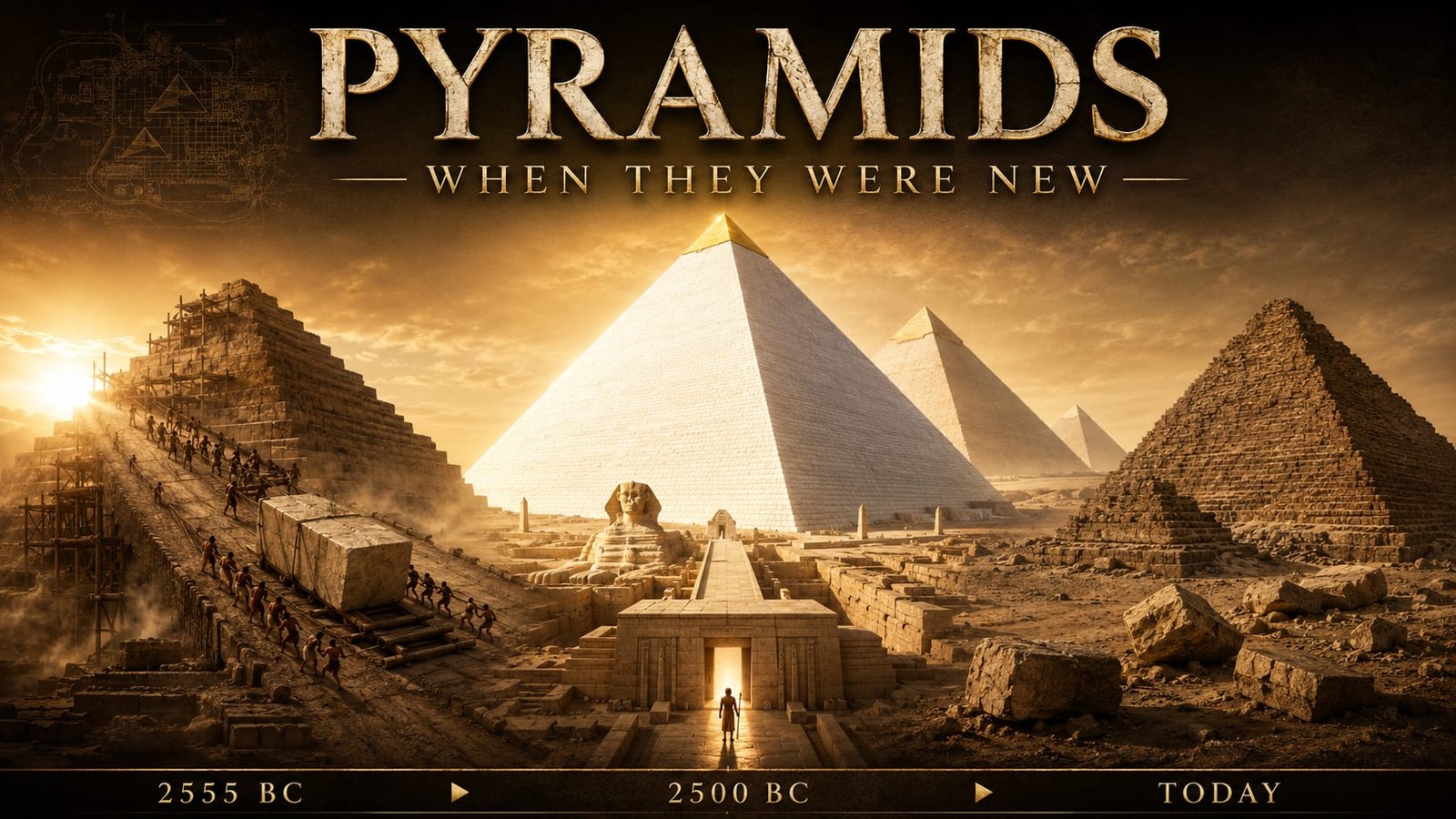
And what did all of that buy? Not the monument you know. The finished Great Pyramid was encased, base to tip, in blocks of fine white Tura limestone, ground and polished to a near-perfect plane. No steps. No ledges. A single, sheer, blinding surface — so reflective in the Egyptian sun that the monument would have been visible for many kilometers, a white blade of light standing on the horizon. At its summit, a capstone that texts suggest may have been sheathed in gold or electrum, catching the first and last sun of every day. The Egyptians named the Great Pyramid Akhet Khufu — the Horizon of Khufu. For once, the poetry was literal. Around it spread a whole machine of eternity: temples on the east, a stone causeway running down to the valley, boat pits holding full-size cedar ships for the king’s voyage among the stars, the queens’ pyramids, and streets of nobles’ tombs in neat rows — a city of the dead, laid out like a capital.
Because that is what a pyramid actually was: not a tombstone, but an engine. In Egyptian belief, the king who died was meant to rise — to join the sun’s voyage and the circling stars that never set — and the pyramid was the apparatus of that resurrection: part tomb, part launch ramp, part eternal lighthouse announcing that the king still reigned. And it did something for the living, too. To build it, Egypt had to invent better versions of itself — censuses, taxes, granaries, fleets, professional administration. The pyramid was the project that organized the state. Egypt built the pyramids — and the pyramids, in a very real sense, built Egypt.
The White Machine — What It Really Looked Like
In 1954, that voyage among the stars stopped being a metaphor. Digging along the Great Pyramid’s southern base, an Egyptian archaeologist uncovered a sealed pit roofed with massive limestone slabs — and inside it, dismantled into more than a thousand pieces, a full-size royal ship of Lebanese cedar, forty-three meters long, older than almost every other boat on Earth and still smelling, the excavators said, faintly of cedar. Reassembled over years, Khufu’s solar barque is complete enough to sail. A forty-five-century-old vessel, buried beside a mountain, waiting for a king to use it. If you want to know how seriously Egypt took eternity — there it is, with its oars still aboard.
The Engine of Eternity
Khufu’s son Khafre raised the second great pyramid beside his father’s — slightly smaller, but set on higher ground so it reads as taller — and near its causeway, a knoll of leftover limestone was carved into a lion with a king’s face: the Great Sphinx, guarding the horizon. Menkaure added the third pyramid, smaller but dressed at its base in costly granite hauled from Aswan. Together the three formed the skyline that would become humanity’s oldest icon. And then — quiet. The age of the giants ended within a century. Later kings built smaller, cheaper, faster; the great machine was never assembled at that scale again. Egypt itself moved on, and the pyramids began their second, stranger career: being ancient. The sand crept back. Within a thousand years, the Sphinx was buried to its neck — until a young prince, dozing in its shadow, dreamed the god beneath the sand promised him the throne if he dug it free. He did both: cleared the sand, and took the crown as Thutmose the Fourth, leaving the story carved on a granite slab between the Sphinx’s paws, where it still stands. Think about what that means: the pyramids were already so old that Egypt’s own kings were excavating them. By the time tourists from Greece came to stare, the pyramids had stood for two thousand years, and the truth was long gone. Herodotus was told tall tales — a hundred thousand men, driven for decades — and wrote them down, planting the seed of the slave myth that would outlive the facts by two millennia. And when Cleopatra ruled Egypt, the Great Pyramid was already more ancient to her than she is to us.
Becoming Ancient
The pyramids’ guardians could not protect them forever. The kings inside were robbed in antiquity, probably within centuries of burial. In 820 AD, the caliph al-Ma’mun’s men tunneled into the Great Pyramid hunting knowledge and treasure, and found the passages — largely empty. But the monument itself, the white mirror, still stood almost intact, nearly four thousand years old and still perfect enough to shine. What finally killed it was not an army. In 1303, a massive earthquake shook the casing loose — and the rulers of a booming medieval Cairo looked at the pyramids and saw the finest pre-cut quarry on Earth. For the next centuries, the white Tura casing was systematically stripped, carted across the river, and built into the walls, bridges, and mosques of the medieval city. It was not vandalism to them. It was recycling — the same pragmatism that had built the pyramids now un-building them, one barge of stone at a time. One sultan’s workmen even tried to demolish Menkaure’s pyramid outright in 1196. They worked for eight months, gouged a great vertical scar you can still see today — and gave up. The pyramid had beaten them. Removing the stones was proving nearly as expensive as placing them.
The Earthquake and the Quarry
Even stripped, the record held. The Great Pyramid remained the tallest structure on Earth until the spire of a medieval English cathedral finally passed it — around the year 1311. One building. A world record held for roughly thirty-eight hundred years. When Napoleon’s army marched into its shadow in 1798, he is said to have told his men that forty centuries looked down upon them — and for once, a general’s arithmetic was roughly right.
So look again at the skeleton on the plateau. The stepped, golden-brown pyramid of every postcard is the core masonry — the rough inner blocks the builders never meant you to see. The real surface survives only in fragments: a few casing stones still in place at the Great Pyramid’s base, fitted so tightly you cannot slide a blade between them — and a smooth pale cap still clinging to the peak of Khafre’s pyramid, the last patch of the original shine. The rest of the Great Pyramid’s skin did not vanish. It is still standing — scattered through the old city of Cairo, hiding in plain sight in walls and minarets. The pyramid did not disappear. It dissolved into the city that replaced its world.
What the Pyramids Really Were
And here is the question the comments always ask: could we build one today? With cranes and diesel — yes, though engineers who have costed it stopped smiling at the price. But that was never the hard part. The hard part was everything around the stone: feeding twenty thousand workers in a desert, running quarries and fleets and bakeries on schedule for twenty years, holding a whole society’s belief steady long enough to finish. The pyramid is not impressive because stone is heavy. It is impressive because organization is heavier.
And that is the entire history of the pyramids of Giza, compressed into a single arc. A civilization teaches itself to build a mountain — step by step, failure by failure. A workforce of free Egyptians raises the tallest structure the human race would know for thirty-eight hundred years, and signs its name inside. The finished machine shines white over the desert, promising a king eternity. And then time does what time does — earthquake, quarry, empire after empire — until only the skeleton remains, too massive to steal, too stubborn to fall. Of the Seven Wonders of the ancient world, six are gone. The oldest one is the only survivor. That is the final, quiet joke of Giza: the monument built for one man’s eternity ended up granting it to the builders instead — to the bakers and boatmen and stone gangs whose fingerprints, bones, and handwriting we are still finding in the sand.