It Was Never White
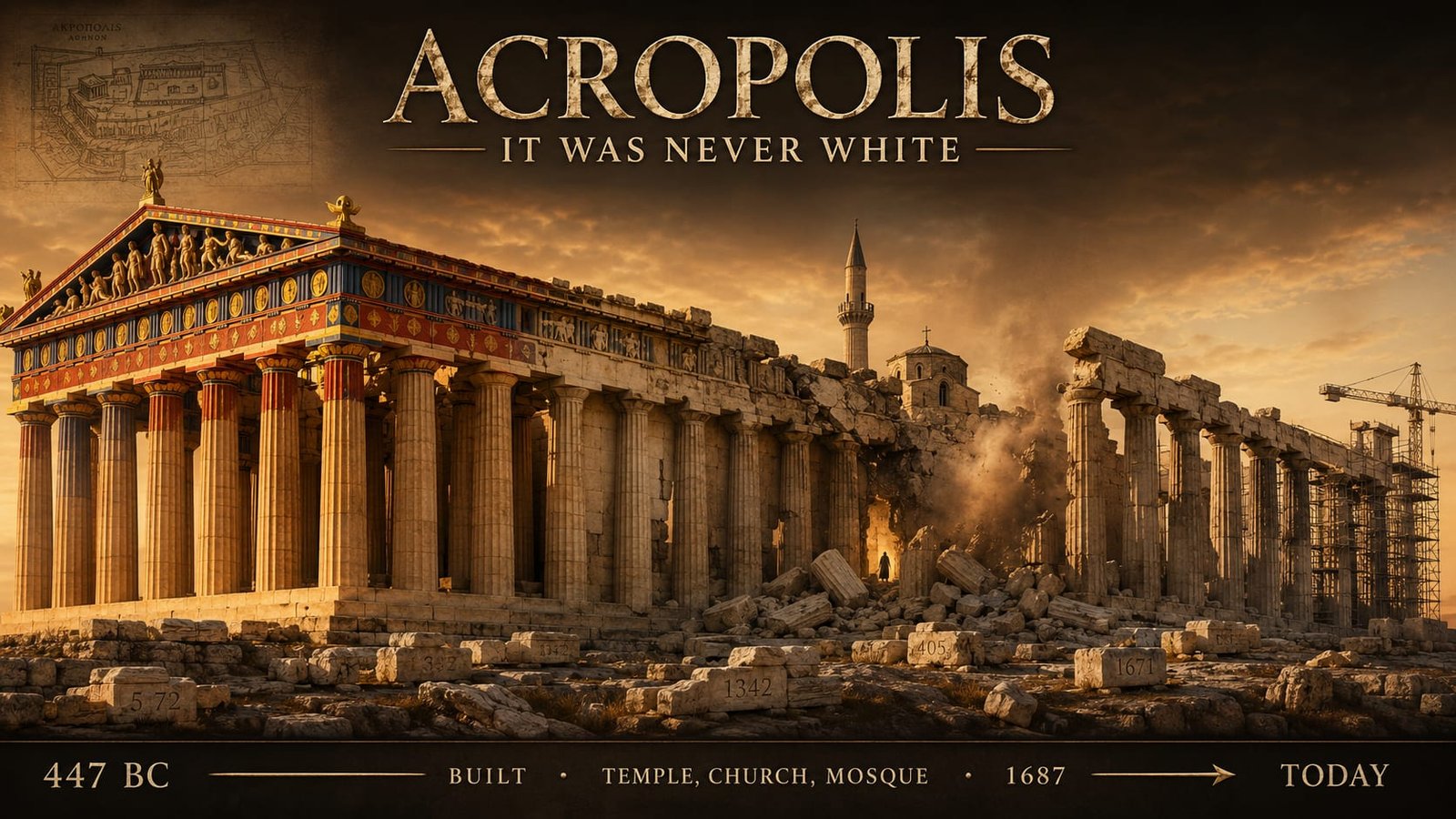
The Parthenon was never white. The bleached ruin on every postcard is not the building the Greeks knew. Theirs was painted — blue and red and gold — with a twelve-meter goddess of gold and ivory standing inside. It stayed almost intact for two thousand years — until one evening in 1687, a single artillery shell blew its heart out. This story comes down to three things: the trick hidden in the stone — a perfect building with almost no straight lines. The vote — a monument decided by ordinary citizens, its budget carved in stone for anyone to read. And the explosion that made the ruin.
The Building With No Straight Lines
Start with the trick, because once you see it, you cannot unsee it. Walk toward the Parthenon and your eye reports a building of perfect straight lines and right angles. Almost none of it is true. The temple’s floor is not flat — it swells upward at the center, a gentle dome disguised as a platform. The columns are not straight — each one bulges slightly at the middle, like a muscle under load, a refinement the Greeks called entasis. The columns do not stand vertical — they all lean inward, so subtly that if you extended them into the sky, they would meet more than a mile above the temple. The corner columns are thicker than the rest, because they stand against open sky, and the architects knew bright light eats at an edge. Why go to such lengths? Because a truly straight building does not look straight. Long horizontal lines appear to sag; uniform columns look thin and lifeless. So the architects bent everything, by centimeters, to defeat the eye’s own errors. There is barely a straight line in the building — which is precisely why it looks perfect. The Parthenon is not geometry. It is geometry corrected for human beings.
The Colors of the Parthenon
And over that corrected geometry went color. Traces survive — in protected corners, under raking light, in pigment ghosts modern imaging can still detect: Egyptian blue, reds, greens, gold leaf on carved details. The sculptures in the pediments were painted like theater; the friezes ran with color against dark backgrounds so they could be read from the ground, far below. To classical eyes, bare white marble meant unfinished. The pale, austere Parthenon we admire is an accident of weathering — and, in truth, a two-thousand-year misunderstanding that shaped all of Western taste. When Renaissance and Enlightenment architects copied “the noble simplicity” of white Greek temples, they were copying a ruin that had lost its clothes.
The Rock Kept as a Wound
But to understand why this building exists at all, you have to stand on the rock when it was covered in ashes. The Acropolis — the “high city” — had been sacred ground for a thousand years before the Parthenon: first a Bronze Age citadel with cyclopean walls, home of Mycenaean kings; then a sanctuary crowded with temples and statues. The Athenians told a story about why the rock mattered. Two gods had competed for the city’s devotion: Poseidon struck the summit with his trident and gave a spring of seawater — power, navies, the sea. Athena touched the rock and gave an olive tree — oil, food, light, peace. The city chose the olive, took her name, and kept the sacred tree on the summit ever after. It is only a myth. But notice what the myth says about them: offered raw power, this city liked to believe it had chosen the useful and the wise. That self-image — earned or not — is the key to everything they built up there. In 480 BC, the Persian army of Xerxes took Athens and burned all of it. The temples, the offerings, an earlier great temple to Athena still under construction — everything on the summit, wrecked and blackened. Even the sacred olive burned. And then, Herodotus reports, the Athenians who climbed back up found something on the charred stump: a fresh green shoot, a cubit long, grown — they swore — in a single day. Believe it or not as you like; they believed it, and it told them what to do next. The Athenians came home to a scorched rock. And they did something strange: for about thirty years, they built almost nothing up there. They gathered the broken statues and burned column drums and buried them, with care, in pits on the summit — where archaeologists would find them twenty-four centuries later, paint still clinging to the marble. Some ruined column drums they built, visibly, into the Acropolis wall itself — facing the city, where every Athenian could look up and see them. The rock was kept as a wound. Remember what they did to us.
The Vote — Democracy Builds
What changed everything was victory — and money. Athens emerged from the Persian wars leading a naval alliance of Greek cities, the Delian League, funded by member contributions to keep the Persians away. Over time, the alliance hardened into something more like an empire, and its treasury moved to Athens. And in the 440s BC, the citizens’ assembly — thousands of ordinary Athenians voting in the open air, farmers and potters and oarsmen — approved the most ambitious building program the Greek world had ever seen. Not a king’s decree. An agenda item. The champion of the program was Pericles — and mind the title, because Athenians would correct you sharply: Pericles was not a ruler. He held no throne; he was a strategos, an elected general, re-elected year after year because he kept winning the argument. His opponents said the plan dressed Athens “like a vain woman, hung with precious stones” — and said it with someone else’s money. The assembly voted anyway. Democracy, it turns out, can be as hungry for glory as any king.
One Block’s Journey
What the vote bought still astonishes. On the summit rose the Parthenon — begun 447 BC, structurally complete in nine years, a speed modern engineers marvel at — under the architects Iktinos and Kallikrates, with the sculptor Phidias directing the art. Follow one block to see what those nine years took. It is cut at Mount Pentelikon, sixteen kilometers away, from marble so fine it glows faintly amber at sunset. It slides down the mountain on greased skids, crosses the plain on ox-drawn carts, and is hauled up the one ramp onto a fortified rock. There, masons dress its joints to a tolerance so fine that many blocks meet with barely a visible seam — no mortar anywhere, just stone on stone, pinned with iron set in lead. Cranes, pulleys, compound tackle — machines the Greeks had been perfecting for a century — swing it into place. Twenty-two thousand tons of marble moved like this, block by block, while the same city fought wars, staged festivals, and ran an empire. Inside stood Phidias’ Athena Parthenos: twelve meters of ivory skin and gold drapery — over a ton of gold, deliberately removable, because the statue doubled as the city’s bullion reserve. The goddess was also the bank. And here is the detail that makes the Acropolis unlike every pharaoh’s monument before it: the accounts were public. The building commissions inscribed their expenses on stone slabs set up for anyone to read — quarrying, hauling, sculptors’ wages. Surviving fragments of the Erechtheion accounts show citizens, resident foreigners, and slaves working side by side, and among the free workers, the same daily wage — one drachma — whether you were a citizen or not. The gateway alone, the Propylaea, consumed a fortune; the little temple of Athena Nike balanced on a bastion; and the Erechtheion raised its porch of six marble maidens — the Caryatids — carrying the roof on their heads with perfect calm. Athens put its empire’s money where every citizen, and every subject ally, could see it: overhead, in marble, in color.
The Frieze — Citizens in Marble
And wrapped around the Parthenon’s inner chamber, high in the shadows of the colonnade, ran a frieze — one hundred sixty meters of low relief, showing not gods at war, not kings in triumph, but what most scholars read as the city’s own great procession: the Panathenaic festival. Riders wheeling, musicians, elders, girls carrying vessels, sacrificial cattle — Athenians, on their own temple. If that reading is right, it may be the first time in history that ordinary citizens carved themselves onto a monument of this rank — the space every earlier empire reserved for pharaohs and god-kings, given to the traffic of a civic parade. The building’s message, top to bottom, was the same message as the assembly that voted for it: we did this. Below the rock, the city’s civic machinery hummed in stone as well — the open-air Theatre of Dionysus on the southern slope, where drama itself was born at festival competitions, and beside it, later, a very different hall: the Odeon, a covered concert building bristling with a forest-like roof. One open to the sky, one roofed — remember the difference; the two have been confused for centuries.
Temple, Church, Mosque
For the next two thousand years, the Parthenon did what almost no ancient building managed: it survived — by never being allowed to die. When the old gods fell, it became a church of the Virgin Mary, and the Christians cut a door and an apse but kept the building. When the Ottomans took Athens in the fifteenth century, it became a mosque, and a minaret rose at one corner — but the building stood. It was a temple for nine centuries, a church for nearly a thousand years, a mosque for two more centuries. Adaptation, not preservation, is what carried it across millennia. By the 1680s it had lost its roofline to one fire and gained whitewash and prayer niches — but it was still, recognizably, Iktinos’ building. Almost intact. Almost.
1687 — The Explosion
Then came the evening of September 26th, 1687. A Venetian army was besieging Ottoman Athens, and the defenders had turned the Acropolis into a fortress — storing their gunpowder inside the Parthenon, betting that no Christian army would fire on a famous church-that-was. The bet failed. A mortar round, arcing over the walls, dropped through the roof — into the magazine. The explosion tore the building open from the inside: the roof gone, the long walls thrown down, columns flung outward, the colonnades gutted, hundreds killed in the fires that followed. Twenty-one centuries of continuous survival, undone between one shell and the next. And the insult was not finished. The Venetian commander, Morosini, took the fortress — and decided to carry off the west pediment’s central sculptures, Athena and Poseidon’s horses, as trophies for Venice. His men rigged tackle to lower the figures; the tackle failed; and statues that had survived the blast itself fell to the rock and shattered. Then the Venetians, unable to hold Athens, simply left. The building had been destroyed for a war that changed nothing. The perfect building did not decay into the ruin we know. It was detonated — in a war between two empires, over a city that had built it under a third.
Scattered and Disputed
The wound kept giving. In the early 1800s, with Athens still Ottoman, the British ambassador Lord Elgin had roughly half of the surviving sculptures — pediment figures, metopes, long runs of the frieze — cut down and shipped to Britain, under a permission whose scope is disputed to this day. They stand now in the British Museum; Greece has asked for them back for two centuries, and built a museum at the foot of the rock with an empty gallery waiting, aligned to the Parthenon itself, visible through glass. Whatever your verdict, the fact is stark: the body of the building is in Athens, and much of its art is seven hundred miles away — a monument split between two nations, arguing about what “saving” means.
Healing the Ruin
And yet the rock’s story bends upward at the end. Greece won its independence in the 1830s, and the Acropolis was demilitarized for the first time in three thousand years — minaret down, barracks out, the summit handed to archaeology. Since 1975, one of the most painstaking restoration projects on Earth has been quietly rebuilding what can honestly be rebuilt: every salvaged fragment catalogued and matched; new marble cut from the same ancient quarries on Pentelikon, left visibly paler so no one is deceived; corroded old iron clamps — which were splitting the stones from within — replaced with titanium. The restorers even correct the errors of earlier restorers. It is slower than building the Parthenon took in the first place. That is not failure. That is reverence, measured in decades.
What the Acropolis Really Teaches
So look up at the high city one last time, and put the three stories together. A building with no straight lines, bent everywhere so that human eyes would finally see something true. A monument no god and no king commanded — voted into existence by an assembly of ordinary citizens who published the receipts, built by free men and slaves earning the same wage, crowned with a goddess who was also the treasury. And a survivor that outlived its own religion twice, only to be blown apart guarding someone else’s gunpowder — then scattered, disputed, and stitched back together, fragment by fragment, by people who will not live to see it finished. The Parthenon has been called the perfect building. But the Acropolis teaches something better than perfection: buildings live exactly as long as people keep arguing about them, praying in them, fighting over them — and, in the end, healing them. Perfection was never the point. The argument was. It still is.