A city preserved while still alive
Almost everything we know about Roman cities comes from places that kept going. Rome itself was rebuilt continuously for two thousand years, and each rebuild destroyed the layer beneath it. The ordinary fabric — shop counters, graffiti, furniture, the layout of a modest house — was lost to success, not to catastrophe.
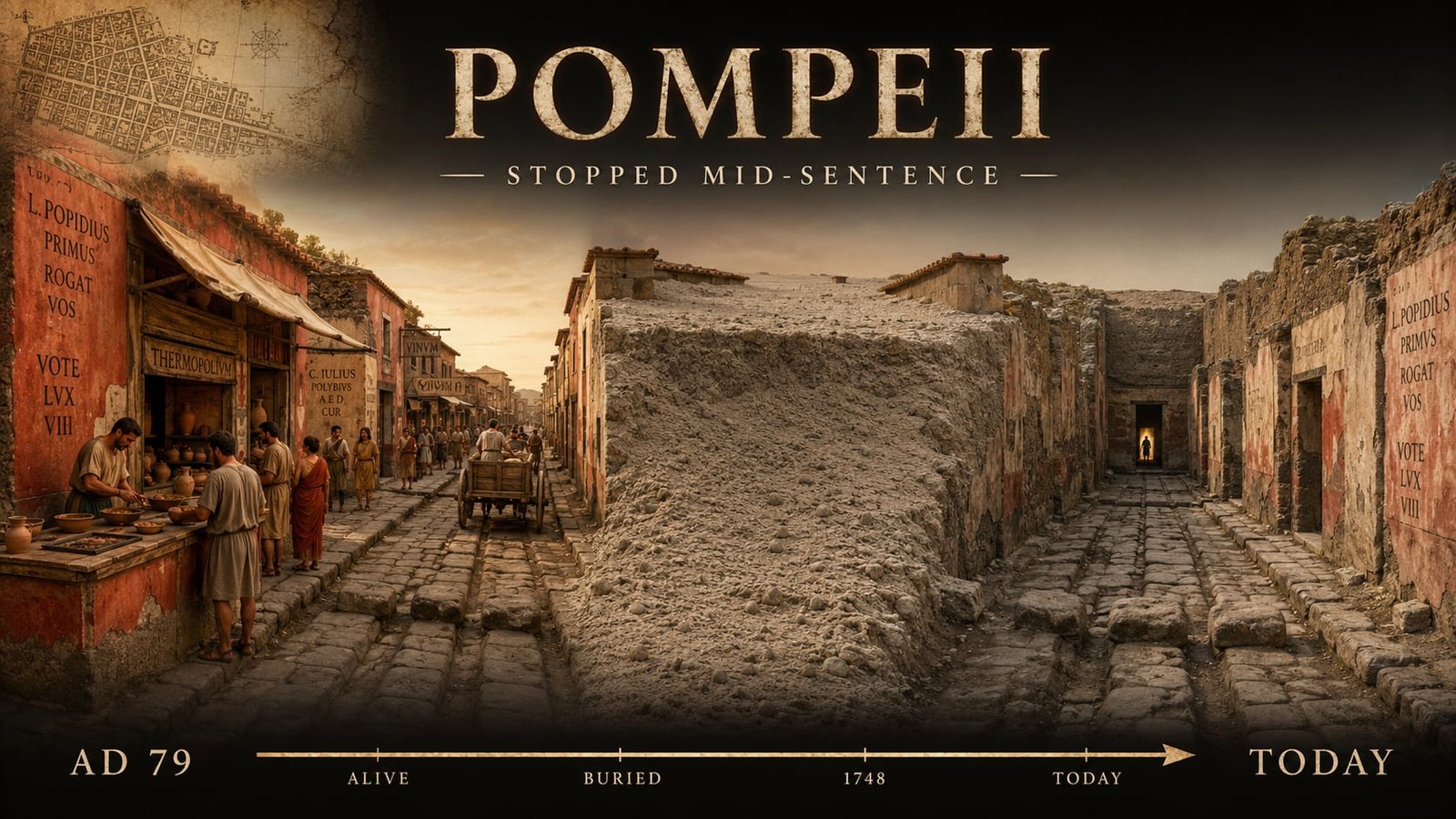
Pompeii is the exception, and it is the exception for an uncomfortable reason. It was sealed under four to six metres of pumice and ash in AD 79 while still fully in use, and then left alone until 1748.
What that preserved is not treasure. It is the ordinary, which is exactly the thing no other site can give us.
Walls that could talk
Start with the outsides of buildings, because that is where the surprise is.
Pompeii’s street façades carry painted notices: election slogans supporting particular candidates, advertisements, announcements of games, and casual scratched graffiti. They survive because they were buried within a season or two of being painted.
The result is that we know the local politics of a small Roman town — who was standing, who endorsed them, which trade associations backed which candidate — at a resolution that exists nowhere else in the Roman world.
The street was the first room
Roman streets in Pompeii did double duty as drainage and, at times, as open sewers. The solution was the raised stepping stone: blocks set into the roadway high enough to keep a pedestrian out of the flow, with gaps sized to let cart axles pass between them.
Ruts worn into the paving show where the traffic actually went. Kerbs, crossings and the positions of fountains map the pedestrian city as clearly as a modern survey would.
Shopfronts opened directly onto this. Counters faced the street with sunken jars set into them, serving food and drink to people who, in most cases, had no kitchen at home.
The house that unfolds
An elite Pompeian house does something that looks wrong to modern eyes: it presents a plain, often near-blank wall to the street.
The display is all interior, and it is sequenced. You enter through a narrow passage, arrive in the atrium with its opening to the sky and its pool below, and see through the axis of the house to the garden at the back. Reception rooms open off that spine. A visitor was moved along it, and how far along it they were admitted was the message.
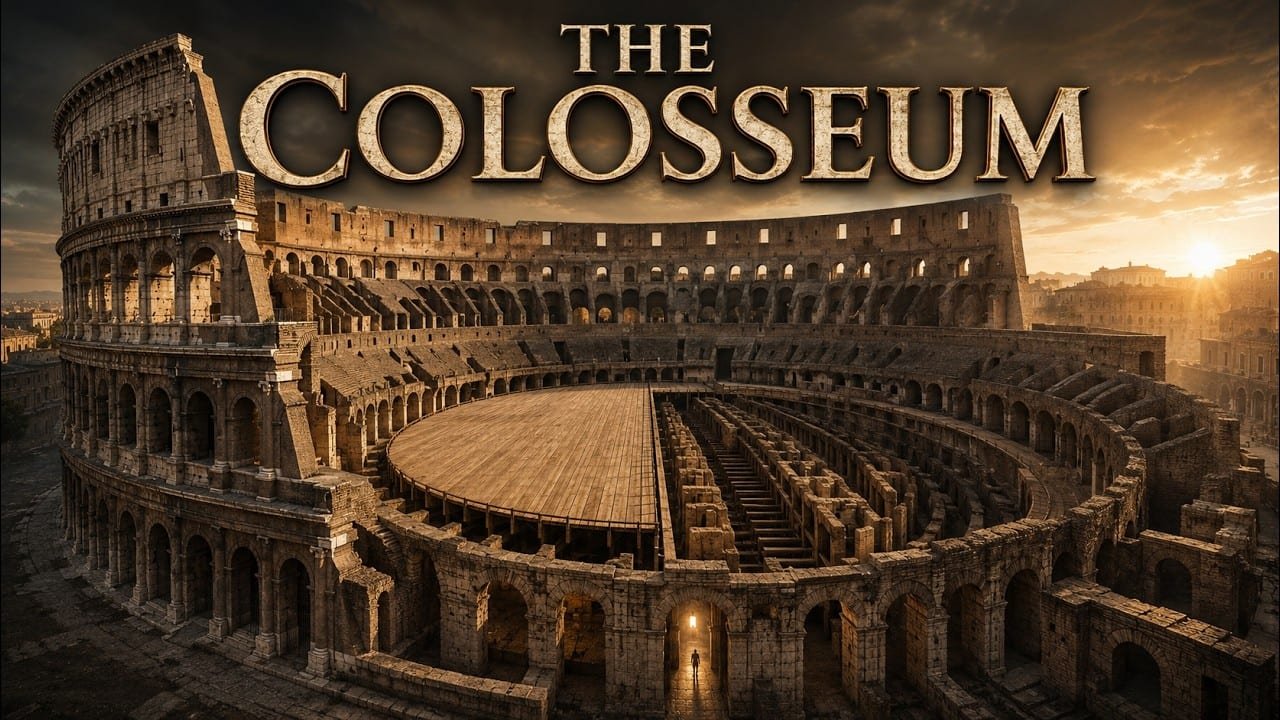
This is architecture as social sorting, on a domestic scale — the same instinct that built the Colosseum’s eighty numbered entrances, applied to a dinner invitation.
When Vesuvius returned
The eruption is described by Pliny the Younger, who watched from across the bay and whose uncle died in it. His letters are the reason we call this type of eruption Plinian.
The traditional date is 24 August. A charcoal graffito uncovered in 2018 records a date in mid-October, which fits other evidence — autumn fruit, heavier clothing, sealed wine — and the autumn dating is now widely preferred. The manuscripts of Pliny are the counter-argument, and manuscripts are copied by hand for centuries.
What the casts actually are
The figures visitors think of as bodies are not bodies. Bodies decayed inside the compacted ash, leaving voids in the exact shape of the person at the moment the ash set around them.
Giuseppe Fiorelli, working from the 1860s, realised those voids could be filled with plaster and then excavated as casts. What we are looking at is a mould made by a corpse, poured eighteen centuries later.
It is worth being precise about that, because the casts are the single most emotionally powerful thing on the site and the mechanism behind them is routinely misdescribed.
Why “ordinary” is the point
Excavation at Pompeii is deliberately unfinished. Roughly a third of the site remains buried, and current policy is to keep it that way — because the moment a wall is uncovered, its decay clock starts, and no conservation regime yet devised stops it.
That is an unusual position for an archaeological site to take, and it is the right one. The value of Pompeii is not in getting all of it out of the ground. It is in the fact that somewhere under that ash, a Roman town is still sealed.