Most ancient buildings survive as suggestions
A broken foundation. A column stump. A scatter of stone, and the rest left to archaeologists, museum labels and your imagination.
Roman arches do not ask you to imagine much. Some still span rivers. Some still cut through cities. Some still hold up the logic that made them work two thousand years ago.
Pont du Gard. Segovia. The Colosseum. The Pantheon. They do not suggest Roman engineering — they demonstrate it. Which raises the only question worth asking about them: why are they still standing?
The short answer is that Rome found a way to make gravity help.
The problem: stone hates being stretched
Stone is strong, but only in one direction.
Pile weight on top of stone and it takes it. Stretch stone across an opening and it eventually fails, because the underside is being pulled apart, and stone is weak in tension in a way it is never weak in compression.
For centuries builders worked around that. More columns. Narrower openings. Thicker walls. Horizontal beams up to a point — and that point set a hard ceiling on what a building could become. A Greek temple is a forest of columns because the beam’s limit put them there.
What the arch actually does
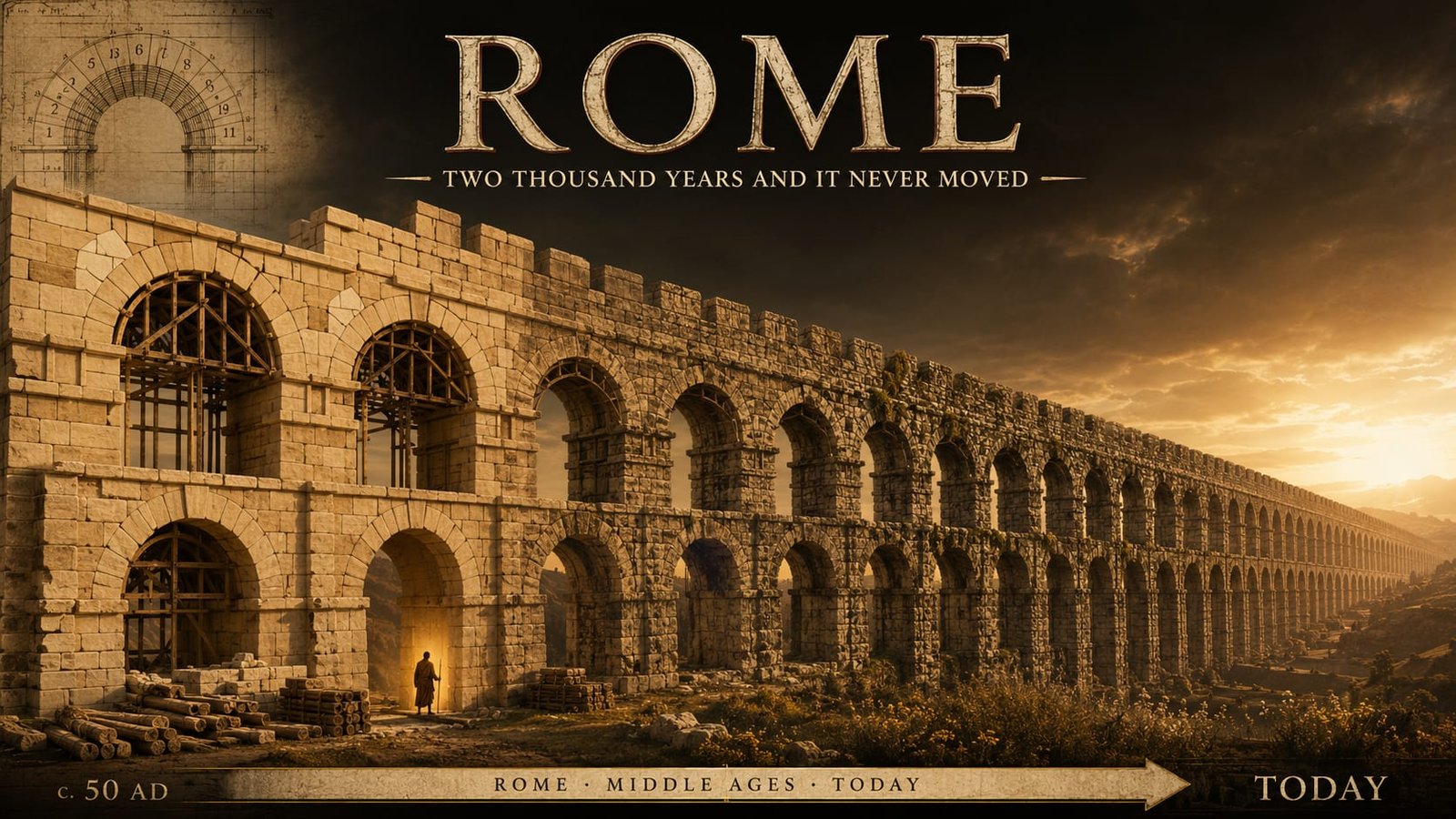
Instead of one long beam doing all the work, an arch uses many small wedge-shaped stones — voussoirs — each pressing into the next.
When weight pushes down, nothing tries to snap in the middle. The force travels around the curve and out into the supports. The harder the load pushes, the more tightly the stones lock together.
That is the first reason these structures are still here: the arch takes gravity and makes it work for the structure rather than against it.
There is a condition attached, and it is the thing that kills badly built arches. The curve pushes outward as well as down, so the supports have to resist that thrust. Weak foundations and the arch spreads and fails. Strong supports and the system becomes remarkably stable.
One more consequence worth naming: an arch does not exist until it is finished. Until the last voussoir is seated, the ring cannot carry itself, so the whole curve sits on a temporary timber framework — the centring. Roman arch building is as much a carpentry problem as a masonry one, and the carpentry is the part that has not survived.
Rome did not invent it — Rome repeated it
Earlier builders in the ancient world used arch forms. Rome’s achievement was different in kind.
The Romans made the arch ordinary enough to repeat, strong enough to trust, and ambitious enough to scale across an empire. That sounds like a modest technical note and it changed the question architecture was asking.
No longer: how wide can this beam go before it fails?
Now: how much weight can this curve organise, and what can we build once it does?
That is a different kind of confidence, and Rome did not stop at a single opening in a wall. Stretch an arch backward and you get a barrel vault. Repeat arches in a line and you get an arcade. Cross vaults and you can cover enormous interiors. Carry the logic as far as it goes and you arrive at a dome.
Opus caementicium — the lime-and-volcanic-ash concrete — is what made that repetition affordable. A cut-stone vault needs skilled masons shaping every voussoir. A cast concrete vault needs a timber form, rubble, and labour you can train. One is a commission; the other is a programme.
This is the moment Roman architecture stops being a collection of buildings and becomes a system.
A warning about how we see it, though. Ancient Rome was not a spotless white marble fantasy. Buildings were painted, plastered, repaired, smoked, crowded and weathered by use. What survives is quieter and cleaner than the world that built it. For the Romans the arch was useful long before it was symbolic — it was infrastructure, a way of organising water, movement, crowds and space.
Aqueducts: the clearest case
Over roughly five hundred years, eleven aqueducts were built to bring water into Rome, from sources as far as 92 kilometres away. Most of that network ran underground or close to the ground. The arches appear exactly where engineers had to cross a valley while holding a precise gravity-fed line across broken terrain.
Which is why the Pont du Gard is extraordinary, and not simply because it is old. It is extraordinary because it still makes the engineering visible.
Three levels of arches. A structure shaped around the flood behaviour of the Gardon. Stone organised so precisely that positioning marks are still legible on some of the voussoirs.
The aqueduct it carried ran about 50 kilometres from Uzès to Nîmes and moved somewhere around 30,000 to 40,000 cubic metres of water a day. The bridge rises almost 49 metres above the river.
It is not a decorative fantasy. It is a machine for controlling force, slope and water across hostile ground — and the job was unforgiving, because the bridge had to preserve a tiny gradient across a long route so the water kept moving by gravity and arrived where it was needed.
Its beauty is not separate from its usefulness. Its beauty is the usefulness made visible.
And the siting is part of the engineering, not a backdrop. The lower principal arch is wider to help move floodwater, and the projecting fronts of the piers deal with high water. Roman engineers were not only asking can this stand? They were asking can this stand here? — which is a much harder question, because a bridge over a river does not live in abstraction. It lives in current, pressure, erosion, weather and time.
Segovia: the one that kept working
Segovia tells the same story in a sharper register. Its Roman aqueduct crosses the city in two superimposed rows of arches, running 813 metres and rising to about 28.5 metres at its highest point. It carried water to the city for centuries — and remained in use into the last third of the twentieth century.
That distinction matters more than it first appears.
A ruin can survive because nobody touches it. A working structure survives because it keeps justifying itself.
Which is why Segovia feels almost unsettlingly alive. It does not stand outside the city like a dead monument. It still cuts through the urban fabric as though Roman engineering never entirely left.
The Colosseum: arch logic becomes a building
This is where the technique stops being a bridge solution and becomes an entire building system.
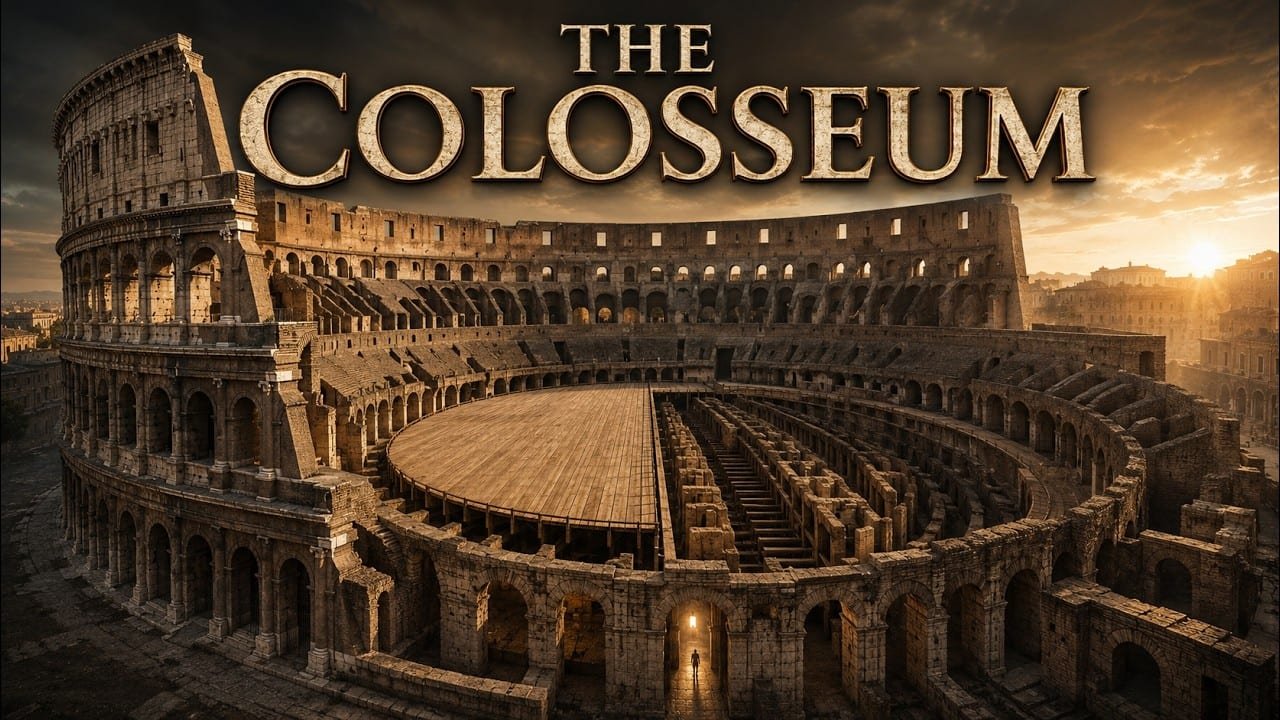
The Colosseum held around 50,000 spectators and — unlike many earlier amphitheatres — did not lean on a hillside for support. It rises from flat ground on a dense internal network of barrel and groin vaults. Those repeated external arcades are not decoration pasted onto a solid mass. They are the structural system, made visible, repeated across a whole building.
That is why it still feels modern. Not modern in style — modern in clarity. You can almost trace where the weight is going by looking at it.
But its real achievement is not that it stood up. It is that it organised people. The same structural logic that made big spaces possible also made circulation possible: entrances, exits, corridors, stairs, seating tiers, vaults and outer arcades working as one controlled environment for an enormous crowd.
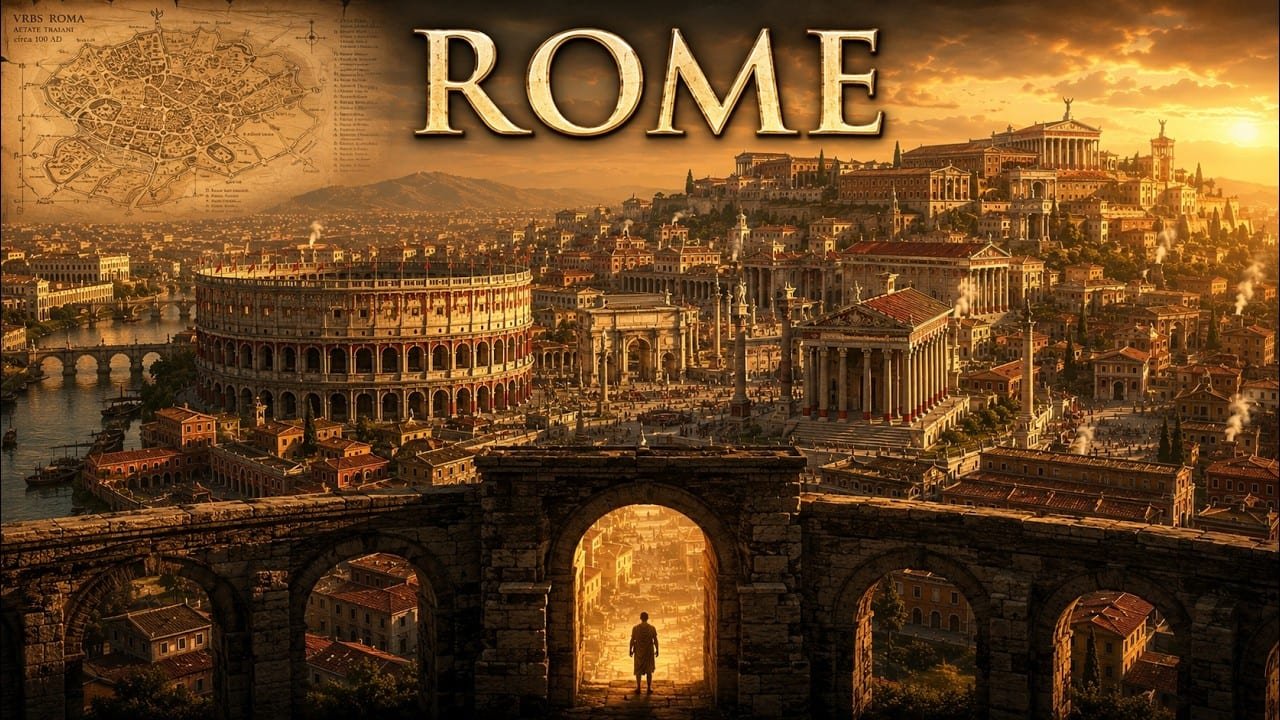
The arch did not only help Rome build bigger. It helped Rome build smarter — and once you look at Roman architecture that way, you stop seeing isolated monuments and start seeing a civilisation that had learned to turn structure into administration. Water moved. Crowds managed. Roads crossed. Public space enlarged. Cities made to feel ordered.
That is when the arch stops being a detail and becomes part of empire.
The Pantheon: the arch carried into a circle
The dome can feel like a separate idea. It is really the arch rotated.
What makes the Pantheon remarkable is not only the curve but the mass behind it: a drum wall more than six metres thick, with geometry, mass and material working together. Nearly two thousand years on, it still holds the largest unreinforced dome ever built, at 43.3 metres in diameter.
It also shows something else about Roman thinking. The Romans used arch logic to produce emotional effect, not just to solve problems. Standing inside the Pantheon, the building feels impossible first and rational second — scale, height, oculus, the mass overhead — awe arriving before understanding.
But the awe exists because the logic is sound. The engineering is not hidden behind the effect. The engineering is the effect.
Why some survived and most did not
If the shape alone were enough, every Roman arch would still be standing. They are not.
Some collapsed in earthquakes. Some were dismantled. Some were quarried for stone. Some simply lacked the historical luck survival demands. The Colosseum was badly damaged by earthquakes and then treated as a quarry for centuries. The Pont du Gard lost stones and needed later repairs. Countless Roman bridges and vaults disappeared entirely.
So the interesting question is not why the arch worked. It is why these ones lasted two millennia. The answer is more interesting than genius.
Geometry matters, but geometry alone does not carry a monument through flood, war, neglect and reuse. Material matters — cut masonry with mortar and, in the most ambitious work, concrete. Site matters, as the Pont du Gard’s flood-shaped lower arch shows. Precision matters, because force has to keep flowing cleanly from one stone to the next, which makes the cut, fit and placement of every voussoir load-bearing in the literal sense. At Pont du Gard and Segovia you are not just seeing old stone; you are seeing organised accuracy, still legible.
And then the least glamorous reason of all: use.
Some Roman structures survived because later societies kept finding reasons not to erase them. The Pantheon stayed in continuous use and became a church. Bridges stayed useful routes. Aqueduct lines stayed valuable. Even a monument as damaged as the Colosseum was eventually protected because it had become too symbolically powerful to lose.
This is one of the most important truths in architectural survival, and it is not a technical one. Buildings do not survive on engineering alone. They survive on engineering plus relevance. A structure that stays meaningful gets repaired. One that stays useful gets defended. One that becomes symbolic gets protected even when practical logic would not have saved it.
Surviving twice
Even after the Roman world fragmented, the round Roman arch kept echoing. Romanesque builders inherited it. Renaissance architects went back to the surviving monuments and studied them to recover the logic.
Most building technologies rise, dominate, and disappear into history. Roman arch logic stayed visible enough, persuasive enough and adaptable enough that later builders kept learning from it.
Which means Roman arches survived twice: first as engineering, then as influence. They stayed in the landscape and they stayed in the imagination.
And perhaps that is the deepest reason they still stand — they still explain themselves. The load gathers. The stones press together. The supports take the thrust. The ground receives the force. Nothing is hidden.
They are not relics. They are legible decisions. Which makes Rome look less like a city of ruins and more like a city of surviving strategies — and suggests the real lesson is not that ancient builders were magically better than everyone else, but that durability is never accidental. It is designed, tested, and maintained.