An island, and a bishop’s decision
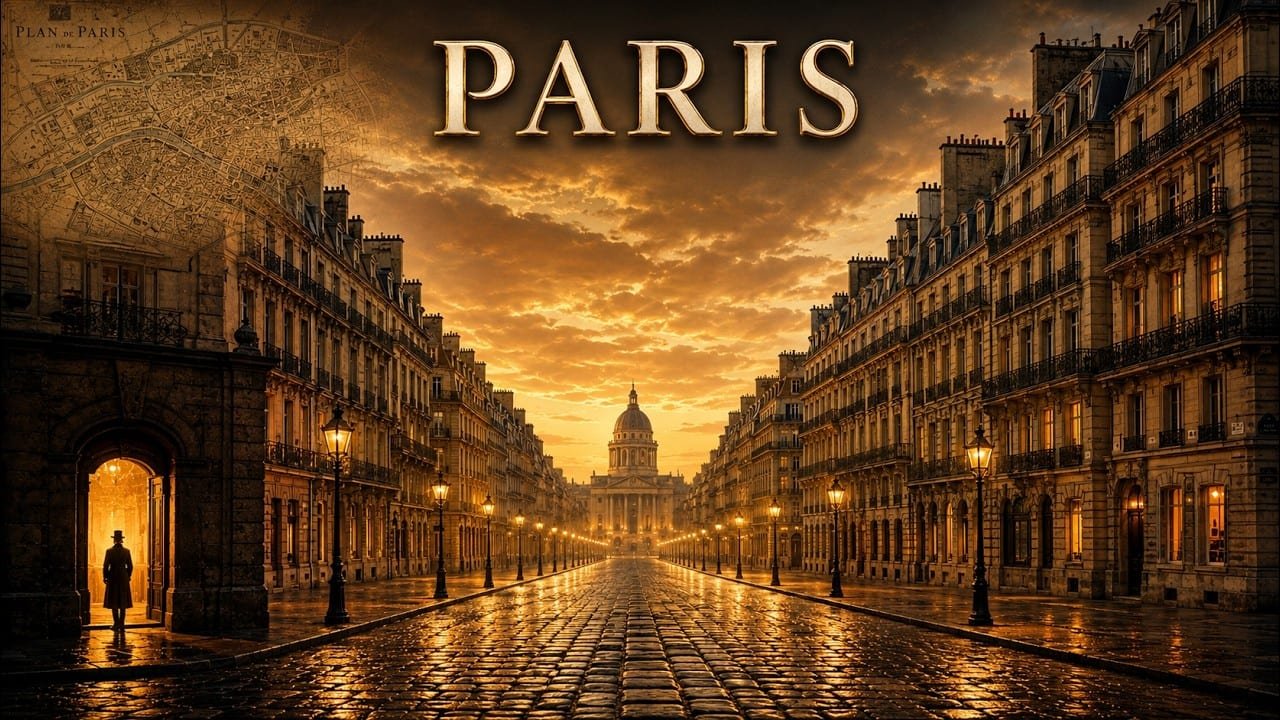
Notre-Dame does not simply stand in Paris. It sits on the Île de la Cité, the island in the Seine where the city started, and everything else grew around it. That position is why the cathedral has spent eight centuries as the place where France holds its ceremonies, whatever France happens to be at the time.
Construction began in 1163 under Bishop Maurice de Sully. The work ran on into the middle of the fourteenth century. Nobody who laid the first stones saw the building finished, and everybody involved knew that when they started. A cathedral at this scale was not a project with a completion date; it was an institution that employed masons for as long as the money held out.
How stone was taught to carry light
The Gothic argument is structural, and it is easy to state and hard to execute.
A round arch pushes outward as well as down, so a Romanesque church needs thick walls and small windows to resist that push. A pointed arch directs more of the load downward. Ribbed vaults concentrate what remains into identifiable points rather than spreading it along the whole wall. Flying buttresses then catch that concentrated thrust outside the building and walk it down to the ground.
Do all three and the wall stops being structural. It is no longer holding the roof up, so it can be opened. That is the whole point of the exercise — the engineering exists to make the glass possible, not the other way round. The rose windows are the visible payoff of an invisible argument about where forces go.
A national stage
In 1804 Napoleon was crowned emperor at Notre-Dame rather than at Reims, where French kings had traditionally been consecrated. The choice was the message: a new regime, in the capital, not a continuation of the old order in its ancestral cathedral.
By then the building was in poor condition. The Revolution had treated it badly — stripped, repurposed, its sculpture attacked. What saved it was not a preservation policy but a novel. Victor Hugo published Notre-Dame de Paris in 1831 partly as a campaign document, and the campaign worked: public sentiment moved, and a restoration was commissioned.
Viollet-le-Duc rebuilds the past
Eugène Viollet-le-Duc led that restoration from 1844. His approach was not conservation as we would now define it. He restored buildings towards what he judged they should have been — a complete and coherent state that may never have actually existed.
The most consequential result stood over the crossing until 2019. Notre-Dame’s medieval spire had been removed at the end of the eighteenth century. The spire the world watched collapse on live television was Viollet-le-Duc’s, finished in the 1860s. It was around 150 years old, not 700.
This matters for reading the building generally. A great deal of what visitors take to be medieval Notre-Dame is nineteenth-century Notre-Dame, executed in a medieval idiom by a brilliant and confident architect who was not always distinguishing between the two — and did not think he needed to.
15 April 2019
The fire took the spire and the roof. What burned above the vaults was the timber frame known as la forêt, the forest: a lattice of oak, a large proportion of it thirteenth century. Roughly a thousand oaks’ worth of medieval carpentry, almost none of it ever seen by anyone but workmen.
The stone vaults underneath mostly held, which is why the interior survived. That is the same structural logic doing its job under conditions its designers never anticipated.
France decided to rebuild roof and spire as they had stood immediately before the fire — that is, to rebuild Viollet-le-Duc — rather than run an open competition for a contemporary replacement. The cathedral reopened in December 2024.
The work was done in oak, hand-hewn, using the medieval framing approach. That produced its own discovery: much of what the thirteenth-century carpenters knew about selecting, cutting and seasoning structural oak had to be reassembled from the surviving timbers themselves, because none of it was ever written down.