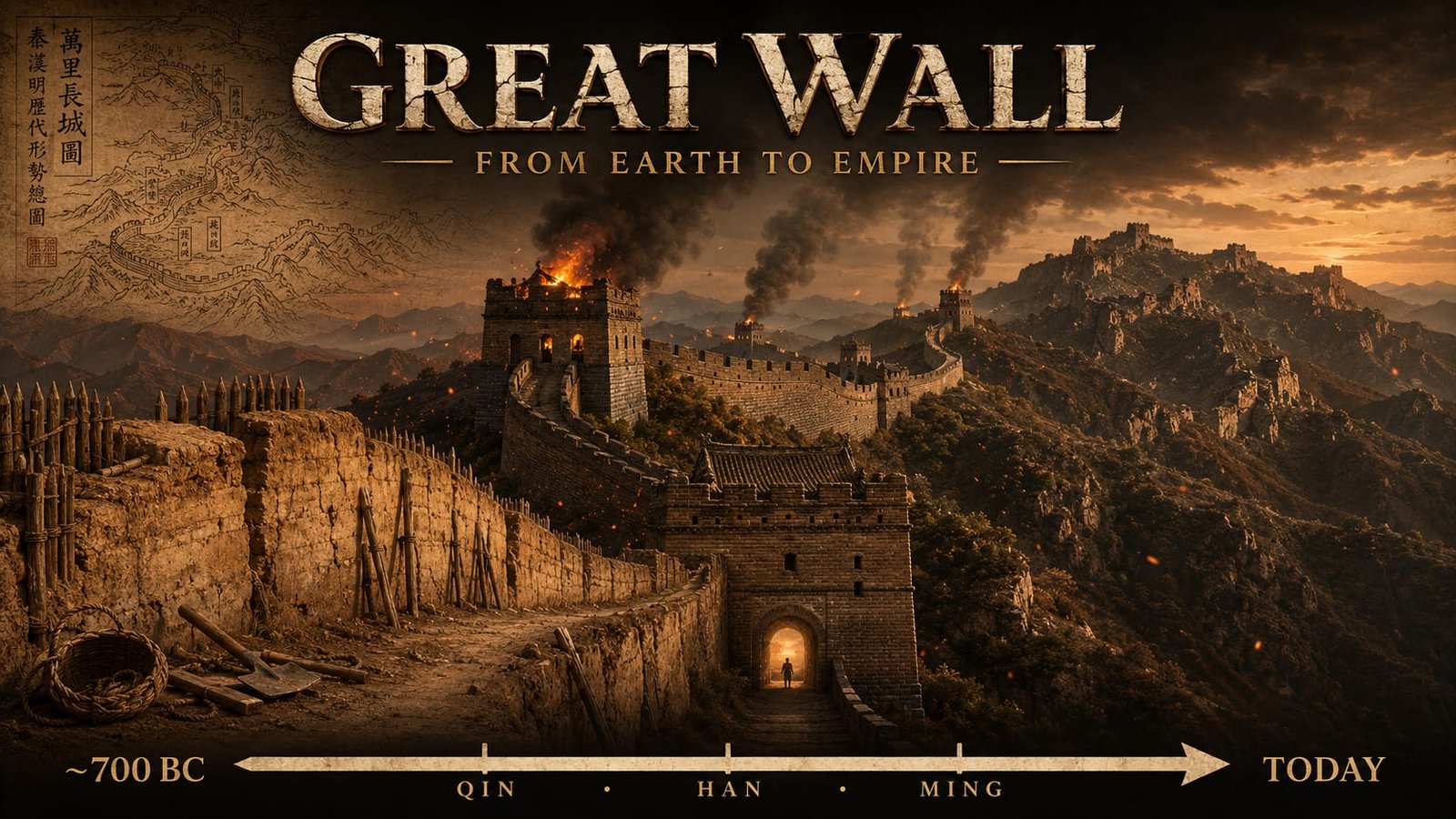
Not One Wall, But Many
The most famous fact about the Great Wall of China is false. You cannot see it from space. Not from the moon. In 2003, China’s own astronaut, Yang Liwei, looked for it from orbit. He couldn’t find it. Yet UNESCO’s official listing still calls it the only human work visible from the moon. The Wall’s protectors are still printing the myth. Because the Wall has always been two things: what it was — and what everyone needed it to be. The real story comes down to three things: a prophecy about death, a recipe made of rice, and a gate opened from the inside.
The Problem of the North
But before there was a wall, there was a problem — and the problem was not armies. It was speed. South of the frontier lay a farming world. Fields. Granaries. Cities. Everything rooted in place. Nothing that could run. North of it, on the open steppe, power moved at the speed of a horse. Raiders could strike a town and vanish into the grassland before an infantry column had covered half the distance. You cannot defeat an enemy that is gone before you arrive. So the northern kingdoms — Qin, Zhao, Yan — built walls. Not to stop the horsemen. Nobody believed a line of rammed earth would do that. But to slow a raid. To funnel attackers. And above all, to carry a signal. Beacon towers, set in chains across hundreds of miles of mountain — smoke by day, fire by night — could throw a warning from hill to hill faster than any horse alive. Before it was a monument, before anyone argued about seeing it from the moon, the Great Wall was a clock. It bought the one thing the farming world could not buy anywhere else: time.
Then, in 221 BC, one man ended every argument at once. His name was Qin Shi Huang — the first emperor of a unified China. He conquered every rival kingdom, dissolved every border between them, and made himself ruler of it all. The separate walls, the separate fears, the separate frontiers — all of it suddenly belonged to one state.
A Machine for Buying Time
But he did not join the walls for strategy alone. Here is the prophecy. His trusted alchemist returned from a failed search for the elixir of immortality carrying an ominous warning: “The Hu will destroy Qin.” The Hu meant the northern nomads. So the emperor launched his general, Meng Tian, northward with three hundred thousand soldiers and one instruction: build. The largest construction project in the ancient world was triggered by a prophecy about death.
And the deepest irony is that the Qin dynasty collapsed anyway. Within fifteen years of unification, the empire fell. Not to the Hu. Not to nomad raids. To its own people — exhausted, conscripted, starved, and broken by the same imperial machine that had built the Wall. Later readers of the prophecy noticed something crueler still. “Hu” was also the name of the emperor’s youngest son — Huhai — whose catastrophic reign destroyed the dynasty from the throne itself. The threat was never beyond the wall. It was inside the palace.
What did it cost to build? Qin Shi Huang sent soldiers, convicts, and peasants conscripted from their farms — hundreds of thousands of them, by some accounts far more — marching to the edge of the known world, into conditions that killed them in numbers that passed into legend. The man who oversaw it all was Meng Tian. And when the emperor died, and palace intrigue condemned Meng Tian to execution, he spoke words that have survived two thousand years: “I built walls and dug moats across more than ten thousand li. How could I not have cut through the veins of the earth? This is my crime.” The man who built the first Great Wall believed he had committed a crime — against the earth, not against the people.
Qin — The First Emperor’s Wall
But where did the bodies go? Were workers really buried inside the Great Wall — is the Wall itself made partly of human remains? The answer is no. Archaeology has found no mass burials within the Wall’s structure. The dead were buried in the ground nearby, not mixed into the rammed earth. But the scale of death was real enough that people gave the Wall a name that has never gone away: the longest cemetery on earth. The name is emotionally accurate even where the literal claim is wrong. The bones lie in the soil around the Wall, not inside it. But the grief is correct. The families who never saw their sons and husbands come home were real.
After the Qin dynasty fell, the Wall remained. And the dynasty that rose next, the Han, inherited the same northern problem — but answered it differently. They pushed the frontier west. Not just to defend, but to expand — out along a narrow corridor of desert and oasis toward Central Asia, past a lonely outpost the Chinese called the Jade Gate, the last threshold before the open deserts stretched to the horizon. And out there, the Wall stopped being a barrier. It became a road. Beacon towers rose at intervals across the dry Gansu landscape. Garrisons watched an empty horizon. But what moved through those defended passes was not only soldiers. It was silk. Spice. Glass. Written ideas. Living people carrying knowledge from one end of the known world to the other. These walls guarded the Silk Road. The Wall was not only keeping something out. It was keeping something moving — the security infrastructure of the greatest trade network the ancient world had produced.
And with that, what the Wall was changed. It was no longer just a line drawn to keep the outside world out. It was a machine for managing contact — deciding where crossing happened, who could pass, where goods could be taxed and watched and controlled. Traders crossed it constantly. Envoys crossed it. Nomadic peoples came to its gates to exchange horses and leather for pottery and cloth. The Wall gave a blurred, dangerous borderland edges. It turned uncertainty into something an empire could administer.
Han — From Barrier to Corridor
For the next thousand years, the answer to the northern question kept changing. Some dynasties built walls aggressively — the Northern Wei built, the Northern Qi built, the Sui mobilized over a million men for their own campaigns. Others preferred diplomacy, or trade, or marriage alliances, or open war. And the Tang — ruling at the very peak of China’s medieval power — built virtually no wall at all. Because the Tang ruling house had an unfair advantage. Its bloodline carried the steppe itself — Xianbei ancestry from the northern frontier. They understood the steppe world from inside it. They fought its way of war. They did not need to wall off the north, because they were, in part, of the north. The Wall was never China’s instinct. It was the confession of dynasties that did not know how else to manage what they could not control.
Centuries later came the Ming — and with them, the Wall finally became what the entire world pictures. Brick. Cut stone. Watchtowers climbing the spines of mountains. Battlements marching ridge after ridge into the distance. The Ming came to power in 1368 by driving out the Mongols, who had ruled all of China for nearly a century. The steppe had not merely raided China. It had conquered it — taken the throne, replaced the emperor with a Khan. The Ming were not going to let that happen again. So they built with an intensity no dynasty had matched: fortified passes, garrison towns, watchtowers close enough together that a warning could leap from one to the next in minutes. The great passes — Juyongguan in the mountains, Shanhaiguan where the Wall runs all the way down to the sea — became fortress towns in their own right, gates layered behind gates.
And here is the recipe. The mortar holding those Ming bricks together was not what anyone expected. When scientists finally analyzed it, they found something unusual blended into the standard lime: sticky rice soup. Boiled, mashed, and mixed with slaked lime, it created the world’s first known composite mortar — organic bound to inorganic — stronger and more water-resistant than lime alone could ever be. So strong that in places, weeds still cannot push through the cracks. So strong that when a bulldozer struck a Ming-era tomb built with it, the story goes, the bulldozer lost. The recipe was a closely guarded secret among master masons for centuries. And it carried a quiet second price: the rice was levied from harvests in the south — grain that could have been food, boiled instead into mortar. The Wall that looks so permanent on the ridges north of Beijing was paid for twice. Once in labor. Once in rice.
The Ming Wall — The Image We Know
And yet. At its mightiest, the Ming Wall still could not do the things an empire actually needed. It could warn a garrison. It could delay an attack. It could funnel an enemy toward chosen ground. But it could not guarantee loyal commanders. It could not stop corruption eating the empire from inside. It could not feed a population collapsing under taxation and famine. In the spring of 1644, all of that came due.
The Ming were rotting. A rebel army marched on Beijing, and the city fell. The last Ming emperor walked up the hill behind his palace and hanged himself. And far to the northeast, at Shanhai Pass — the great gate where the Wall runs down to meet the sea — the final act played out. General Wu Sangui held that gate. On one side of him: the rebels who had just destroyed his dynasty, holding Beijing — and his family inside it. On the other: the Manchu cavalry, a rising power from the northeast, waiting beyond the Wall. He could not fight both. So he made the choice that ended an age. He opened the gate — and invited the Manchus through.
The Manchu cavalry rode in and destroyed the rebel army in a single battle. They had done exactly what Wu Sangui asked. And then they did something no one asked them to do. They kept going. Into Beijing. Onto the throne. Over all of China. They founded the Qing dynasty, which would rule for the next two and a half centuries. The greatest defensive structure ever raised by human hands was not stormed. It was not battered down. It was opened — from the inside, by one of its own commanders.
Under the Qing, the Wall’s military meaning dissolved completely. The Qing ruled the lands on both sides of the old frontier; the boundary the Wall had guarded for two thousand years now ran through the middle of their own territory. There was nothing left to keep out, because the people who had always been outside were now inside — ruling. So the Wall was left to crumble. Sections decayed. Others were quarried by local people for building stone. Parts simply melted back into the hills they had been made from.
1644 — The Gate That Opened
And as the structure faded, something strange happened to its meaning. The outside world arrived. European travellers and missionaries saw the Wall and described something China’s own people had stopped seeing centuries before. They did not see the grief, or the shame. They saw wonder — a marvel so large it seemed impossible, the greatest construction in human history. This was genuinely new. For long stretches of Chinese history after the Ming, the Wall had been viewed as an embarrassment: a monument to fear, evidence of a civilization so afraid of the north that it spent two thousand years trying to wall it out. The outside world’s astonishment transformed what the Wall meant.
Then came the twentieth century — and something nobody expected. During the Cultural Revolution, the dismantling of the Wall was actively encouraged. Local people were told to take its bricks for homes, for animal pens, for road foundations. Long stretches were stripped. Not by invaders. Not by nomads. By the country that built it — which had decided the Wall was a feudal relic, something to be ashamed of. The Wall that two thousand years of dynasties had bled to build was being demolished by the descendants of the people who built it.
Then, in 1984, Deng Xiaoping reversed everything with a single campaign: Love China. Restore the Great Wall. And restoration began. But here is the ending nobody tells you. The Wall you have seen in every photograph, on every postcard, in every travel documentary — that Wall is largely a modern reconstruction. The famous sections at Badaling and Mutianyu, the ones ten million tourists walk every year, were rebuilt — first at Badaling in the Fifties, then on a massive scale after 1984 — in places nearly from scratch, designed to look the way the world expected the Great Wall to look. It was the only time in the Wall’s entire history that it was built with no military purpose at all. Not for defense. Not for fear. For the photograph. For tourism. China spent two thousand years building a wall to keep the outside world out — then rebuilt a version of it specifically to invite the outside world in.
From Defense to Memory
And the ancient Wall — the one Qin Shi Huang’s conscripts raised out of rammed earth and grief? It is almost entirely gone. A national survey completed in 2012 found that only around eight percent of the Ming wall survives in good condition, and that nearly a third has vanished entirely. The Qin sections exist only as faint ridges in the landscape, barely distinguishable from the hills around them. The longest cemetery on earth is also the most invisible structure in China.
What the Great Wall Really Was
So stand back and look at the whole length of it. What was the Great Wall of China, really? It was not one wall. It was a clock. A road. A tax checkpoint. A signal network. A refuge from a prophecy. A monument to fear dressed in the language of strength. It was built by an empire that collapsed before the mortar dried. Extended by a dynasty that used it to carry silk to the world. Ignored by dynasties confident enough not to need it. Rebuilt in brick and sticky rice by emperors who had watched the steppe swallow China once and could not stop seeing it happen again. Opened by a single commander on a single morning. Torn down by the descendants of the people who built it. And then rebuilt — not for defense, not for fear, but for the photograph the world wanted to take.
So no — you cannot see the Great Wall from space. But that was never the right question. The Wall was never about the stone. It was about everything on the other side of it. The farms that could not run. The families waiting for sons who did not come back. The general at the gate, calculating the cost of opening it. The worker who boiled the rice, mixed the mortar, carried the brick up a ridge in the freezing dark — and never knew whether what he was building would hold. It did not hold. No wall does, in the end. But for two thousand years, ordinary people kept building it anyway — because the fear that drove it was real, even when the Wall was not enough. This is the history of the Great Wall of China. Not the monument. The fear behind it. And the people who were spent to build it.