The City That Could Not Be Taken
For a thousand years, no army on Earth could take this city. The Persians tried. The Avars, the Arabs, the Bulgars, the Rus — they came with fleets and siege towers, and they broke against a single line of stone. In 626, two empires attacked it from land and sea on the same day. The city threw them both back. This is Constantinople. How it ruled for eleven centuries — and how it died in one morning — comes down to three things: a wall built like a trap, a dome that hangs from heaven, and the one weapon that made the wall meaningless.
A New Rome
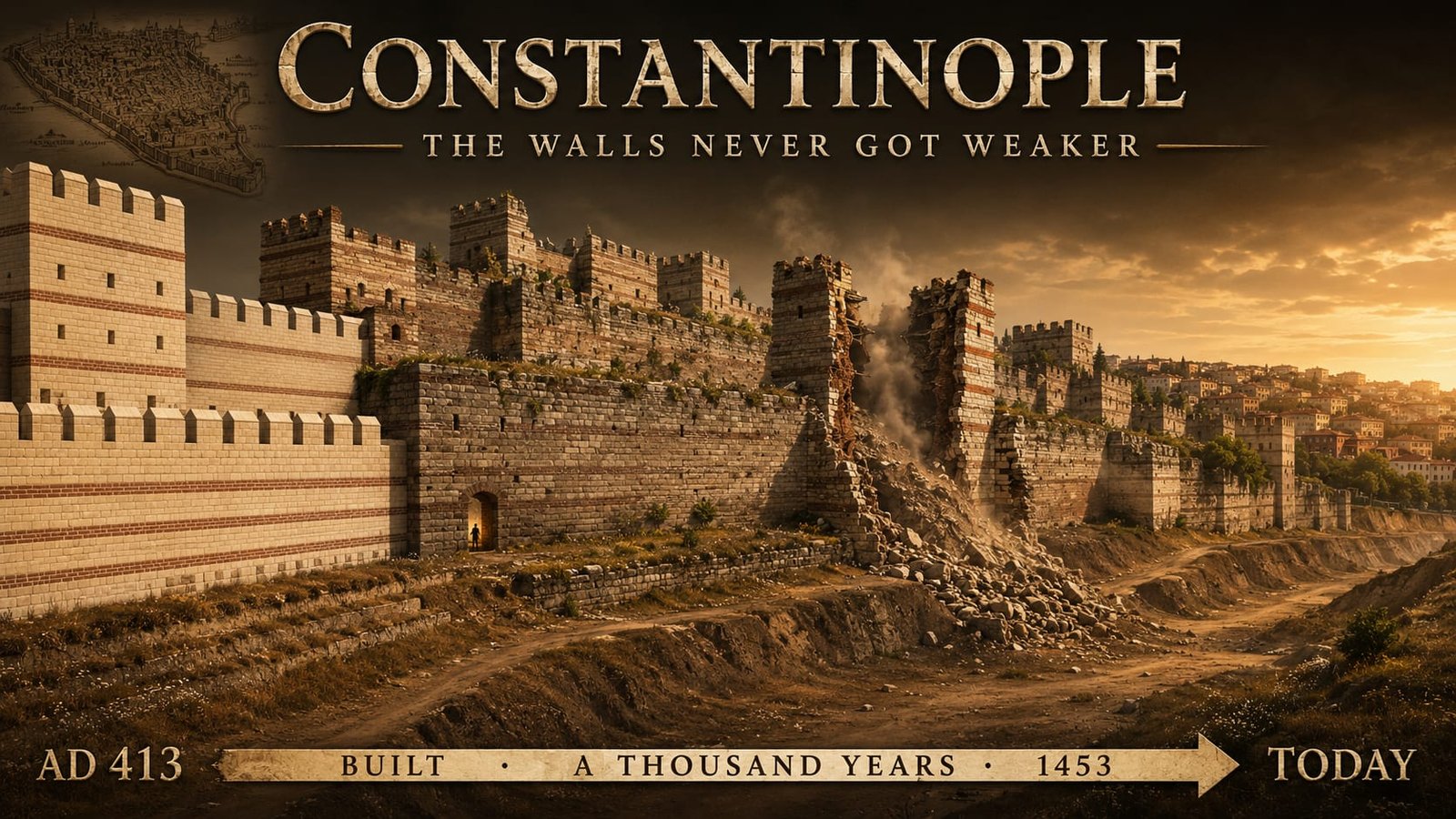
Start with the wall — because it is not one wall. It is a machine for killing armies, and it works like this. Picture yourself as an attacker, advancing on the city’s only land approach. First you reach a moat, wide and deep. You cross it under a storm of arrows. Then comes the outer wall, lined with archers. Suppose you climb it. You have not entered the city. You have entered the trap. You drop into a narrow terrace, open to the sky — and rising in front of you is the real wall: twelve meters high, five meters thick, crowned with ninety-six towers. Defenders above you fire down. Defenders in the towers fire in from the sides. Every step forward puts you under a new angle of attack. The space between the walls is not a passage. It is a killing ground. That is why, for a thousand years, armies could reach Constantinople — and could not take it.
So who builds a machine like that — and why here? The answer is in the water. The city sits on a triangular peninsula, with sea on three sides. Along the north runs the Golden Horn, a deep, sheltered inlet — one of the finest natural harbors on Earth. To the east and south lie the Bosphorus and the Sea of Marmara, the straits that connect the Black Sea to the Mediterranean. Grain, silk, gold, armies, and rumor — everything moving between those seas has to pass this exact point. Whoever holds this peninsula does not sit beside history. He sits on the route history has to take.
The Triple Walls
And for a very long time, someone small held it. A Greek colony called Byzantion had stood on this point for nearly a thousand years — a port town: useful, strategic, alive, but small. What changed everything was a decision made in the year 330. The Roman emperor Constantine did something no emperor had done before: he moved the center of the Roman world. The empire’s wars and wealth now lay to the east, so Constantine left the old capital behind, took this modest Greek port, and refounded it as his New Rome — filled with forums, palaces, statues, churches, and a hippodrome where tens of thousands could gather beneath the eye of the emperor. People soon stopped using the old name, and called the city after him instead: Constantinople.
But a capital this rich, connected to the world by a single strip of land, needed that strip sealed. So in the early four hundreds, under the emperor Theodosius the Second, the Romans built the triple wall you have already crossed in your imagination. And for the next thousand years, the world tested it.
The Avars and Persians besieged the city together — and were thrown back. The Arabs came twice, in vast fleets — and met a Byzantine secret weapon: Greek Fire, a liquid flame sprayed from ships, that burned even on the surface of the sea and could not be put out. The formula was guarded so closely that it was eventually lost forever. The fear of it never was. The Bulgars came, and failed. The Rus came down the rivers in their longships, and failed. Walls defended the land. Fire defended the water. And Constantinople became one of the hardest prizes on Earth.
And one moment proved the city’s deepest strength. In 447, an earthquake threw down long stretches of the wall — just as Attila and the Huns were bearing down on it. It should have been the end. Instead, the people of Constantinople rebuilt the shattered defenses in roughly two months, the city’s rival chariot factions laboring side by side. By the time Attila might have struck, the walls stood again. The city could repair itself faster than the world could knock it down.
But walls only explain why Constantinople was hard to take. They do not explain why army after army was willing to die against that stone. For that, you have to go inside.
Holy Wisdom — The Richest City on Earth
Inside was the richest city in the Christian world. Constantinople sat on the hinge between Europe and Asia, and the trade of three continents funneled through its straits — and the city taxed all of it. That wealth paid for the second of our three things. And it rose, strangely, out of fire.
In January of 532, Constantinople nearly destroyed itself. The chariot factions of the Hippodrome, the Blues and the Greens, were far more than sports fans — they were networks of politics, neighborhood, and identity, and together they could shout at the emperor in one voice. When anger against the emperor Justinian exploded, the factions united under a single cry: Nika. Victory. For days the city burned — streets, palaces, the main church, all of it. Justinian prepared to flee. And then the empress Theodora spoke. She had risen from the world far below the throne — her father had worked around the Hippodrome — and she refused to run. Her meaning was simple: if power had to end, it would end here. Justinian stayed. The revolt was crushed, at a terrible price. And in the ashes, the emperor made a decision that turned catastrophe into glory: on the ruins of the burned church, he would raise the largest and most magnificent church the world had ever seen.
It took just five years. In 537, Justinian walked into the finished Hagia Sophia — Holy Wisdom — and, the story goes, looked up and said: Solomon, I have surpassed you.
Walk inside, even now, and the walls seem to fall away. Above you floats a dome a hundred feet across, ringed at its base by forty windows, so that it appears not to rest on the building at all, but to hover over it on a circle of light. A writer of the time said it looked as though it were suspended from heaven by a golden chain. To hold a round dome above a square hall, Justinian’s architects — Anthemius and Isidore, mathematicians as much as builders — used curved triangles of stone called pendentives, an answer so elegant it would be copied in domes for the next fifteen hundred years. Marble from every province lined the walls. Gold mosaic caught the light above. For the better part of a millennium, this was the largest enclosed space on the planet. The walls told enemies that Constantinople could resist them. Hagia Sophia told the world why it mattered.
And the dome did not stand alone. Beneath the streets, engineers dug enormous covered cisterns — underground halls where forests of marble columns stand in still, dark water — so the city could keep drinking through the longest siege. Aqueducts carried fresh water in from hills kilometers away. Across the heart of the city ran a grand colonnaded avenue, lined with forums, statues, and markets. And at one end of it stood the Hippodrome — a vast arena where tens of thousands roared at the chariot races, and where emperors showed themselves to their people. Because in this city, spectacle was part of power. At its height, perhaps half a million people lived here — at a time when Paris and London were small towns of wood and mud. This was not a medieval city. It was a surviving piece of the ancient world, running at full power.
Sacked by Its Own — 1204
And here is the part that still astonishes. When the western Roman Empire collapsed in 476 — when Rome itself sank into ruin — Constantinople did not fall with it. It kept the Roman name, the Roman law, the Roman idea of itself, and carried them forward for another thousand years. To the people inside these walls, the Roman Empire never ended. It moved east, and endured. And that endurance was not only political. While ancient texts were disappearing across the West, the scholars of Constantinople kept copying Plato and Aristotle, Euclid and Archimedes — a thousand years of hands, candlelight, and ink, preserving the ancient mind. When those manuscripts later traveled west, they helped feed the Renaissance itself. Not as the only cause. But as one powerful current in a much larger awakening.
1453 — The Machine at the Gates
Which makes the city’s deepest wound so hard to believe — because it came not from the east, but from fellow Christians. In 1204, a crusader army bound for Jerusalem was diverted, by debt and ambition, to the richest Christian city in the world. They attacked from the Golden Horn, where the sea walls were lowest, and for the first time in nearly nine centuries, the defenses were broken from outside. For three days, Constantinople was sacked. Hagia Sophia was stripped of its gold. Relics, bronze, and treasure vanished by the shipload. The Byzantines took their capital back in 1261 — but the city that returned was a shell: poorer, emptier, whole districts standing abandoned inside walls built for a population that no longer existed.
Which brings us to the last of our three things — and the hardest question of all. A city behind the greatest walls ever built, a city that had thrown back nearly every army for a thousand years: how does a place like that finally fall? The answer arrives in the spring of 1453. And it is not really an army. It is a machine.
By then, the empire had shrunk to little more than the city itself, surrounded on every side by the rising Ottoman Empire. The new sultan, Mehmed the Second, was twenty-one years old, and he wanted Constantinople more than anything in the world. He came in April with an army that may have numbered seventy thousand or more. Behind the walls stood roughly seven thousand defenders — including a few hundred Genoese soldiers under a brilliant commander named Giustiniani — to hold nearly twenty kilometers of wall.
But Mehmed brought something the walls had never faced. Cannon — and one cannon above all: a monstrous bronze bombard, cast by a gunmaker named Orban, so enormous that teams of oxen and hundreds of men dragged it into position. For ten centuries, the walls had defeated everything by simply standing still — taking the ram, the arrow, the ladder, and not moving. But a cannonball does not climb a wall. It strikes the wall. And breaks it. The greatest fortification in human history had one hidden assumption built into every stone: that the strongest thing on a battlefield was a wall. For a thousand years, that had been true. In the spring of 1453, it stopped being true.
Why It Held, and Why It Fell
Day after day, the great gun and its companions hammered the same stretches of stone, and the wall that had stood since Theodosius began to crack, and crumble, and fall. Each night, the defenders rushed into the gaps and rebuilt them with rubble, timber, and barrels of earth — repairing by darkness what gunpowder destroyed by daylight. And for weeks, impossibly, it almost worked. When the Byzantines sealed the harbor with a great iron chain stretched across the Golden Horn, Mehmed had his ships hauled overland on greased wooden rollers — up over the hills, around the chain, and down into the harbor behind it. Now the weaker sea walls were under threat too. And slowly, the defenders ran out of men they could not replace.
On the evening of May the twenty-eighth, the people of Constantinople gathered inside Hagia Sophia — Greeks and Latins, Orthodox and Catholic, divided by centuries of suspicion, praying together under Justinian’s dome. Then the last emperor, Constantine the Eleventh, went to the walls.
Before dawn on May the twenty-ninth, 1453, the final assault came — wave after wave against the broken stone. And still the defenders held. Until Giustiniani was struck down and carried, bleeding, from the wall. The line wavered. A gap opened. Later legend would even blame a small forgotten gate, the Kerkoporta, left open in the chaos — as if eleven centuries of defense could be undone by one unlocked door. The Ottomans poured through. Constantine the Eleventh is said to have thrown off the purple marks of his rank and charged into the fighting as an ordinary soldier. He was never certainly seen again. After fifty-three days of siege, and eleven hundred years of empire, the city of Constantine had fallen.
What Still Stands
Now stand back, and look at the whole shape of it. A wall. A dome. A weapon. The wall turned the city’s one weakness — that single strip of land — into a death trap no army could force. The dome, and the wealth and faith it stood for, made the city worth dying for, and rich enough to heal itself again and again. And the weapon ended it all — not because the city grew weak, or foolish, or forgot how to fight, but because the world changed underneath it. The Theodosian Walls were the perfect answer to every weapon ever aimed at them — until gunpowder turned a tall stone wall from the strongest thing you could build into simply a very large target. That is the lesson hidden in these stones: no defense is permanent, because the attack never stops evolving. And the city lasted as long as it did because, night after night, century after century, ordinary people kept choosing to defend what was inside it — builders, sailors, scholars, and one empress who refused to run.
And yet, the city did not vanish. Mehmed did not leave Constantinople a corpse. He made it the capital of his own empire — repaired it, repopulated it — and in time, the world came to know it by another name: Istanbul. Hagia Sophia still stands, its dome still floating above the same marble floor after fifteen hundred years. And along the old western edge, you can still walk the ruins of the Theodosian Walls — broken now, overgrown with grass and fig trees — still tracing, hill after hill, the exact line that no army could cross for a thousand years. The same water still wraps the peninsula. The same strait still carries ships between two continents. The crossing is still alive. The empire is gone. The shape of the unconquerable city is still there, written in stone.