The Temple That Shouldn’t Exist
This temple is seven thousand years older than the pyramids. It shouldn’t exist.
The Impossible Date
The people who raised its ten-ton pillars had no pottery, no metal, no wheel, and no writing. They were hunter-gatherers — the kind of people the history books said could never build anything at all.
What they left on this hill holds three impossibilities. One: a date so old it breaks the timeline of civilization. Two: the carvings — including one stone that some believe records a catastrophe from the sky. And three, the strangest of all: the people who built this place buried it. Deliberately. And no one alive knows why.
Here is the first impossibility — and it begins with a mistake. In 1963, archaeologists surveying southeastern Türkiye actually stood on this hill. They saw broken limestone slabs in the dirt, wrote them down as grave markers from a medieval cemetery, and walked away. For thirty more years, the most important archaeological site on Earth sat under a farmer’s wheat field, filed away as nothing.
The World Before Farms
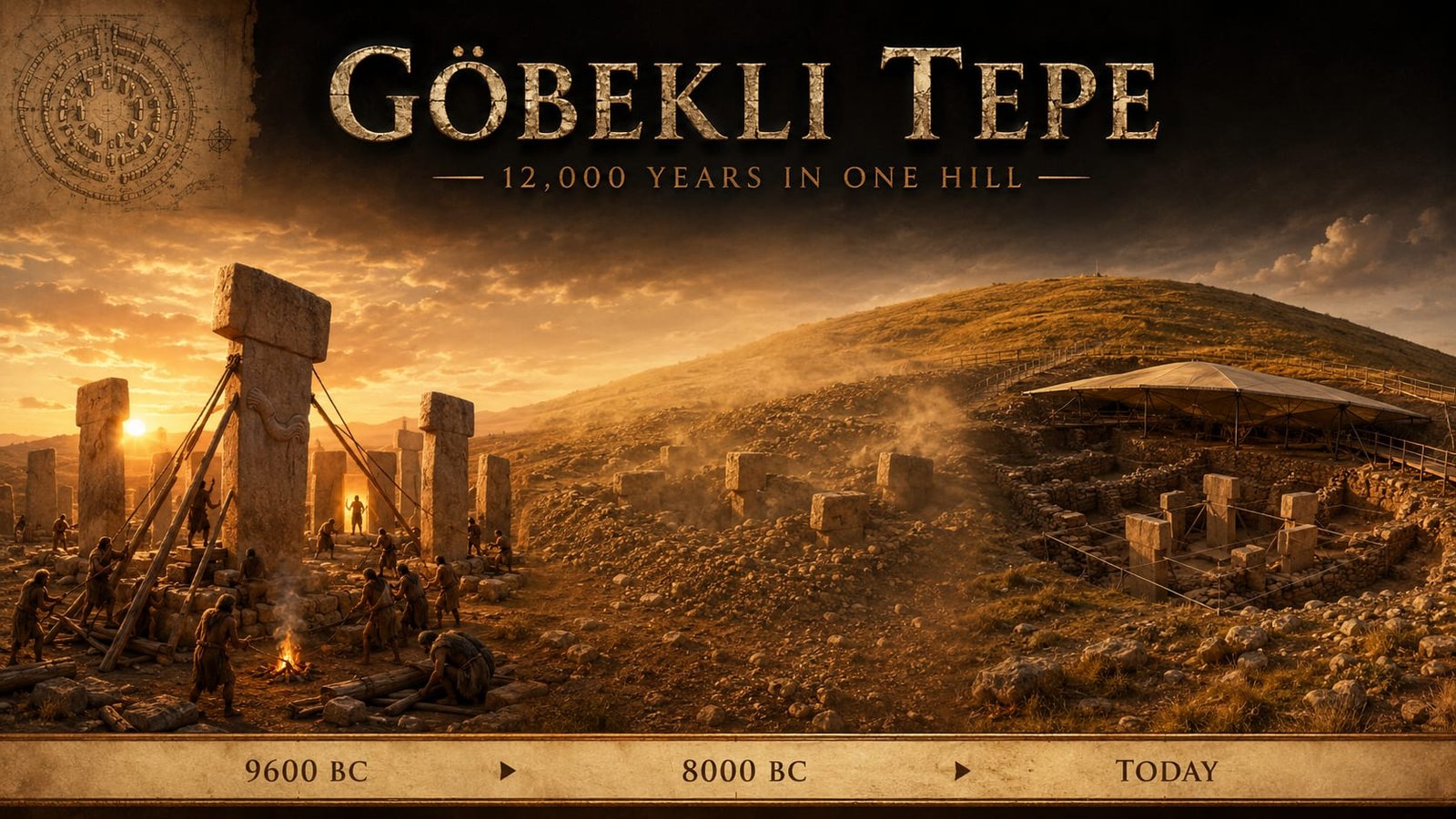
Then, in October 1994, a German archaeologist named Klaus Schmidt re-read that dusty survey report — and climbed the hill to see for himself. He knew worked flint when he saw it, and the slopes were covered in it, glittering in the sun. Within a year he was digging. What came out of the ground made no sense. Rings of T-shaped limestone pillars, up to five and a half meters tall, weighing as much as ten tons — and in the old quarry nearby, one unfinished giant that would have weighed fifty. And when the dates came back from the material sealed around them, they said: about ninety-six hundred BC.
Let that number land. When these pillars rose, the last mammoths still walked the Earth. Britain was not an island — you could walk there. Stonehenge lay six thousand years in the future; the pyramids, seven thousand. Every temple, every city, every monument humanity had ever raised — none of it existed yet.
This came first.
Now — how can anyone know that? You cannot radiocarbon-date a stone. But you can date what the builders left around the stone: charcoal from their fires, organic traces sealed inside the wall plaster, bone from the soil that buried the pillars. Dozens of samples, independent laboratories, one converging answer. The oldest circles were standing by around ninety-six hundred BC — and to understand why that date shattered everything, you have to understand who these builders were. They lived at the very end of the Ice Age, in a world without farms. No sheep, no cattle, no fields of grain — those wouldn’t exist for centuries. They hunted gazelle and wild aurochs across a landscape greener than today’s bare plains — open woodland and grass, streaked with herds. Wild wheat grew on the hillsides by itself, and they gathered it without ever planting a seed. They made their tools by knapping flint, one strike at a time. Archaeologists call their era the Pre-Pottery Neolithic — a name that tells you what they lacked. Not even a clay pot.
Enclosure D — The Ring of Giants
The hill itself sits on the highest point of a limestone ridge above the Harran plain, in southeastern Türkiye, a short drive from the ancient city of Şanlıurfa. The locals had always had a name for its rounded summit: Göbekli Tepe — “Potbelly Hill.” No one suspected the belly was artificial: fifteen meters of accumulated ruins, rubble, and buried monuments, stacked up by human hands over more than a thousand years. The hill is the site. People made this mountain.
And yet somewhere in those hills, someone looked at a limestone ridge and imagined something that had never existed before: architecture. Not a hut. Not a windbreak. A monument.
Klaus Schmidt understood all of this within days of his first climb — he said later that on that hill he’d faced a choice: walk away, or spend the rest of his life there. He chose the hill. He spent the next twenty years excavating it, working alongside the Şanlıurfa Museum and the German Archaeological Institute. He died suddenly in 2014, at sixty, with the overwhelming share of the hill still untouched beneath his feet — a discoverer who knew, and said openly, that he would not live to see his site understood. What he did uncover was enough to force the textbooks to be rewritten. And the strangest things he found were the pillars themselves.
The Carved Bestiary
Walk into the largest circle uncovered so far — archaeologists call it Enclosure D — and the second impossibility surrounds you. The enclosures are rings ten to twenty meters across: an outer wall of rough stone, a bench running along its inside face, and set into the wall, T-shaped pillars facing inward like figures gathered around a meeting. In the center of each ring stand two giants, face to face — in Enclosure D, five and a half meters tall. Whoever sat on that bench sat among them, small, encircled, watched.
And here is the detail most documentaries miss: the T-shape is not abstract. Look closely at the central pillars. Arms, carved in low relief, run down their sides. Hands with long fingers meet over a belt. Below the belt hangs what looks like a loincloth of fox pelts. These are not columns. They are beings — stylized, towering, and deliberately faceless. Whether they were gods, ancestors, or something we have no word for anymore, they are among the first monumental images humanity ever made of something beyond itself.
Pillar 43 — The Stone Everyone Argues About
Around them, the stones crawl with animals. Foxes with bared teeth. Snakes pouring down the pillar faces in braided torrents. Scorpions. Wild boars. Cranes. Vultures with spread wings. Some are cut in flat relief; others erupt from the stone fully three-dimensional — a snarling predator, jaws open, lunging out of a pillar’s face as if half-escaped from it. Every one of them was carved with flint, because nothing harder existed. And almost none of it is prey being hunted — these are predators and scavengers, carved with their dangers intact, watching the circle from every side. This is not decoration. It reads like a message — in a language that died fourteen thousand years before anyone thought to write one down.
And then there is Pillar 43 — the one the internet cannot stop arguing about. Near the top, a vulture spreads its wings, and above one wing sits a carved disc. Beside it, a scorpion. And at the bottom, a small human figure — with no head.
Some researchers claim these carvings are a star map: that the animals are constellations, and the disc marks the sun’s position on a specific date — the moment, they argue, when fragments of a comet struck the Earth around ten thousand eight hundred BC, triggering the cold snap geologists call the Younger Dryas. In this reading, Pillar 43 is a memorial to a cataclysm — the oldest date-stamp in human history.
They Buried It on Purpose
It’s a thrilling idea. Here is what the archaeologists who actually excavate the site say back. The pillars were moved and reused in antiquity, so their positions can’t be trusted as sky-charts. The same animals appear on dozens of pillars in every combination. And no impact layer has been found at the site itself — while the comet hypothesis is still fighting for acceptance among geologists.
What the evidence does support is stranger than a star map. The headless figure is not alone — headless humans appear elsewhere at the site, and excavators have found fragments of human skulls here, carved with deep, deliberate grooves, apparently for hanging or display. The vulture, in later cultures of this region, carried the dead to the sky. Piece those fragments together and a picture emerges: this may be a monument where the living met their dead — a cult of skulls and vultures, on a hill above the plain, before the plow, before the wheel, before everything.
The honest answer is that no one can read Pillar 43 — and that is more unsettling than any theory.
For centuries the mystery of monuments was always how — how were the stones cut, moved, raised? At Göbekli Tepe the how is surprisingly clear: the limestone is soft, the quarries are meters away, and a few hundred organized people with flint tools, timber levers, and rope could do it all. The real mystery is not how it rose.
It’s why it vanished.
Deliberate, Natural — or Both
Because here is the third impossibility. Göbekli Tepe was not destroyed. It was not abandoned to the wind and left to fall. Sometime around eight thousand BC — after more than a thousand years of use, longer than the entire history of Christianity — the great circles were filled in. Buried to the brim under tons of rubble, broken flint tools, and animal bones, until the rings of giants disappeared and the hill closed over them like a healed wound. Think about the labor involved. Burying these enclosures took nearly as much organized effort as building them. Whoever did it wasn’t fleeing — you don’t haul thousands of basket-loads of debris while running away. They finished something. And that burial is the only reason the site survived — sealed and protected under its own tomb of earth while every later monument on Earth was quarried, toppled, or worn away.
Klaus Schmidt read that filling as a deliberate, ritual act: the enclosures had lived out their purpose, and their builders decommissioned them the way you would close a grave. Some of the rubble may even have come from feasts — one last ceremony before the burial.
Only 5% Excavated
But science keeps interrogating its own story, and you deserve the current version. Researchers working at the site since Schmidt argue the truth is messier: that parts of the fill slid down from the slope above in rain and earthquakes, that people rebuilt among the ruins and recycled the old stones, and that nature may have finished what ritual began. Deliberate burial, natural burial, or both — the debate is live, and it matters, because each answer describes a different relationship between these people and their temple.
Here is what should keep you up at night: we may already know less than five percent of this place. That is the share of the site excavated to date — after thirty years of work. Ground-penetrating radar on the unexcavated slopes shows the outlines of what could be fifteen or more further enclosures still sealed underground — plus a large building and clusters of smaller structures no one has ever opened. The excavation continues every season, and the ground keeps answering: as recently as twenty twenty-five, diggers pulled a carved human statue — head and torso clearly defined — from the soil between two of the known circles, where it had waited eleven thousand years.
The Stone Hills — Karahan Tepe
And Göbekli Tepe is no longer alone. Across these hills, a dozen sister sites are emerging from the ground — an entire lost world archaeologists now call the Taş Tepeler, the Stone Hills. The most astonishing is Karahan Tepe, a day’s walk away: pillars cut directly out of the living bedrock, chambers carved into the hill itself, and human statues of an intensity that stops the breath — including a stone face, deep-eyed and sharp-jawed, that stared out of the ground at its excavators after all those millennia. One hill was an anomaly. A civilization of hills is a chapter of the human story we have barely opened.
The Temple Before the Wheat
Whatever this place was, we have seen only its edge.
Now assemble the three impossibilities, because together they say something enormous.
For a century, the story of civilization ran in one direction. First, farming: humans domesticate wheat and sheep, settle down, and produce a surplus. Surplus builds villages, villages build cities, and only then — rich, fed, and organized — does humanity afford temples and gods. Agriculture first. Religion last. Every textbook agreed.
Göbekli Tepe stands in the ground as a refutation. Hunter-gatherers — people with no farms and no cities — organized by the hundreds, quarried ten-ton monoliths, raised the first monuments on Earth, and gathered here to feast. Excavators have found the debris of those gatherings: mountains of gazelle and aurochs bone, and huge limestone vats, up to a hundred and sixty liters, whose chemical residues hint they may even have brewed a kind of beer. Picture the scene the bones describe — hundreds of people converging on the ridge from a day’s walk in every direction, the roasting fires, the vats, the work-gangs hauling the next pillar up from the quarry on timber sleds — a festival, a construction site, and a sanctuary at once, seven thousand years before anyone raised a pyramid.
And every feast created a problem: how do you feed a crowd that size, in one place, on wild food alone? Hold that question.
Because then the evidence turns the arrow of history around completely. In the nineteen-nineties, geneticists went hunting for the birthplace of domesticated wheat. They compared the DNA of cultivated einkorn — one of humanity’s founder crops — against wild wheats from across the Near East. The closest living match grows on the slopes of Karacadağ, a volcanic mountain on the horizon of this very hill, barely a day’s walk away. Within centuries of the first pillars rising, the first farmed grain in human history appears — here, in this landscape, among the very people who kept having to feed the crowds at the temple. The problem of the feast may have produced the solution of the farm.
Schmidt put the heresy in a single sentence: first came the temple, then the city. The need to gather — to worship, to feast, to build something enormous together — may be what forced humans to tame the wheat, not the other way around. Belief may have built civilization.
From the First Temple to the Greatest City
Is that final? No — and this site punishes certainty. Newer excavations have found what look like houses and rainwater cisterns, hinting that people may have lived on the hill, not merely visited it — less a lonely cathedral, more a living town wrapped around its shrines. The story is still being revised, trench by trench, and with ninety-five percent of the hill unopened, the next revision may already be underground, waiting.
But the core discovery has survived every challenge: the monument came before the farm. Organized faith came before the plow. On this hill, at the end of the Ice Age, people who owned nothing but flint and conviction built the first great architecture of the human story — and in doing so, they may have lit the fuse of everything that followed.
Because everything that followed leads somewhere. The wheat tamed in these hills fed villages, the villages became towns, and the towns marched south into Mesopotamia, where mud brick and ambition raised humanity’s first true metropolis — a city of gates of blue and gardens in the sky, whose fall came in a single night. From the first temple ever built to the greatest city of the ancient world: that is where Archmyst goes next, this Saturday.