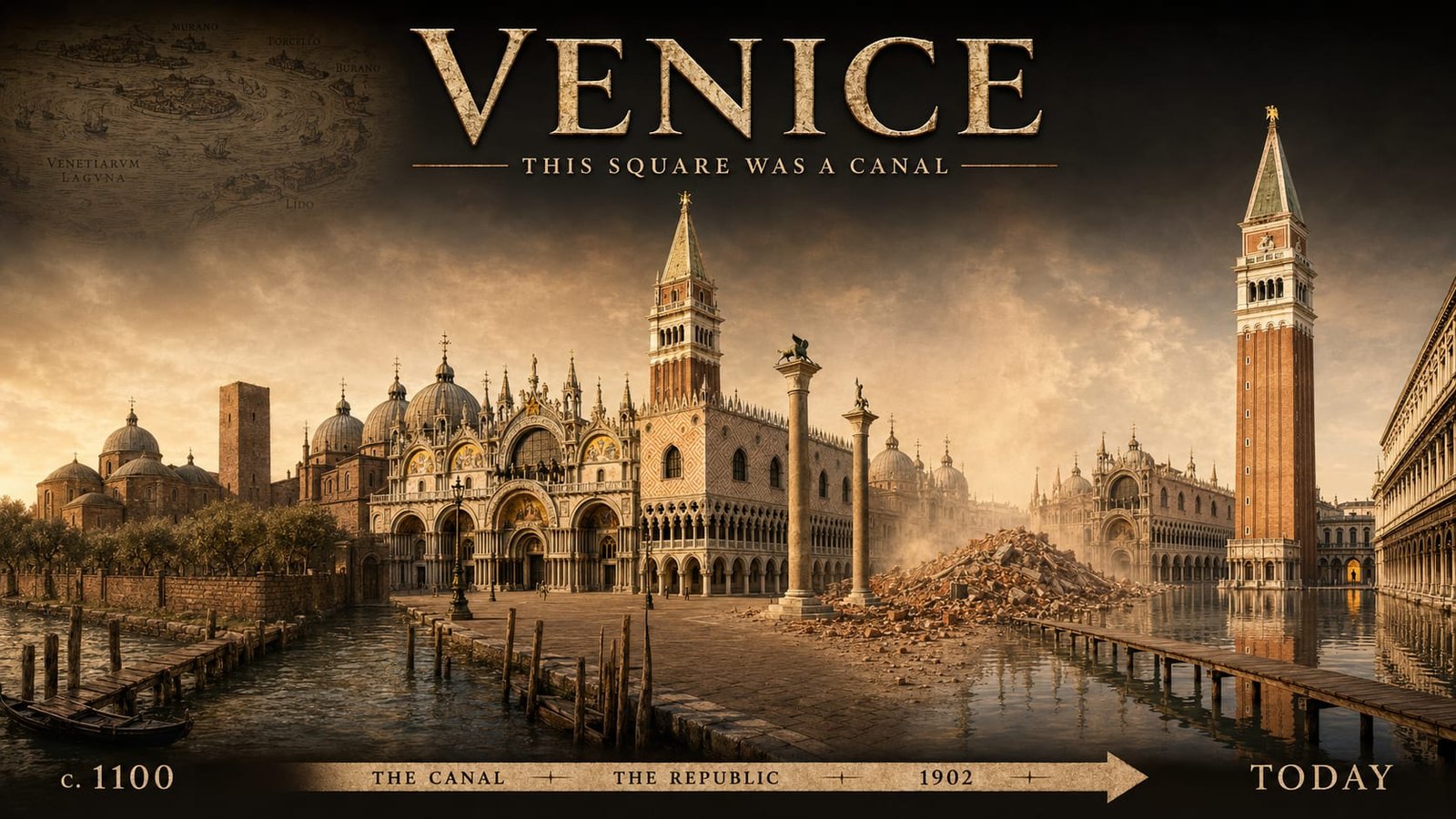
A city that should not be there
Most cities make sense the moment you look at them. You see the ground, you see what was built on it, and you understand why someone chose the spot.
Venice does not work that way. Palaces rising straight out of the water. Churches balanced above a lagoon with no solid ground beneath them. Towers, domes, bridges and marble façades arranged across more than a hundred small islands, as though the water below was always meant to hold them.
For more than a thousand years it did — through storms, invasions, plague, fire, and the relentless rhythm of tides that have no particular concern for what human beings put in their path.
Then there is the other image, and almost everyone has seen it. St Mark’s Square underwater. Café tables surrounded by floodwater. Raised walkways across one of the most famous public spaces on earth. Palace doors sitting almost level with the tide.
Out of which comes the most familiar warning in the world: Venice is sinking.
That phrase is too simple, and the truth is more serious than the phrase. Venice is not sinking the way a stone drops into still water — one clean motion, one direction, one identifiable failure. What is actually happening is that the city is losing height relative to the sea around it, for several reasons operating at the same time.
Venice is not floating
The most important correction first.
Venice sits in a shallow coastal lagoon at the north-western edge of the Adriatic. A thin chain of barrier islands separates it from open water, and three narrow inlets connect the lagoon to the sea.
Those inlets are what made Venice one of the great maritime powers of the medieval world. Ships passed through them. Tides moved in and out. The lagoon offered a defensive position no inland city could match, and for centuries that combination of access and protection was exactly what a trading empire needed.
Water was not the enemy. Water was the entire point.
How you build a stone city on mud
Water also meant the ground beneath Venice was never solid. The lagoon floor is soft sediment — compressible, slow-moving, and unsuited to carrying the weight of a major city by any conventional measure.
The early builders knew that, and did not try to engineer around it conventionally. They built with the lagoon.
Timber piles were driven into the wet sediment in dense rows, compressing the material underneath and creating a firmer platform above. Wooden planking went across the pile heads. Brick and stone went above that.
Two details in that sequence do most of the work, and both are routinely mis-told.
The piles are not floats. They do not hold the city up on the water. They are a load path — a way of getting masonry weight down past material that cannot carry it. And they did more than transfer load: placed densely and deliberately, they compressed the ground until it became firmer than the surrounding lagoon floor. The buildings are not resting on soft material. They are resting on material they helped make stronger.
The timbers have not rotted. This sounds impossible and is the simplest thing here. Wood decays because organisms need oxygen. The piles sit in waterlogged, low-oxygen sediment, which does not support the biological processes that normally break wood down. What sounds fragile from the outside became durable precisely because it stayed submerged.
The corollary is uncomfortable and worth stating plainly: the foundations are safe as long as they stay wet. Anything that drops the water table around a Venetian building exposes timber that has been anaerobic for eight hundred years, and starts a clock that had never been running.
Venice did not conquer its environment. It read that environment carefully and built a solution that worked inside it — which is also the paradox. The city survived because water protected parts of it, and it is threatened because water can reach too high, too often, and too forcefully.
The right frame is relative sea level
The first mistake most people make is picturing a clean vertical descent: land going one way, everything else holding still.
What matters is not only whether the land is moving down. It is the relationship between land and water. If the land sinks, the city loses height. If the sea rises, the city loses height. If both happen together, the effect compounds.
In Venice both have been happening for a long time. Across roughly the past century and a half the city has seen an average relative sea-level rise of about two and a half millimetres a year.
That sounds like nothing. Applied across decades it becomes a meaningful shift in how often water enters the city, how high it gets when it does, and how much damage it does each time. More recent analyses suggest the rate has accelerated — one estimate puts mean relative sea-level rise in Venice near 4.9 mm a year, from sea-level rise and subsidence combined.
What the twentieth century cost
The land component comes from two distinct places, and only one of them is anybody’s fault.
The first is natural. The northern Adriatic sits on sedimentary deposits that have been compacting under their own weight for a very long time. The Po basin behind Venice is built from river sediment that shifts and settles gradually. That process predates Venice and will continue regardless of anything Venice does.
The second is not natural. For much of the twentieth century, industrial development in the Marghera zone on the mainland drew groundwater from the region’s aquifers on an enormous scale. It supported industry, and it accelerated subsidence sharply — in the worst-affected areas the land was dropping by 10 to 20 millimetres a year at peak extraction.
Venice itself lost roughly 10 centimetres of elevation to human-driven subsidence in the two decades between 1950 and 1970.
Ten centimetres in twenty years, for a city already living close to the waterline. That was not a detail. It was a warning.
4 November 1966
Then the warning arrived in person.
A storm surge, heavy rain, strong winds and an exceptional high tide pushed Venice to a record high-water level of 194 centimetres above mean sea level. The flooding reached almost the entire city. Water stayed above damaging levels for hours. Ground floors were devastated. Artworks and historic interiors were damaged. Pumping systems struggled. People waited on upper floors for water that seemed in no hurry to leave.
After 1966, groundwater extraction was sharply reduced. The fastest human-driven subsidence slowed and largely stabilised.
But stopping one form of subsidence does not stop the sea rising. It does not give back the elevation already lost. It does not prevent local ground movement. And it does not remove the tides and storm conditions that push water into the lagoon.
Which is why “Venice is still sinking” is misleading and true at the same time. Venice is no longer sinking the way it did during the worst of the pumping. Venice is still losing height relative to the water around it.
The danger is not downward movement. It is the shrinking space between the city and the sea.
The threat is repetition, not a flood
Once that space shrinks, ordinary water becomes more powerful. A tide that once stayed below a doorway starts reaching the threshold. A flood that felt exceptional returns more often. Saltwater touches materials it was never meant to touch repeatedly.
Stone endures a great deal. But salt, moisture and time work slowly, and they do not need to destroy Venice in one dramatic moment. They only need to keep coming back.
Repeated wetting changes the lower parts of buildings. Salt crystals grow inside porous materials and break them from within. Boat wake strikes canal walls again and again. Edges erode. Paving, thresholds, steps and brickwork become a record of repeated exposure.
A city like Venice can survive great shocks. It can also be worn down by small forces that never stop.
That is why floodwater in St Mark’s Square is such a powerful image. It is not an image of inconvenience. It is an image of a boundary being crossed. For centuries Venice survived by holding certain boundaries in balance — water below, architecture above; lagoon outside, city within; tide as rhythm rather than permanent invasion. Those boundaries are now less secure.
Venice was built to negotiate with water. The terms of that negotiation have shifted against it.
MOSE, and what a barrier cannot do
If water is the threat, why not block it?
Venice answered that with MOSE: 78 hinged metal gates installed across the lagoon’s three inlet channels in four barrier rows. Under ordinary conditions the gates lie flat on the lagoon floor, filled with water, letting normal tidal exchange and shipping continue. When a dangerous tide is forecast, compressed air fills the hollow gates, pushes the water out, and they rise from the floor to close a barrier across each inlet. The system is designed to defend the lagoon against tide events up to three metres.
When the barriers were first raised against major incoming tides, St Mark’s Square stayed dry. For anyone who had watched that square flood repeatedly for decades, that was proof the engineering answer was real.
MOSE works. It gave Venice something it badly needed: time.
But time is not a cure. A barrier can be raised when an extreme tide threatens, hold water back for hours, and be lowered once the peak passes. That is what it was designed to do, and it does it.
What it cannot do is raise the land. What it cannot do is stop the sea rising. What it cannot do is reverse a shift in relative elevation that has been building for generations.
And as that relative elevation keeps changing, the number of events requiring closure may increase — so a system built as an occasional emergency defence may have to become a regular part of the lagoon’s life.
Every closure is a trade-off. The lagoon ecosystem depends on regular tidal exchange to stay healthy; a barrier closing too frequently affects water quality, sediment movement, navigation, and the biological systems that have sustained the lagoon for centuries.
Protection and preservation are not always pointing the same way. That is what makes this defence so hard. The more the sea rises, the more often protection is needed — and the more often the lagoon is cut off from the sea, the more delicate the balance becomes.
A living maintenance project
Venice is a masterpiece because it made fragility look permanent. But permanence was never the same as stillness.
The city has always changed. Islands were consolidated. Rivers were diverted. Foundations settled. Stones were replaced. Edges were repaired. Floods came and went. Venice endured because every generation inherited not a finished object but a living maintenance project.
That is the most honest way to see it now — not a museum, not a doomed postcard, but an architectural system under pressure.
So why is Venice still sinking? Because it was built on soft ground in a tidal lagoon and that ground has never stopped moving. Because twentieth-century decisions accelerated the movement and cost the city elevation it cannot get back. Because the sea is rising independently of anything Venice does. Because high water now arrives more often and reaches higher. Because MOSE addresses acute flooding without solving the underlying elevation problem. And because the daily erosion of water, salt and wake continues in the background of every passing year.
Underneath all of that sits a simpler answer. Venice is still sinking because Venice was never a finished object. It was always a balance — architecture and water, weight and softness, beauty and maintenance, protection and exposure.
What makes it miraculous is not that it escaped those forces. It is that it turned them into beauty for so long.
Which is why the question is not whether Venice can become a normal city. It cannot. The question is whether it can keep doing what it has always done: adapt without losing itself — and that question now belongs to every coastal city, not just this one.