Nobody Built This City
Nobody built this city. They carved it — straight out of the side of a mountain, from the top down. In one of the driest deserts on Earth, thirty thousand people lived among fountains, pools, and gardens. And two thousand years later, eighty-five percent of their capital is still buried under the sand. This story comes down to three things: how you carve a city from a cliff — top first, no scaffolds; how you make a desert drink; and how a capital of six hundred monuments vanishes from every Western map for six hundred years.
Carved From the Top Down
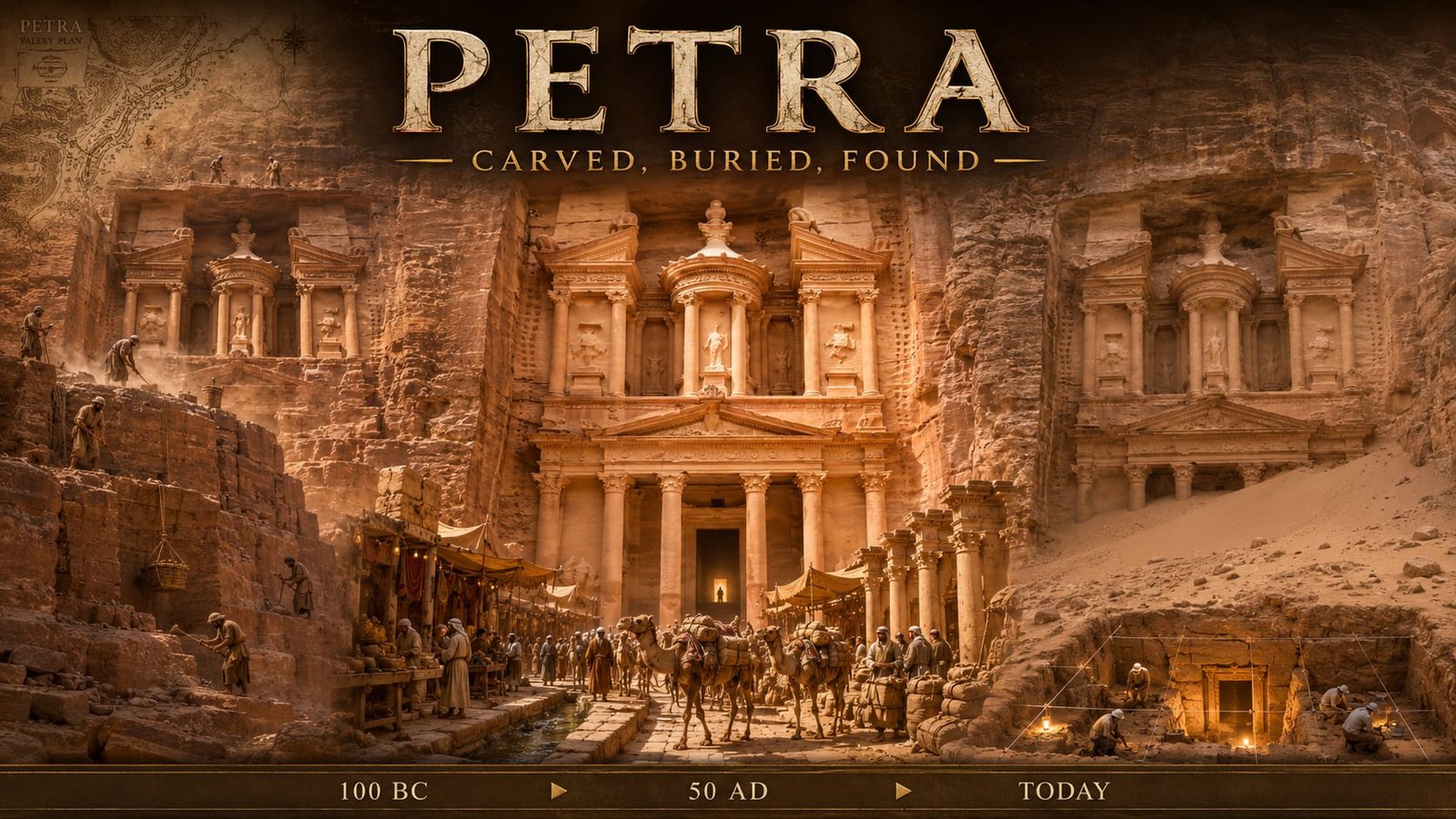
Start in the crack. The only way into Petra is a gorge called the Siq — more than a kilometer of winding corridor where the cliff walls squeeze to a few meters wide and rise some eighty meters overhead, so deep that the sky narrows to a ribbon. You walk it in shadow. And then the rock splits open, and forty meters of carved facade stand blazing in the light — columns, pediments, gods — positioned exactly where its architects aimed the reveal, two thousand years ago. All of it is one piece of the mountain. And that is the answer to the first impossible claim. A built structure rises from the ground up — foundations, walls, roof — and every stage needs scaffolding to climb. The Nabataeans worked in the opposite direction. Their masons climbed to the top of the cliff, cut a standing ledge into the rock, and carved the crown of the building first — the topmost cornice, finished to perfection — then chiseled their way down, storey by storey, standing on the raw stone that would become the next level of the design. The mountain was its own scaffold. When the chisels reached the ground, the building was complete — and nobody had ever laid a single stone. We know, because they left the proof behind: Petra’s unfinished tombs still wear their working ledges like a staircase, frozen mid-carve — crowns immaculate, feet still buried in solid rock.
The Treasury Holds No Treasure
That first facade at the end of the Siq has a name: Al-Khazneh — the Treasury. Look at what the carvers actually made, because it repays the attention. Two storeys, nearly forty meters of them: a classical portico below, and above it a broken pediment framing a carved rotunda — a design so theatrical that architects in Rome itself were only beginning to attempt it. The columns wear Corinthian capitals; the niches hold gods — Greek, Egyptian, and Arabian side by side, because the Nabataeans took the styles of everyone they traded with and fused them into something that belongs to nobody else. And the whole composition is drawn in stone the color of a sunset: the sandstone of Petra runs in bands of rose, ochre, and copper, swirling through walls and ceilings like poured silk — the reason a Victorian poet’s line about “a rose-red city half as old as time” refused to ever die. But the building’s name is a legend, and the legend left scars. High on the second storey stands a giant stone urn, and for centuries a story circulated among desert travelers that a pharaoh had hidden his treasure inside it. Generations of hopeful marksmen fired at the urn to crack it open — the bullet marks are still there. But the urn is solid sandstone. It never held anything, because the Treasury was never a treasury. Almost every serious reading of the building says the same thing: it is a tomb — most likely the mausoleum of a king, and the leading candidate is Aretas the Fourth, the ruler under whom Petra reached its height around the turn of the first century. The grandest building in the city was made for the dead — and hold that thought, because the Treasury has one more secret, and it stayed sealed until almost yesterday. The Treasury is only the doorman. Deeper in, the canyon opens into a capital. A theater sits carved into the hillside — not built against it, carved into it, every tier of seating cut from the same continuous rock, with room for thousands; when the theater was later enlarged, the carvers simply sliced through an older street of tombs above it, leaving their doorways hanging open in the back wall like boxes at an opera. Along the cliff face beyond stand the Royal Tombs — palace-sized facades stacked with columns and stairways, their interiors single vast rooms whose banded ceilings look painted but are simply the mountain’s own colors. More than six hundred carved monuments survive. And the largest of them hides at the top of the city: climb roughly eight hundred rock-cut steps and the trail turns a corner into the Monastery — a facade about fifty meters wide and forty-seven high, plainer than the Treasury, vaster than a cathedral front, cut from the summit of a mountain with the same top-down patience. Its urn alone is the size of a house. Stand in its doorway and you are a speck in a carving.
The Nomads Who Built Nothing
So who does this? The Nabataeans were Arab nomads — herders and caravan traders who, a few centuries before Christ, made themselves masters of the desert crossings of Arabia. Early Greek accounts describe them as unconquerable precisely because they built nothing: no houses to burn, no fields to seize, wealth on the move. Then, within a handful of generations, the people famous for building nothing carved the most spectacular city in the desert — without ever giving up the thing that made them rich. They kept no army to speak of and won their wars with distance and thirst. They wrote in a script of their own — and that script never died: carried down the caravan roads and across the centuries, Nabataean letters evolved into the Arabic script, written today by hundreds of millions. A people the world forgot are on half the world’s street signs. They knew the land the way only nomads can: every hidden spring, every rock basin that held rainwater. And that knowledge became the foundation of everything — because the second impossible thing about Petra is not the carving. It is the water.
The Empire of Water
Petra sits at the crossing point of the incense roads — the caravan routes that carried frankincense and myrrh two thousand kilometers from southern Arabia toward the Mediterranean. It is hard to overstate what that cargo was worth: every temple in the classical world burned incense daily, every great funeral demanded it, and it grew in exactly one corner of the map. A camel train might walk two months through some of the harshest country on Earth to deliver it — and whoever could offer those caravans safety and water at the desert’s heart could charge for both. The Nabataeans could — because in the driest hills imaginable, they had learned to farm the rain. First as a secret: a network of hidden, plastered cisterns across the desert, invisible to strangers, marked in the memory of the tribe — an empire’s advantage stored underground. Then, at Petra, at the scale of a capital. Spring water was piped into the city from kilometers away, flowing through channels and ceramic pipelines carved and laid along the walls of the Siq itself — walk it today and the water channels still run beside you the whole way. Rainfall, when it came, came as a killer: flash floods that could fill the Siq wall to wall in minutes. So the Nabataeans built a dam squarely across the Siq’s mouth and bored a tunnel through the rock beside it, throwing the floodwater around the city instead of through it — then caught that same water in reservoirs and saved it. Hundreds of cisterns riddled the mountains. Gravity fed the network; carefully managed gradients kept the flow steady year-round. The desert city had running water — fountains, a monumental pool with a garden island at its center, irrigated terraces and orchards in the heart of the ravines. Picture the place at its height, in the decades around the year zero: camel trains unloading in the caravanserais; a colonnaded street of shops and markets running along the valley floor; the great freestanding temple the Bedouin later named Qasr al-Bint rising at its end; incense smoke over the altars; a dozen languages in the streets — and everywhere, the sound no desert should make: water moving. Roughly thirty thousand people drank from stone that drinks almost nothing. Ancient writers marveled at it; modern engineers still do. And when the desert throws a flash flood at Petra today, the defense that catches it stands on foundations the Nabataeans laid two thousand years ago.
Rome and the Earthquake
Water bought the Nabataeans something rarer than gold: independence. While empires swallowed the ancient world around them, Petra paid, negotiated, and out-supplied every army that came for it. But no dam holds back economics. In the year 106, Rome absorbed the Nabataean kingdom — by arrangement more than by battle, as far as the sources tell — and Petra became a provincial city of Arabia. The caravans that had made it rich began to bypass it: trade shifted to Red Sea shipping and to rival routes through Palmyra, and the toll gate of the desert slowly lost its traffic. Then the ground itself turned. In the year 363, a massive earthquake shattered the city — and, worse than the toppled columns, it broke pieces of the water system that had made the desert livable. Notice what the quake could and could not kill. The built city — the freestanding columns, the walls, the temples — collapsed and kept collapsing in the quakes that followed. The carved city could not fall down. A facade with a mountain behind it has nowhere to go. Petra endured for centuries more as a Byzantine town — a bishop’s seat with churches floored in mosaic; in one of them, excavators found a cache of sixth-century papyrus scrolls, carbonized by fire and still readable, the paperwork of a city quietly going about its decline. But the caravans were gone, the people followed, and by the Middle Ages — after Crusaders briefly fortified the cliffs and left — the city carved from the mountain did something no one thought a wonder of the world could do. As far as the West was concerned, it disappeared. For roughly six hundred years, no European laid eyes on Petra — a capital erased from the map, surviving only as rumor. The mountain kept its city, and the Bedouin who lived among these canyons kept its memory, telling no outsider — a treasure, this time, worth guarding.
1812 — The Man in Disguise
It took a disguise to bring it back. In 1812, a young Swiss explorer named Johann Ludwig Burckhardt — traveling as Sheikh Ibrahim, in Arab dress, fluent in Arabic after years of living the part — heard local talk of extraordinary ruins hidden in the mountains around Wadi Musa. He suspected what they might be: ancient geographers had written of a rock-cut capital called Petra, and here was a valley full of wonders exactly where the old books pointed. But he knew an open request to see ruins would mark him as a treasure hunter — or worse, an infidel spy — so he invented a pilgrim’s errand: a vow, he said, to sacrifice a goat at the tomb of the prophet Aaron, whose white shrine crowns the peak beyond the valley. The road to Aaron’s tomb runs through the Siq. On the twenty-second of August, 1812, his guide led him down the dark corridor of stone — and Burckhardt, forcing himself not to stare, not to write, not to linger, walked out of the shadow and into the sight of the Treasury. He paced the city with the goat at his heels, memorizing what he dared not sketch, while his guide grew openly suspicious. That night he wrote up everything in secret. His journal carried the news out of the desert, published to an astonished Europe: the lost city had a name again.
The Sealed Room — The Discovery Never Ended
Here is the part that should change how you see every photograph of this place: the rediscovery never ended. Petra has now been explored for two centuries — and it is still mostly a sealed room. In 2016, archaeologists Sarah Parcak and Christopher Tuttle, working with satellite imagery and drones, found something hiding in plain sight: a monumental ceremonial platform, longer than an Olympic pool, buried under the surface less than a kilometer from the city center — a major structure that two hundred years of boots on the ground had simply never noticed. And in 2024, ground-penetrating radar found a void beneath the Treasury itself. When excavators opened it, they found a sealed burial chamber holding twelve complete skeletons and grave goods of bronze, iron, and ceramic — untouched for two thousand years, the first intact tomb group of its kind found in Petra in the entire history of its excavation. The grandest facade in the city had been standing on an unopened room all along. Archaeologists estimate that around eighty-five percent of Petra is still underground — an entire capital’s worth of streets, houses, and tombs, waiting under the sand with the patience of stone.
One Continuous Sculpture
Stand at the end of the Siq at dusk and put the whole story in one frame. Other civilizations built their monuments on the landscape. The Nabataeans found theirs inside it. Every column here was never raised; every dome of banded ceiling was never roofed. Petra is one continuous sculpture — a single work of art the size of a city, subtracted from the mountain by people who understood stone and water better than anyone alive. That is why it survived. Buildings fall; Petra’s architecture is the bedrock itself, and to destroy it you would have to destroy the mountain. Empires rose on what the Nabataeans carried across this desert; Rome absorbed them; the earth shook their fountains dry; the desert took the city back and hid it for six hundred years. And still the mountain is not finished with them — it releases its secrets one sealed room at a time, and four-fifths of everything they made has yet to see the light. Nobody built Petra. They revealed it — and the mountain remembers its carvers.