Seven Was a Sales Pitch
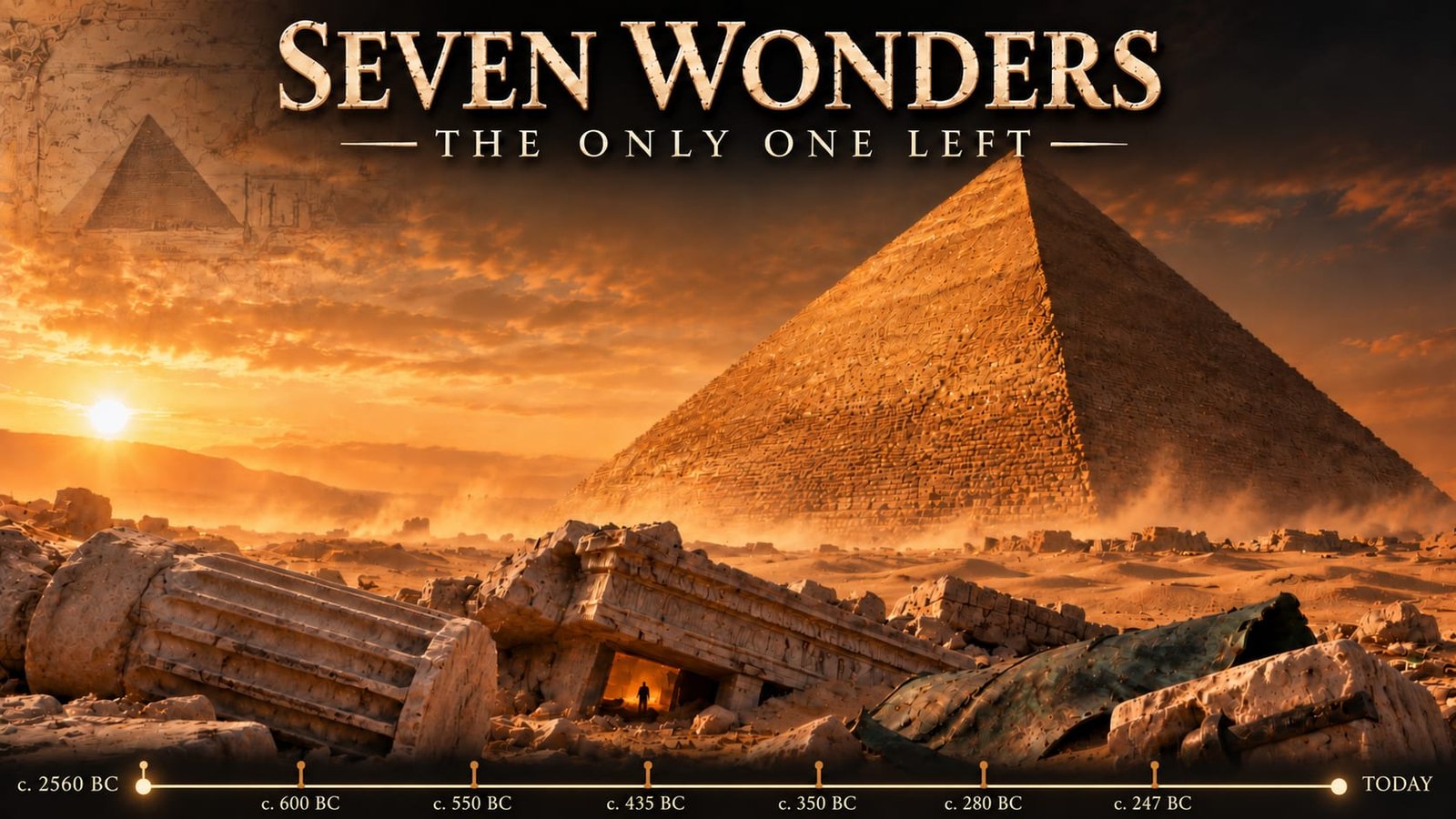
There was no committee. That is the first thing to get straight, because almost every retelling treats the Seven Wonders as though a body of ancient experts sat down and ruled on them. Nobody did. What survives is a handful of Greek lists that do not agree with each other — the best known credited to Antipater of Sidon in the second century BC, another circulating under the name of Philo of Byzantium — and what they are is closer to a travel brochure than a canon. These are the sights a Hellenistic tourist with money and a berth on a ship could actually go and see. Every one of them sits within reach of the eastern Mediterranean.
Which is why the list tells you as much about the person writing it as about the buildings. There is nothing from China on it. Nothing from India, nothing from the Americas, nothing from sub-Saharan Africa. The Great Wall was already being built. It is not a list of the seven greatest things ever made. It is a map of how big one man’s world was — and the honest way to read it is as a document of Greek geography, not of human achievement.
The number itself is doing work too. Seven was the count of the classical planets, the number the Greeks reached for when they wanted a set to feel complete. And the contents were not fixed: earlier versions sometimes carry the Walls of Babylon where later ones put the Pharos of Alexandria — a lighthouse that did not yet exist when the first lists were circulating. The canon we recite was still being edited centuries after the oldest item on it was finished.
The One That Refused
Start with the survivor, because the answer is embarrassingly simple, and it is not the one people expect.
The Great Pyramid of Giza is not a building. A building is a shell: walls holding up a roof, with air inside. Push the walls hard enough and that air becomes the failure — the roof comes down and the whole thing is rubble. The Great Pyramid is not a shell. It is a solid mountain of cut stone, roughly two point three million blocks, something close to six million tonnes of limestone and granite, stacked into the one shape that cannot fall over. Its centre of gravity sits almost on the ground. Every block is pinned by the weight of every block above it. There is no span to collapse, no frame to buckle, no roof to burn.
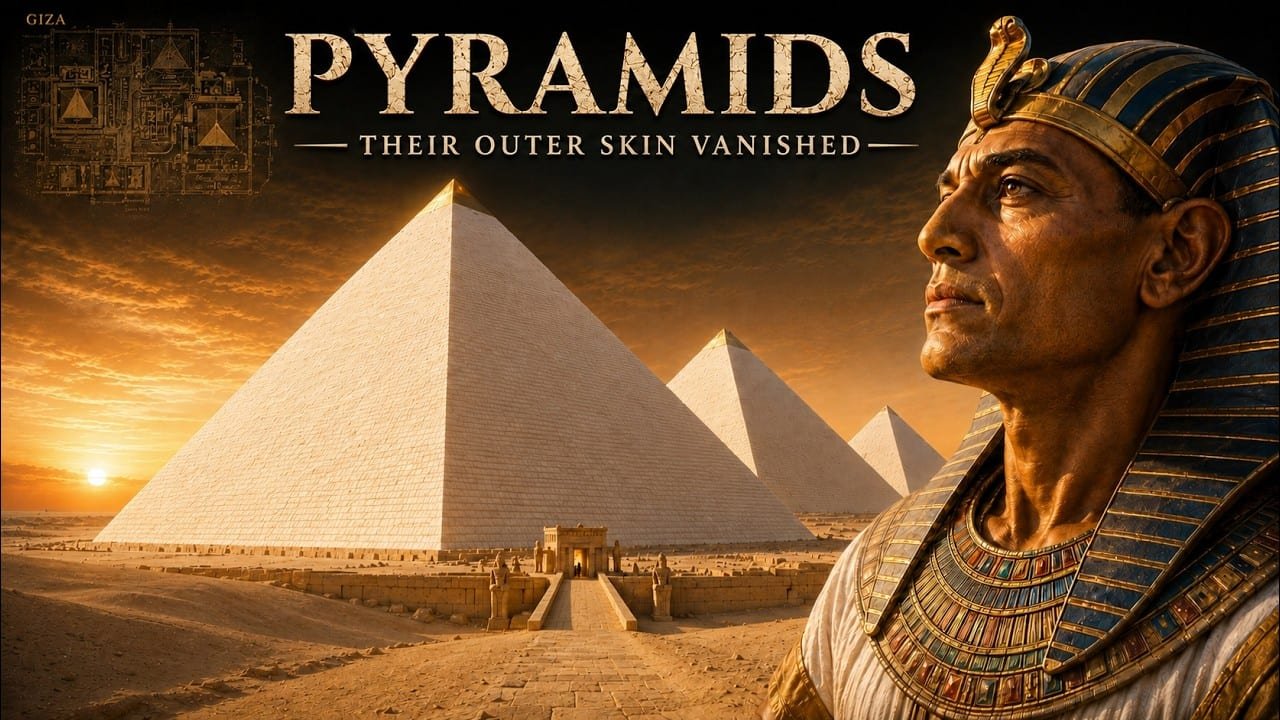
So it has taken four and a half thousand years of earthquakes and shrugged. It has also been robbed, thoroughly. A fourteenth-century earthquake shook its polished white casing loose, and medieval Cairo carted the stone away to build itself. That is the part worth sitting with. The pyramid was stripped of its entire outer surface and it is still a pyramid. Take the skin off any of the other six and there is nothing left to look at.
The numbers are worth having exactly, because the rounding hides how much has gone. It rose to 146.6 metres and stands at about 138.5 today: the missing eight metres are the apex and the casing, not settlement. Each side of the base runs 230.3 metres, and the four are equal to within about 5 centimetres.
And it is the only wonder on the list still producing new findings. In 2023 the ScanPyramids team published, in Nature Communications, the precise shape of a void behind the chevron blocks on the north face: a corridor roughly 9 metres long and 2 metres square, with a vaulted ceiling, mapped by cosmic-ray muons and then confirmed by ground-penetrating radar, ultrasonic testing and electrical resistivity — four independent methods, three peer-reviewed papers. An endoscope threaded between the blocks returned the first images of a passage nobody had entered since it was sealed. Nobody yet knows what it is for.
The following year answered a different question — how the stone arrived. Satellite radar and sediment cores traced a 64-kilometre branch of the Nile, now buried under farmland and desert, running along the pyramid field; the causeways of pyramid after pyramid end at what would have been its bank. The river that made the building possible had simply moved away, and taken the explanation with it.
It is also the oldest by an almost absurd margin. When Antipater wrote the list down, the Great Pyramid had already been standing for around twenty-three centuries. It was more ancient to him than he is to us.
Ordered by Cause of Death
Here is the argument this dossier is really making. The six that failed did not fail at random, and they did not fail because they were less impressive. Line them up not by geography and not by date, but by how they died, and a pattern falls out immediately.
Everything with a frame inside it is gone. Bronze skin over an iron armature — snapped. Gold and ivory over a wooden core — burned. Marble columns under a timber roof — burned, twice. Marble on its own, unprotected — quarried, and cooked into cement. Solid stone survived.
The Great Pyramid outlived the rest not because it was the most brilliant piece of engineering on the list. It outlived them because it was the least clever.
Fire — the Temple of Artemis at Ephesus
The largest Greek temple ever raised: about a hundred and twenty-seven marble columns, some of them eighteen metres tall, on a footprint no other Greek temple matched. Its Archaic version was funded in part by Croesus of Lydia around 550 BC — the king whose name became the byword for wealth.
Marble does not burn. The roof over it was not marble. Greek temples at that scale carried timber framing under their tiles, and in 356 BC a man set fire to it purely so that his name would be remembered. The Ephesians made it a capital offence to speak that name. We know it anyway, which tells you roughly how well such bans work, and it is also worth not repeating here.
But the fire was not the end, and this is where most retellings stop too early. The temple had already been destroyed and rebuilt once before 356 BC, and it was rebuilt again afterwards, grander than before, and stood roughly six hundred years more. What finished it was not one dramatic night: a Gothic raid in 262 AD, and then the slow withdrawal of a city whose harbour was silting up and whose religion had changed. The site was lost so completely that John Turtle Wood spent six years hunting for it in the 1860s before finding it under the mud.
Today one column stands there, re-assembled from excavated fragments. A hundred and twenty-seven, down to one.
Snap — the Colossus of Rhodes
A bronze sun-god about thirty-three metres tall, which is roughly the Statue of Liberty without her pedestal. Rhodes paid for it by selling the siege equipment Demetrius Poliorcetes abandoned when he failed to take the island; the sculptor was Chares of Lindos, and it went up around 280 BC.
He did not stand with his legs apart across the harbour mouth with ships sailing between them. No ancient source describes that. The image comes from sixteenth-century engravings, and it is structurally impossible: a bronze figure spanning that gap would tear itself apart at the ankles under its own weight. He stood with his feet together, on a stone base, on land. Where exactly on land, nobody knows.
He was bronze plate over an armature of iron and stone — and an armature is a weakness. In 226 BC an earthquake broke him at the knees. He had been standing about fifty-four years, the shortest life of anything on the list by an enormous margin. An oracle advised against putting him back up, so he was left where he fell, and lay there in pieces for something like eight centuries: a ruin that tourists still travelled to see. Pliny saw him prostrate and remarked that few people could get their arms around one of his thumbs. Eventually the bronze was sold for scrap, which is the least romantic ending available and almost certainly the true one.
Instalments — the Pharos of Alexandria
Over a hundred metres of stone in three tiers — square base, octagon, cylinder — with an open fire burning at the top at night and a polished mirror throwing the sun back out to sea by day. The honest figure for its height is a range, not a number: the medieval Arab writers who climbed it and measured it give between about a hundred and three and a hundred and eighteen metres.
It was the toughest of the six by a wide margin. It worked for roughly sixteen hundred years. And there was no dramatic night: Alexandria sits near a fault, and earthquakes took the tower down in instalments across three centuries. In 956 the top twenty metres came off. In 1303 a great earthquake off Crete effectively finished it. Ibn Battuta walked inside in 1326; returning in 1349, he could not reach the doorway.
And then it was not destroyed at all. It was recycled. In 1477 the sultan Qaitbay came to look at the ruin himself and ordered a fortress raised on its foundations, out of its own fallen blocks. The fortress is still there. Which means one of the Seven Wonders is a building you can put your hand on, if you know that is what you are touching.
The rest of it is on the seabed, and it is being put back together. Over the past decade more than a hundred of its blocks have been recorded underwater by photogrammetry, and in July 2025 a team led by the archaeologist and architect Isabelle Hairy, of the French CNRS, lifted twenty-two of the largest clear of the water — among them the lintels and uprights of a monumental doorway weighing seventy to eighty tonnes apiece. They are being scanned and virtually reassembled. The point is not a picture: a model built from the actual stones can be used to test the competing accounts of how the tower was built, how it worked, and why it came down.
Quarry — the Mausoleum at Halicarnassus
The tomb of a Persian satrap so extravagant that his name became the word for the building type: Mausolus, mausoleum. Around forty-five metres of white marble on a high podium, a stepped pyramid roof, a four-horse chariot at the summit, and sculpture by the best carvers in the Greek world — Scopas, Bryaxis, Leochares and Timotheus are all named as having worked on it.
It stood for something like sixteen centuries. Earthquakes cracked it open but did not take it away. What emptied it was people: the Knights of St John, fortifying Bodrum Castle from 1494 onward, treated the ruin as a pre-cut quarry. And worse than the theft of the blocks was what happened to the sculpture — much of that irreplaceable carved marble was burned into lime, for mortar.
That is the cruellest line on the whole list, and it is chemistry rather than malice. Marble is calcium carbonate. Heat it hard enough and it becomes quicklime. The most beautiful material in the ancient world is also, to a garrison in a hurry, a bag of cement waiting to happen. Some of what survived was recovered by Charles Newton in the 1850s and is in the British Museum. Most of the rest is in the walls. Almost everything we now understand about the building’s plan comes from later work: a Danish expedition under Kristian Jeppesen dug the site from 1966 to 1977 and published it across six volumes — the longest Danish excavation ever mounted abroad, and the reason a wonder reduced to foundations can be drawn at all.
Wood and Glue — the statue of Zeus at Olympia
Thirteen metres of a seated god, made by Pheidias around 435 BC, so oversized for its temple that Strabo passed on the joke that if he stood up he would take the roof off — and meant it as criticism, not praise.
He was not carved from stone. He was chryselephantine: sheets of ivory for the skin, hammered gold for the robes, over a frame of wood. Pausanias records that a family at Olympia held the hereditary job of keeping him oiled, because the ivory would crack in the valley’s damp without it. Wood. Glue. Ivory. A masterpiece that required continuous maintenance simply to keep existing.
So when the games ended, and the money and the attendants went with them, his survival was already conditional. The ancient accounts say Zeus was shipped to Constantinople as a collector’s piece and burned in a palace fire around 475 — though those accounts are late, and some scholars think he perished at Olympia instead. Either way, nothing of him survives.
What does survive is his workshop. Excavations at Olympia in the 1950s identified the building where he was assembled, and in it a plain black cup, scratched underneath with three words: I belong to Pheidias. The god is gone. The sculptor’s mug is in a museum.
The Wonder Nobody Can Find
Which leaves the one that may never have been there at all.
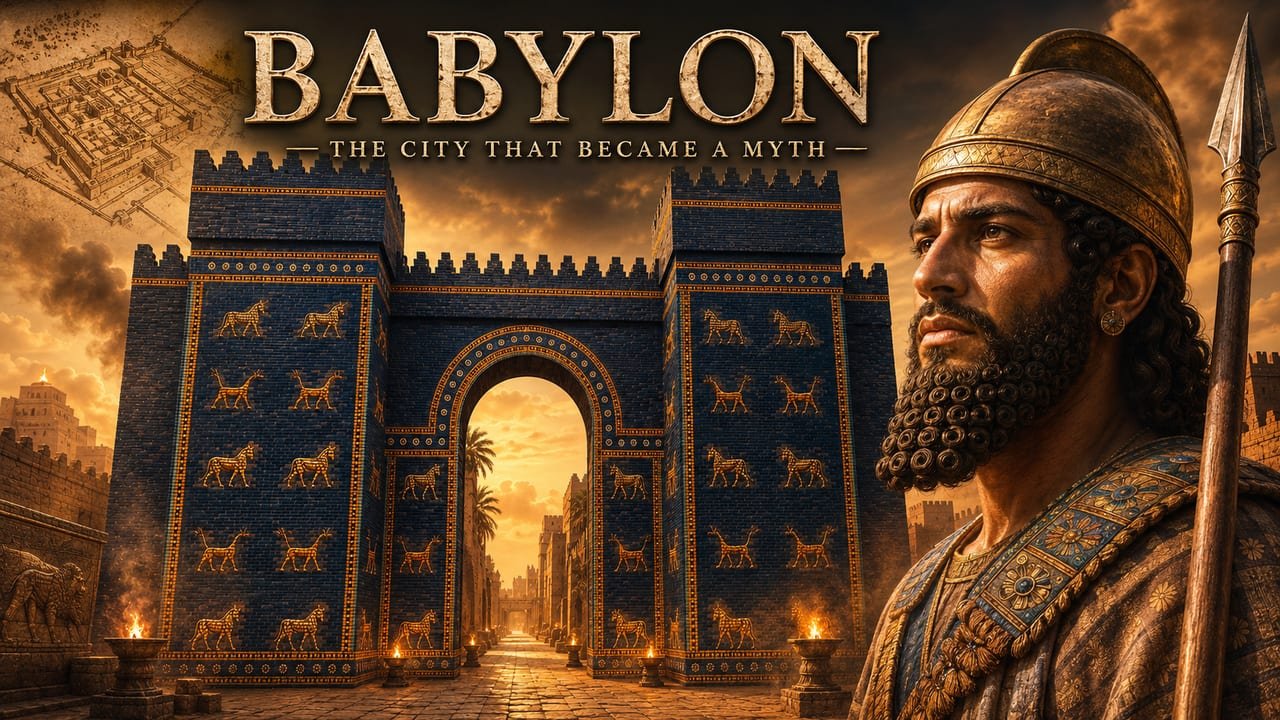
Nobody has ever found the Hanging Gardens of Babylon. On its own that proves little — Babylon is badly eroded and much of it is unexcavated. What is far harder to explain is the silence. Nebuchadnezzar II, the king credited with building them, left an enormous body of inscriptions doing almost nothing but boasting about his construction projects: the walls, the gates, the temples, the canals, all itemised. The gardens are not mentioned. Not once. And Herodotus, who describes Babylon at length and is not shy about marvels, never mentions them either. Every account we have is Greek, later, and second-hand.
So the Oxford Assyriologist Stephanie Dalley proposed something uncomfortable: that the gardens were real, and that we have been digging in the wrong city. Four hundred kilometres north at Nineveh, a century earlier, King Sennacherib built a palace garden — and unlike Nebuchadnezzar, he described it. A garden raised on terraces. A bronze water-raising screw, in his own inscriptions, centuries before Archimedes. Water carried from hills some eighty kilometres away, along a stone aqueduct at Jerwan you can still walk on. There is even a palace relief showing trees on a terraced hillside, fed by an aqueduct.
It fits. It is not proven, and serious scholars disagree. But it is the only version of the story with hardware attached to it, and it is a better answer than the two that were on offer before it: that the gardens were at Babylon and we have simply failed to find them, or that they were invented outright.
What the Pattern Says
Stand back and the list stops being a parade and becomes an argument about materials.
Solid stone survived. Bronze over iron snapped at the joint. Gold and ivory over wood burned. Marble under a timber roof burned, twice, and marble on its own was cooked into mortar. Every one of the six had something inside it weaker than its surface, and every one of them failed at exactly that seam. The Great Pyramid had no seam. It also, crucially, had nothing worth stealing that could be taken without dismantling the structure: strip the casing and you still have the mountain.
There is a second lesson buried in the first, and it is about upkeep rather than material. Zeus needed oiling. The Pharos needed a fire lit every night and repairs after every earthquake. The temple at Ephesus was rebuilt at least twice. These were not objects, they were commitments — and they lasted exactly as long as somebody was still paying to keep them.
And then there is the list itself, which is the most fragile thing on it. Six of the seven are gone, one is now a fortress wall, one may never have existed, and the whole set was a shortlist of what a Greek traveller could reach by boat. What actually survives of the Seven Wonders is the habit of counting them.