The City Is Not Lost
Alexandria’s royal quarter is not missing. It is on the floor of a working harbour, a few metres down, and it has been surveyed block by block since 1992. There are coordinates. There are plans. Boats pass over it every day.
That is the first correction this dossier has to make, and there are two more behind it. The lighthouse was not destroyed; it was taken apart by earthquakes over three centuries and then rebuilt, as a fortress, out of its own stone — you can put your hand on it. And the Library did not burn in a single night, because that story is a myth with no single fire and no single villain in it.
What follows is the working: where each of those beliefs came from, what the evidence actually says, and which parts we still do not know.
The Tower They Built Because the Coast Had None
The Egyptian coast is a trap. It is flat, low and featureless, with offshore shoals that give a ship no warning, and nothing on the horizon a pilot can steer by. A captain running for Alexandria in the wrong weather had no way to tell where the harbour mouth was until he was in the shallows.
So the Ptolemies built the landmark themselves. Ptolemy I commissioned it; his son Ptolemy II finished it, twelve years and eight hundred talents of silver later — a sum on the order of a tenth of the royal treasury, spent on a navigation aid. It stood on the island of Pharos at the harbour mouth, and the island’s name did something no other building on this site has managed: it became the word. Phare in French, faro in Spanish and Italian, farol in Portuguese. Every lighthouse in half of Europe is named after one island in Egypt.
How tall was it? The honest answer is a range, and giving a single number is the first sign that an account is not being careful. The medieval Arab writers who climbed it and measured it disagree — but only by about fifteen per cent, which for pre-modern measurement is remarkably tight: from about a hundred and three metres to a hundred and eighteen, on a square base thirty metres to a side. One outlier, al-Idrisi in 1154, gives a figure half again as large and is generally set aside.
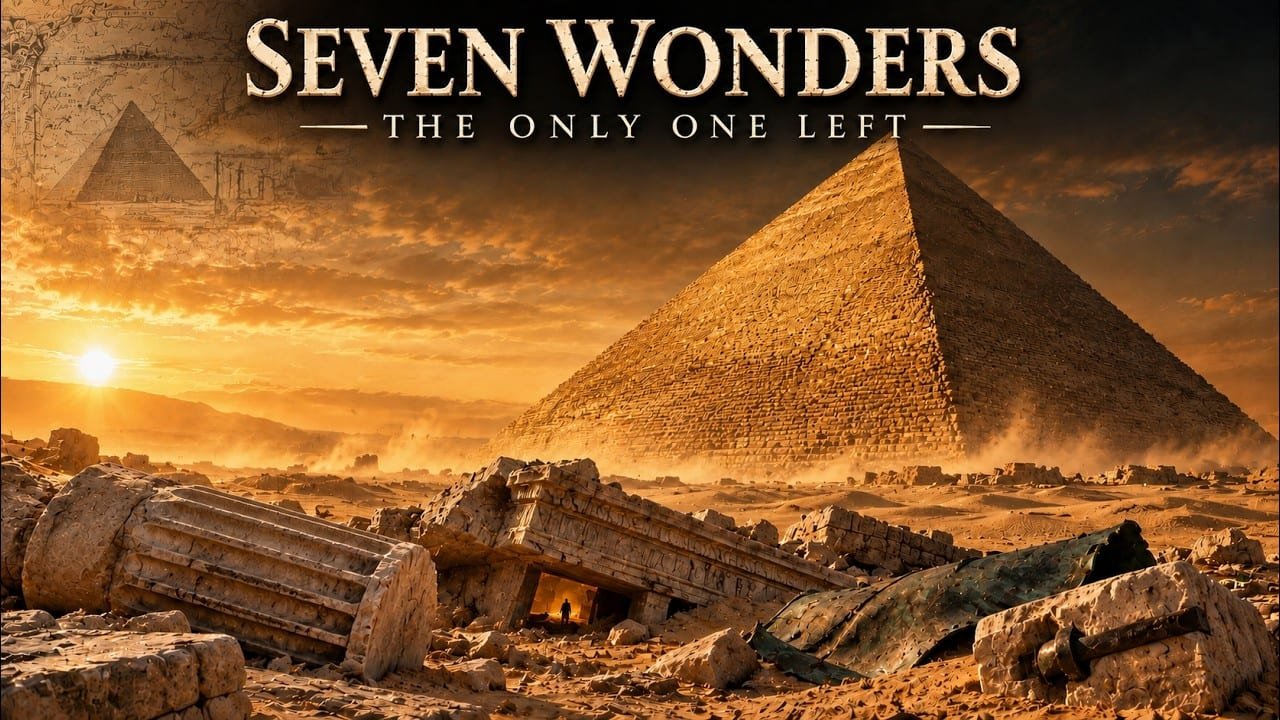
And it was not the tallest building in the world. You will read that constantly and it is simply wrong: the Great Pyramid had been taller for two thousand years before the Pharos was begun, and remained taller after it fell. The Pharos was not built to break a record. It was built where height saves lives.
Three Tiers, a Fire and a Mirror
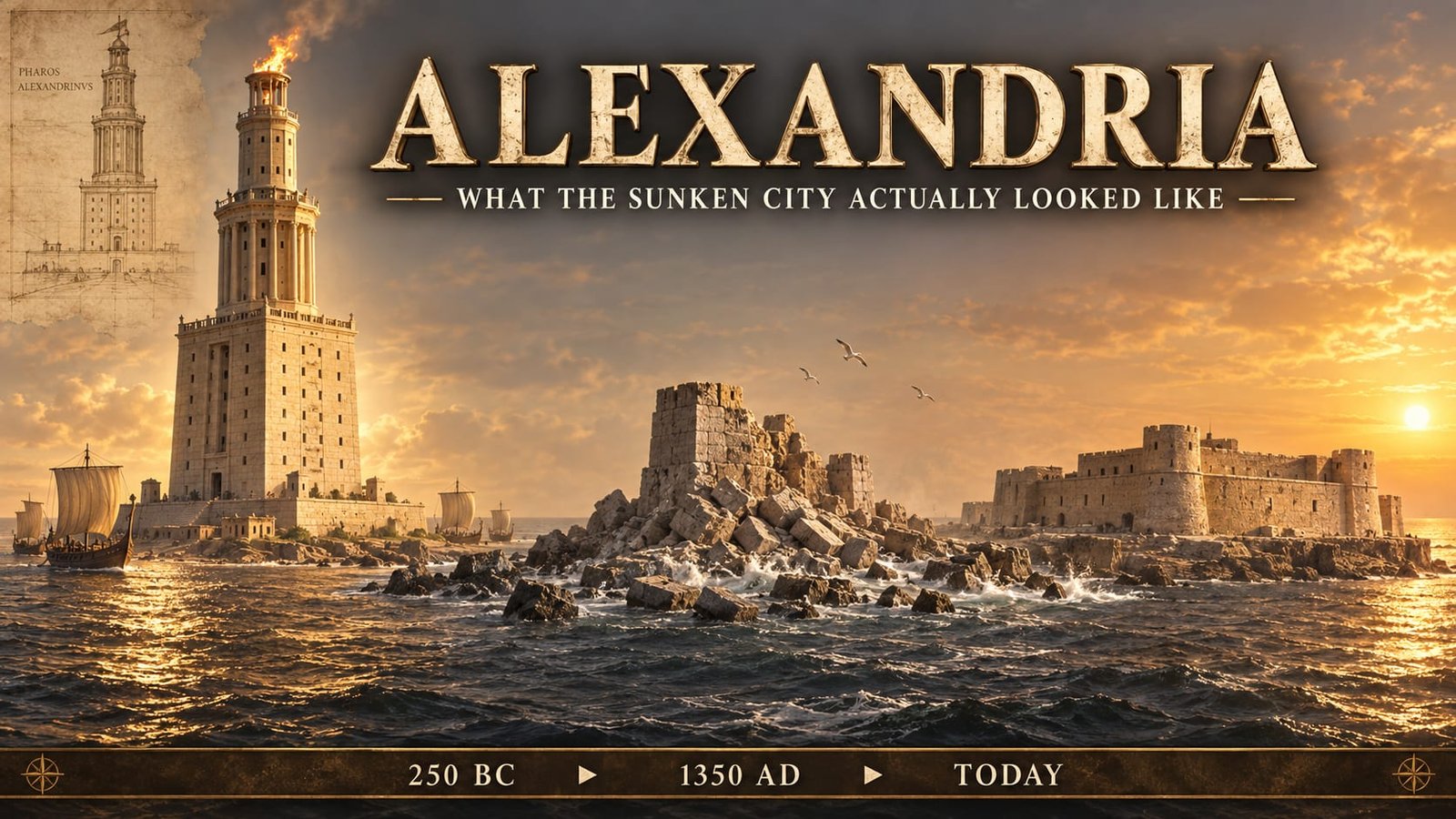
The shape is consistent across every description: three tiers, tapering. A square base, then an octagonal section, then a cylinder at the top. Inside the base ran a ramp, spiralling up — and al-Balawi, who went in during a visit in 1166 and left the fullest account of the interior we have, records that it was wide enough for two horsemen to pass each other. That is not decoration; a working lighthouse needs fuel carried up it every day, and pack animals are how you do that.
At the top: an open fire at night, and a great polished mirror throwing the sun back out to sea by day.
Two things about that mirror are worth stating plainly, because the tower is drawn wrongly more often than it is drawn correctly. It was not a lens and it did not produce a beam — the physics of a projected beam were centuries away. And the mirror was up there with the fire, at the summit, not at the base reflecting light upward. The popular image of a fire burning low in the tower with mirrors relaying its light to the top has no support in the sources. Nor, for that matter, does the story of a mirror that set enemy ships alight, which is late, legendary, and borrowed from the Archimedes tradition.
So how do we know what it looked like at all, given that nothing of the elevation survives? Because somebody built a model. Thirty kilometres down the coast at Taposiris Magna — Abusir — stands a funerary monument raised at almost the same moment, in the same sequence: square, then octagon, then cylinder, at roughly a fifth or a quarter of the scale. It was never a lighthouse. It is a tomb that quotes one. And it is the physical basis for every serious reconstruction drawn since, because the model outlived the original by seven hundred years.
Sixteen Centuries, Then the Ground
It worked for around sixteen hundred years. What took it down was not an army, a siege or a fire. It was the ground.
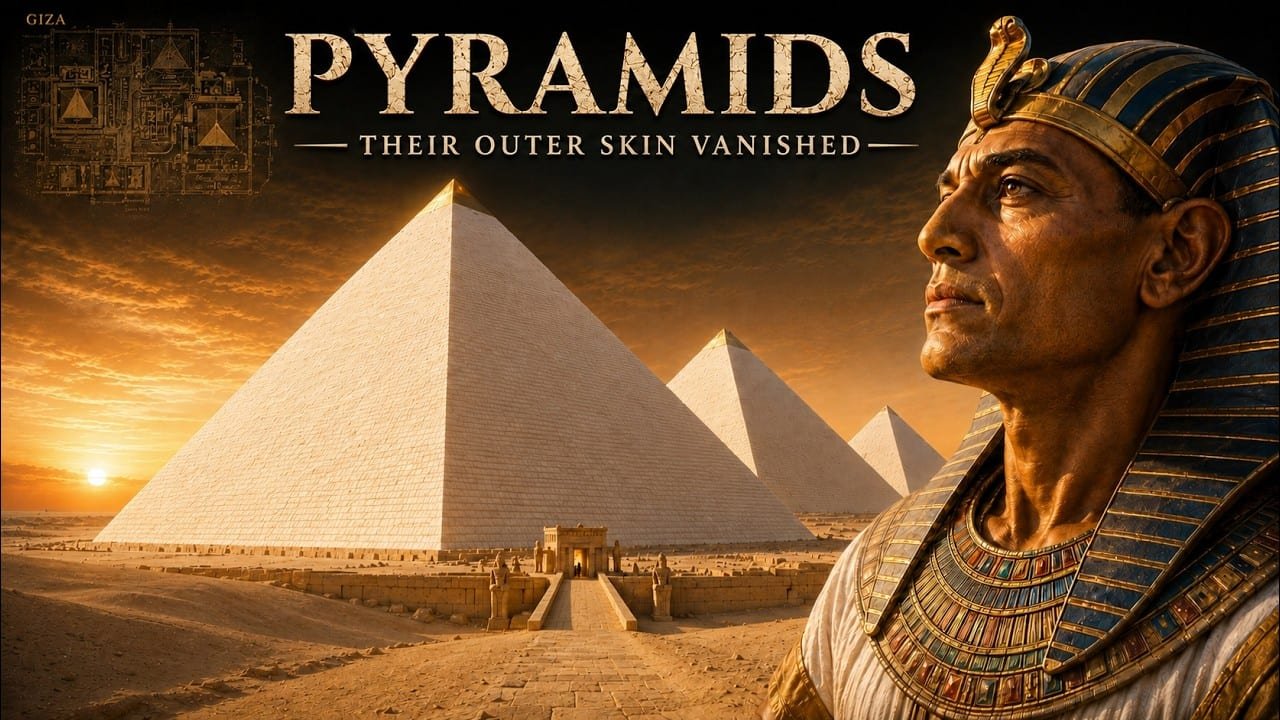
Alexandria sits near an active fault system, and the record of damage is a sequence rather than an event. Earthquakes cracked the tower in the eighth and tenth centuries; in 956 the top twenty metres came off. It was patched and kept working. In 1303 a very large earthquake off Crete — the same event that shook the casing loose from the Great Pyramid, four hundred kilometres away — effectively finished it. A structural study of that earthquake’s effect on the tower has been published in the engineering literature, which is an unusual thing to be able to say about a building that has been gone for seven centuries.
The two-stage collapse has an eyewitness. Ibn Battuta walked inside the ruin in 1326 and found one face fallen but the doorway reachable. Returning in 1349, he could not get to the doorway at all.
And then, in 1477, the sultan Qaitbay came to Alexandria, looked at the rubble himself, and ordered a fortress built on the tower’s foundations out of its own fallen stone. The work took about two years and cost more than a hundred thousand gold dinars. The fortress is still standing. Which means that one of the Seven Wonders of the Ancient World is a building you can walk up to and touch — it is simply wearing a citadel.
The Mouseion Was Not a Library
Now the part where nearly every popular account goes wrong from the first sentence.
It was never just a library. The Library was one department of an institution called the Mouseion — a shrine to the Muses in name, and in practice something with no real precedent: a place where the state paid you a salary, housed you, fed you at a common table, and asked you to do nothing but read, copy, compare and think. No teaching obligation. The sources describe a colonnade, a walk, a dining hall, reading rooms, gardens and lecture halls. It is the ancestor of the university campus, and it was a state research budget five centuries before the Roman Empire existed.
What came out of it is the argument for it.
Callimachus compiled the Pinakes, a catalogue of the collection running to a hundred and twenty books — arguably the first library catalogue ever made, and the beginning of bibliography as a discipline. He was never, despite frequent claims, the chief librarian.
Eratosthenes, who was, measured the circumference of the Earth using a stick, a shadow, and the distance between two Egyptian towns — and got it right to within a few hundred kilometres. It is the single most quoted result from the ancient world, and it was done on a research salary.
Aristophanes of Byzantium invented the Greek accent marks, and was the first person to break poetry into lines on the page. Before him, verse was written out like prose. Every poem you have ever read is laid out the way it is because of a librarian in Alexandria.
How many scrolls? Nobody knows. The estimates in the literature run from forty thousand to seven hundred thousand, no ancient source gives a figure anyone can check, and anyone who quotes you one number is guessing.
Six Endings, Not One Fire
So how did it end? Not in one night, and not by one hand. There are at least six separate events across almost eight hundred years, and no historian treats any one of them as the ending.
145 BC — the scholars are expelled. Ptolemy VIII purged the Mouseion for backing the wrong claimant to the throne. The chief librarian, Aristarchus of Samothrace, fled to Cyprus and died there; Dionysius Thrax went to Rhodes, Apollodorus to Pergamon. The building was untouched. The Library ended that day anyway, in the only sense that matters, because a library is the people in it.
48 BC — Caesar’s fire. Besieged in the harbour, Julius Caesar set fire to ships at the dock and the fire spread ashore. Livy, quoted by Seneca, says forty thousand scrolls burned. Cassius Dio says what burned were the dockside warehouses of grain and books. Plutarch is the one who says the great library itself went. And the decisive evidence is what happens next: Strabo visits the Mouseion in person around 20 BC and writes about it. It survived. This is the single most repeated false fact about the ancient world, and the reason it is false is one Greek geographer turning up and taking notes.
Under Rome — the money stops. Membership of the Mouseion stopped being awarded for scholarship and became a reward for service in government, the army, or even athletics. The only chief librarian we know from the Roman period was a politician and soldier with no scholarly output at all. The last record of any member is from the 260s AD.
272 AD — Aurelian. Almost nobody names this one, and it is probably the answer. The emperor Aurelian fought to retake Alexandria from the forces of Palmyra, and his army destroyed the Broucheion — the royal quarter, the district the Library stood in. Twenty-five years later Diocletian besieged the city and the same quarter burned again. If you want a single moment at which the building most likely ceased to exist, it is a Roman emperor putting down a revolt in a war almost no one remembers.
391 AD — the Serapeum. The daughter library, and by the fourth century probably the largest collection left in the city, was destroyed under the bishop Theophilus. What is honestly not known is how many books were still in it by then.
642 AD — the caliph and the baths. The story that the books were burned to heat Alexandria’s bathhouses appears for the first time in al-Qifti, writing more than five centuries after the event. It names a scholar who was almost certainly already dead, and describes a library that had not existed for generations. Historians treat it as legend; one suggestion is that it was invented much later to justify an entirely different dismantling of libraries.
No single fire. No single villain. Funding, politics, a civil war, a siege, a riot — and four hundred years.
What Was Actually Lost
It is worth being precise about what disappeared, because “the lost knowledge of the ancients” is the wrong frame and it leads somewhere silly.
Most of what was in the Library was not unique to it. Texts that mattered were copied and circulated; the ones that vanished mostly vanished the ordinary way, by ceasing to be recopied when nobody wanted them any more. Papyrus does not survive in a Mediterranean climate. A book that was not worth someone’s time to copy every few generations was already gone, fire or no fire.
What was genuinely lost was the institution. Alexandria was the first place on Earth where copying carefully, checking one text against another, cataloguing what you held and writing down what you actually found was somebody’s whole job, paid for by the state and expected of nobody else. That habit had to be reinvented, and reinventing it took a very long time. Shelves can be refilled. A funded profession is much harder to rebuild.
The Tomb That Stopped Being Mentioned
One more thing vanished here and it is the strangest of them.
Alexander the Great was buried in Alexandria, in a tomb near the crossroads at the centre of the city. It was not hidden or secret — the opposite. Roman emperors travelled to Egypt specifically to look at it, and the visits are recorded.
Then, in late antiquity, the record simply stops. Nobody writes about destroying it. Nobody writes about moving it. It is never mentioned again, and it has never been found.
That is all we know, and it is worth resisting the pull to say more. The tomb of Alexander is where a great deal of nonsense enters this subject, and the honest position is a short one.
A Wave, and a Slow Surrender
Which brings us to the water, and to a claim that has become more interesting since the scientists got to it.
On 21 July 365 an enormous earthquake struck off Crete. Modern work puts it above magnitude 8 and has shown that western Crete was lifted as much as ten metres out of the sea, synchronously with the shock — the geological signature is still legible on the coastline. Ammianus Marcellinus, writing within living memory, describes the sea at Alexandria pulling back to expose the seabed, people walking out to collect stranded fish, and the water returning to throw ships onto the roofs of houses.
It is one of the most vivid passages in ancient literature, and it may not describe Alexandria. A 2020 re-examination of the historical and sedimentary evidence argues that no major tsunami destruction of Alexandria can be demonstrated, and that Ammianus appears to have combined two separate events — a local seabed slump affecting the eastern delta, and the Crete tsunami. Alexandria may have seen only marginal effects. The debate is live, and a dossier that pretended otherwise would be doing the same thing as the accounts it is correcting.
But here is the part that is not in dispute, and it matters more. The wave is not why the palaces are underwater. The real cause is slower and duller: the ground here has been going down for two thousand years. The Nile delta compacts under its own sediment, the coastline subsides, and the eastern harbour has dropped several metres — carrying the royal quarter with it. There was no single night on which Alexandria sank. It settled.
The Survey, With Coordinates
Then, in the 1990s, people went and looked properly.
The idea that something was down there was not new — a UNESCO expedition under Honor Frost had confirmed ruins in the eastern harbour in 1968, and there were reports going back to 1916. What changed was the method and the scale.
In 1994 a French team under Jean-Yves Empereur dived the area off the Qaitbay fortress and found the Pharos itself on the seabed: granite blocks of forty-nine to sixty tonnes, thirty sphinxes, five obelisks, and columns carved a thousand years before Alexandria existed — because the Ptolemies shipped pharaonic stone down from Upper Egypt to decorate their Greek capital. Within two years the team had photographed and mapped more than three thousand three hundred pieces.
Across the harbour, Franck Goddio’s team surveyed the sunken royal quarter from 1992: the ancient port, the wharves, the Poseidium promontory, and the island of Antirhodos, where a Ptolemaic palace stood. This is not a rumour or a legend. It is a survey, with a grid and coordinates, done with sonar and satellite positioning.
And it is still going. In July 2025 a team led by Isabelle Hairy of the French CNRS lifted twenty-two of the largest lighthouse blocks clear of the water — among them the lintels and uprights of a monumental doorway weighing seventy to eighty tonnes apiece — to be scanned and virtually reassembled alongside the hundred-odd blocks already recorded underwater by photogrammetry. The aim is not a pretty picture. A model built from the real stones can be used to test the competing accounts of how the tower was built, how it stood, and how it came down.
The Causeway Became a Neighbourhood
The last piece is not under the water. It is under your feet.
When Alexandria was founded, Pharos was an island. To reach it, the city built a causeway seven stades long — which is where its name comes from, the Heptastadion: over twelve hundred metres of stone laid across open water.
A causeway does something a bridge does not. It stops the current. Silt that had always swept along the coast began to settle against it instead, year after year, century after century, until the sea filled in on both sides and the causeway stopped being a causeway and became an isthmus. The entire central district of modern Alexandria stands on that accumulated silt. The promontory of Ras el-Tin is what is left of the island; the exact point where the Pharos stood has been eaten by the sea.
So the city did not vanish. It went in three directions at once. Half of the old royal quarter went under the harbour and is being surveyed. The lighthouse was dismantled by earthquakes and rebuilt as a fortress that still stands on its own foundations. And the causeway that joined them turned into ground — into streets, and buildings, and people who live on it without knowing what is underneath.
Alexandria was never lost. It was reused, and drowned, and walked on.